


There are days — and let’s be honest, whole eras — where the simplest task feels like trying to run a marathon in molasses. You walk into a room and forget why. You stare at a sink full of dishes like it’s trying to fight you. Your to-do list is screaming, your brain is buffering, and somehow the only thing you do manage to do is… nothing.
You’re not lazy. You’re not broken. You’re overwhelmed — and your brain has hit the freeze setting.
This isn’t just relatable, it’s biological.
🧬 Why Your Brain Freezes When You’re Overwhelmed
When your brain perceives stress — whether that’s from sensory overload, emotional exhaustion, chronic illness, or straight-up having too many tabs open in your life — it doesn’t care if it’s “just” a sink full of dishes. It reacts like there’s danger.
And that reaction? It comes from your amygdala, the little almond-shaped area in your brain responsible for detecting threats. When it thinks something’s Too Much™, it sends a signal that hijacks your logical brain (the prefrontal cortex) and triggers a fight, flight, or freeze response.
🧠 The prefrontal cortex — the part that helps you plan, prioritize, and remember what you walked into the kitchen for — literally goes offline when overwhelm spikes.
🔄 That’s why you can ping between “I should do something” and “Why am I scrolling Instagram again?” without ever actually starting the thing.
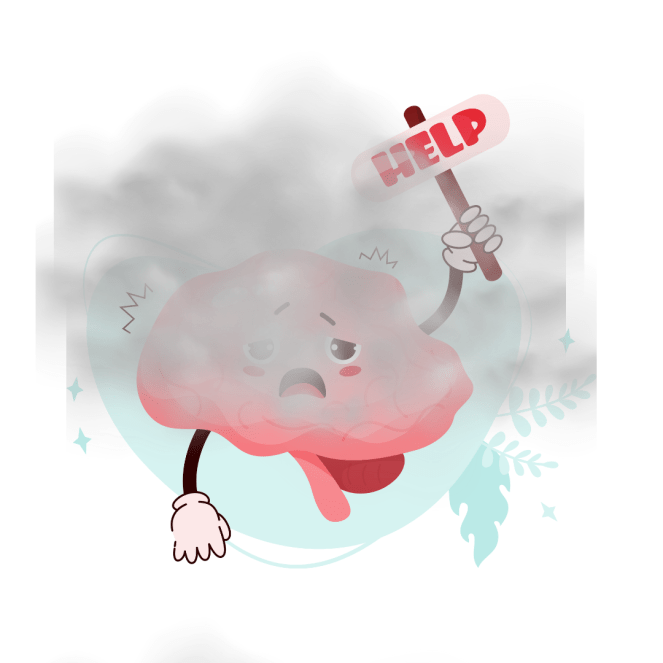
According to a 2016 article in the Harvard Business Review, when we experience cognitive overload, we lose access to “working memory,” which is the part of our brain that helps us juggle tasks. And a study in the Journal of Neuroscience showed that chronic stress impairs decision-making and reduces the brain’s ability to adapt — making it even harder to snap out of the fog once you’re in it.
Basically: the more overwhelmed you are, the harder it is to stop being overwhelmed. Coolcoolcool.
🔓 Getting Unstuck: How to Unfreeze When You’re Overwhelmed
First, let’s make one thing clear: you don’t need a complete life overhaul to start moving again. We’re not doing a Marie Kondo purge, a 10-step plan, or a productivity bootcamp. We’re just finding tiny ways to signal to your brain, “Hey, we’re safe. We can take a step now.” I think I’ve talked about these before but they bear repeating.
Here are some strategies that actually help:
1. Name It to Tame It
Saying out loud, “I feel frozen right now,” isn’t weakness — it’s neuroscience. Recognizing your emotional state lights up the prefrontal cortex and starts to re-engage that logical part of your brain.
Bonus tip: Try writing it down, even if it’s just “overwhelmed AF” on a sticky note.
2. Do One Teeny, Tiny Thing
Literally one thing. Not “do the dishes.” Just “stand next to the sink.” Or “put one plate in the dishwasher.”
That’s it. Dopamine doesn’t care how small — it still gives you a little hit for doing something. And that can be just enough to take another step.
3. Try a “Body Double” Moment
This is magic for ADHD brains but helpful for anyone: having someone around (even virtually!) can snap your brain out of a freeze. It’s not about accountability — it’s about regulation.
Text a friend, turn on a co-working YouTube, or call your sister and do five minutes of Something While Complaining.
4. Change the Channel (Sensory Reset)

Sometimes your brain needs a hard reboot. That can be as simple as:
- Splashing cold water on your face
- Stepping outside and feeling the air
- Listening to music with no lyrics (lofi is a fave here)
- Switching to a different space (yes, flopping on a new surface counts)
5. The “Timer Trick”
Set a timer for 5–10 minutes and say, “I’ll just do this one thing until the timer goes off.”
You can stop when it dings — really! — but often, starting is the hardest part. The timer gives your brain a finish line.
🌱 One Last Thing: You’re Allowed to Rest

Freezing isn’t failure. It’s your brain doing its best to protect you — and that means you don’t need to bully it into productivity. Sometimes the most radical act is letting yourself rest without shame.
You are not lazy. You are not broken. You’re surviving in a system that wasn’t designed for brains like yours — but you’re still here. That’s power. Til next time gang, take care of yourselves, and each other!
 WannaBeNormal