Uncategorized

Reasons I Walked Into This Room (Spoiler: I Still Don’t Know)

An ADHD mystery in real time

Here I am, standing in my bedroom, looking around like I’ve never seen this place before in my life. I definitely had a purpose when I left the kitchen. I was very determined. I had INTENT.

Now? I got nothing.

What I Tell Myself It Might Have Been:

  1. To get my phone charger
    (Nope my phone is at 97%)
  2. To grab that important document I need
    (what document? for what? the mystery deepens)
  3. To put away that thing I left in here yesterday
    (what thing? which yesterday? time is a construct)
  4. To check if I left my coffee cup in here
    (I’m not even drinking coffee today)
  5. To get something for my kid who asked for… something
    (they’re at school. it’s Tuesday. I think.)
  6. To turn off a light that was bothering me
    (all the lights are off. it’s 2 PM. I’m questioning reality)
  7. To find my glasses
    (they’re on my head. they’ve been on my head this entire time)
  8. To get that book I was reading
    (I haven’t touched a book in three weeks, what am I even talking about)
  9. To look for my keys so I don’t lose them later
    (they’re in my pocket. jingling. mocking me)

The Actual Reason:

I followed the cat.

The cat had no destination either.

We’re both just standing here now, equally confused, staring at each other and wondering what we’re doing with our lives. At least the cat has an excuse – he’s a cat. His life goals include knocking things off counters, judging my life choices, and staring at invisible things on the wall.

I’m a grown adult who apparently takes navigation cues from a creature whose biggest daily decision is which sunny spot to nap in.

Current Status:

Still in the room. Still don’t know why. The cat has moved on to more important cat business (aggressive grooming of one specific paw). I’m considering asking him for directions back to whatever I was originally doing, but he’s giving me that look that says, “Figure it out yourself, human. I’m not your GPS.”

Maybe I’ll just stay here forever. Set up camp. Make this room my new home base. At least then when people ask “Why are you in here?” I can say “I live here now. This is my life. The cat is my roommate. We don’t ask questions.”

Anyone else take mystery tours of their own house, or is it just me and my feline guide to nowhere?

Uncategorized

The Great Medication Shuffle: Morning Pills, Evening Pills, and the Ones I Forgot Existed

Or: How My Medicine Cabinet Became a Small Pharmacy and I Still Can’t Remember What I’m Supposed to Take When

Looking at my bathroom counter right now, I count fourteen different pill bottles, three liquid medications, two inhalers, and a partridge in a pear tree. Okay, maybe not the partridge, but at this point I wouldn’t be surprised if my doctor prescribed one for “mood support.”

For those of you managing multiple chronic conditions, you know the drill. What started as “just take this once a day” has evolved into a complex choreographed dance that would make Broadway jealous. And like any good performance, timing is everythingโ€”except I have ADHD and the memory of a goldfish with anxiety.

Meet the Cast of Characters

The Morning Crew: These are the heavy hitters that transform me from zombie to semi-functional human. They’re the ones that make it possible for me to remember my own name and possibly locate the coffee maker.

I have to take 16 pills in the morning, and it’s as gross and exhausting as it sounds. While I’m supposed to take all that in the morning, I split it up to make it easier to manage, so my pills are morning, later morning, dinner/bed. Frequently when I sit down to do my meds I have missed a few from the “later morning” category. Because nothing says “good morning” like swallowing what feels like a handful of gravel.

The Evening Squad: The night shift workers whose job is to help me actually sleep instead of lying awake cataloging every embarrassing thing I’ve done since 1987.

At night I feel like I do a lot of prep work. I take 5 at dinner. One of those is half a dose of sleep/anti-anxiety. I take another 3 when I sit down for the night. Once I have done my chores I pop the other half and soon am out cold. If any one of those is off by an inch I won’t sleep or will pass out mid-chore. It’s like a tightrope balance really, but I fall far more often lol. Nothing quite like waking up on the couch with a half-folded load of laundry as your blanket.

The Wildcards: These are the divas of the medication world. Take with food. Don’t take with food. Take two hours before this other medication but not within four hours of dairy products. Take while standing on your head during a full moon. (Okay, I made that last one up, but honestly, would you be surprised?)

I take one that’s ‘take with 600 calories.’ Ok, as in, how close to eating? Before? After? What will happen if I’m not a nutritionist and therefore have NO IDEA how many calories will be enough? Do I need to whip out a food scale? Should I be doing math at breakfast? Is a bagel with cream cheese 600 calories or am I supposed to add a side of existential dread?

The Forgotten: Every medicine cabinet has themโ€”the bottles in the back that you rediscover like archaeological artifacts. “Oh hey, I was supposed to be taking this for anxiety… six months ago. That explains a lot.”

I have a tough time with my late morning meds, so they often get forgotten until later in the day, then it’s the ‘would it be better to double up/take them closer to the night time ones? When do we no longer consider it because it’s too close to the others?’ Such fickle little things they are. It’s like playing medication Jengaโ€”one wrong move and the whole system comes tumbling down.

The Systems I’ve Tried (And How They’ve Failed Me)

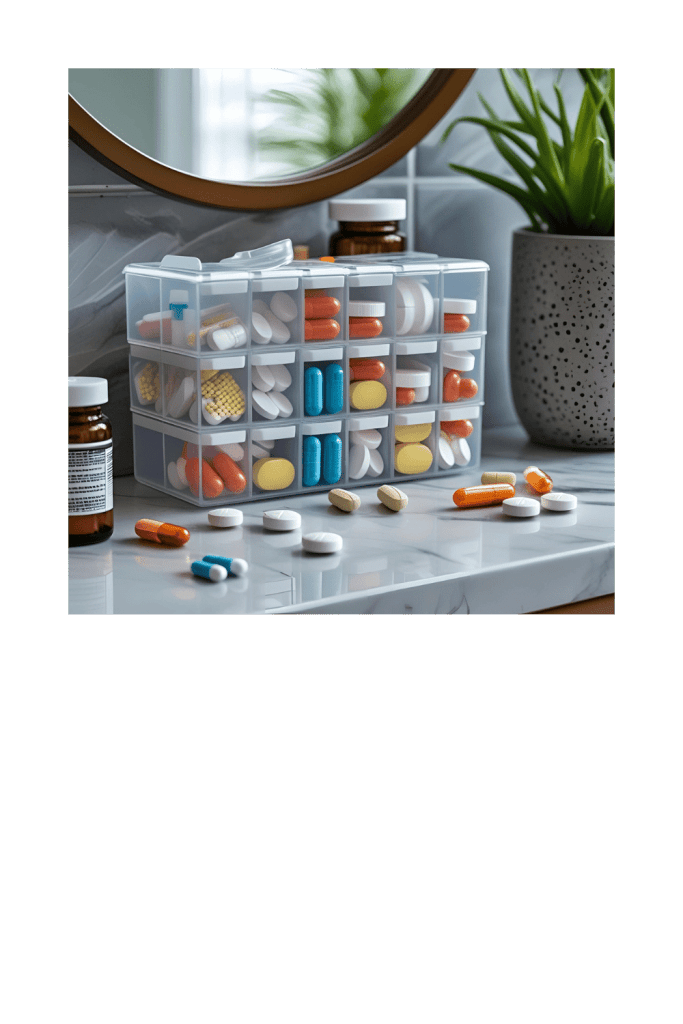
The Pill Organizer Approach: Seemed foolproof, right? Wrong. First, I had to figure out which size. The tiny ones where I can barely fit my horse-sized vitamins? The weekly ones that don’t account for my twice-daily medications? The monthly system that takes up half my kitchen counter?

I started out resisting these HARD, then went to the daily ones. They didn’t workโ€”I’d forget to fill it, so one day at a time, I was not responsible enough for that. I lived, I learned, I got a weekly with the days broke into 4 sections, and it works. And if I forget, I always skip just because that’s easier to fix than the opposite wayโ€”it’s better to err on the side of caution. Nothing like turning medication management into a weekly game of Tetris.

The Phone Alarm Method: Set seventeen different alarms with helpful names like “ADHD Med” and “Don’t Forget Thyroid Pill.” Works great until you’re in an important meeting and your phone starts screaming “TAKE YOUR CRAZY PILLS NOW” at full volume.

Or, like me, you manage to dismiss them all subconsciously or your brain chooses to ignore them lol. It’s like my ADHD brain has developed selective hearing specifically for the alarms that are supposed to help me function. I can hear a bag of chips opening from three rooms away, but medication reminders? Nope, not registering.

The Medication Apps: Downloaded four different apps that promised to change my life. They all judged me harder than my mother when I inevitably forgot to log my doses. Nothing like a guilt trip from your phone to start the day.

The apps that would change my life all involved either purchases through the app, or require so much of my time I spent more energy journaling and entering the same responses than actually taking the medications. Or I’d not remember to enter them at all after week two. Apparently, I need an app to remind me to use the app that reminds me to take my medication. It’s apps all the way down.

The “I’ll Just Remember” Method: The most delusional approach of all. My ADHD brain that can’t remember where I put my keys five minutes ago was somehow going to remember a complex medication schedule. Spoiler alert: it didn’t work.

I will have my bottle in my hand wondering if I JUST took one, or if my brain is showing me past me taking them as I’d done countless times before. It’s like my brain is running a highlight reel of every time I’ve ever taken that medication, making it impossible to distinguish between “five minutes ago” and “Tuesday three weeks ago.”

The Real Struggles Nobody Talks About

The “Did I or Didn’t I?” Game: Standing in your bathroom at 2 PM, staring at a pill bottle, trying to remember if you took your morning medication or just thought really hard about taking it. It’s like the worst guessing game ever, with side effects as consequences.

So I stand there, debating my next move like it’s a choose-your-own-adventure novel: Option A: Take the pills and risk double-dosing myself into a nap I didn’t plan. Option B: Skip them and spend the rest of the day vibrating at the wrong frequency. Spoiler alert: I picked Option C โ€” called my teen into the room and asked, “Hey, did you see me take these earlier?” They just stared at me like, “You realize I don’t follow your every move, right?” Thanks, kid. Very helpful.

The Pharmacy Mystery Calls: “Hi, your prescription for [medication you’ve never heard of] is ready for pickup!” Wait, what? When did I get prescribed that? Have I been supposed to be taking something this whole time?

Frequently I will go in for my appointment and bloodwork and she’ll call something in but forget to send the email until I contact them. So I’m left wondering if this mystery medication is something crucial I’ve been missing, or if it’s the pharmaceutical equivalent of a pocket dial. Either way, I’m driving to the pharmacy feeling like I’m solving a medical mystery.

The Coordination Nightmare: Doctor A wants to change medication X, but you have to check with Doctor B because it interacts with medication Y, and Doctor C doesn’t know about either of them because the medical records system is apparently held together with duct tape and prayers.

I once spent three weeks playing telephone between my psychiatrist, primary care doctor, and endocrinologist because nobody could agree on whether my new thyroid medication would interfere with my ADHD meds. Meanwhile, I’m sitting in the middle like a very tired, very caffeinated UN mediator, taking notes and trying to remember who said what about which pill. Spoiler alert: they all had different opinions, and I ended up being my own case study.

The Instruction Manual: That one medication that comes with a novel’s worth of instructions. Take with food, but not dairy. Don’t lie down for 30 minutes after taking. Avoid sunlight. May cause drowsiness or insomnia (thanks for being specific).

My personal favorite is the medication that says “may cause dizziness” and “do not operate heavy machinery,” but then also warns “may cause restlessness and inability to sit still.” So… I can’t drive, but I also can’t stop moving? Should I just pace around my house indefinitely? And don’t get me started on “take on an empty stomach” versus “take with food to avoid nausea.” Pick a lane, pharmaceutical industry!

What Actually Works (Sort Of)

After years of trial and error (emphasis on error), I’ve cobbled together a system that works approximately 73% of the time, which in my world counts as a rousing success.

My current system is that weekly pill organizer with four compartments per day, plus a backup system of keeping the bottles nearby for those “did I or didn’t I” moments and I actually write an x. I’ve learned to embrace the “when in doubt, skip it” philosophy because it’s easier to catch up on a missed dose than to undo a double dose. And yes, I still sometimes ask my family members if they’ve seen me take my pills, because apparently it takes a village to medicate one ADHD brain.

The key insight I’ve learned is this: there is no perfect system. There’s only the system that fails less catastrophically than the others. Some days I nail the medication schedule like a responsible adult. Other days I take my evening pills at 2 PM and wonder why I’m sleepy.

Just last week, I confidently took my morning pills, felt very proud of myself, and then found the same pills sitting in my pill organizer an hour later. Turns out I had taken yesterday’s forgotten dose. Mystery solved, but also… how did I not notice I was taking pills from the wrong day? ADHD brain strikes again.

The Bottom Line

If you’re struggling with medication management, know that you’re not alone in this pharmaceutical juggling act. We’re all just doing our best with brains that sometimes work against us and bodies that require more maintenance than a vintage car.

Your worth isn’t measured by how perfectly you follow your medication schedule. It’s measured by the fact that you keep trying, keep adapting, and keep finding ways to take care of yourself even when it feels impossibly complicated. Some days “good enough” really is good enough, and that’s perfectly okay.

Managing multiple chronic conditions isn’t just about remembering to take pillsโ€”it’s about being patient with yourself when your brain doesn’t cooperate, forgiving yourself when systems fail, and celebrating the small victories like remembering your evening meds before midnight.

Now if you’ll excuse me, I need to go stare at my pill bottles and try to remember if 2 PM counts as “evening” for my twice-daily medication.


Uncategorized

Body Function Bingo

A totally real medical game where everyoneโ€™s a winner and no one feels good.

๐ŸŽฏ 1. The Surprise Soundtrack

Symptom: Your joints crack like bubble wrap every time you move.
Fun fact: The average human knee wasn’t designed to sound like a haunted rocking chair โ€” yet here we are.
Personal take: I’m TERRIFIED of moving like swaying because I’ve been warned repeatedly if my hip pops out I wont enjoy it. I keep remembering how EASY my hip used to pop out, I gotta be mindful of yet another ailment; *Dramatic fall upon our ‘fainting couch’ only to pop right back up*


๐Ÿง  2. Brain Fog Blackout

Symptom: You walk into a room and instantly forget why.
Science says: Fibro and ADHD can both affect working memory. That means your brainโ€™s โ€œclipboardโ€ is full of glitter and expired coupons.
Pro tip: Keep a notebook, or just live in the room you walked into. Itโ€™s yours now. Your life exists there.


๐Ÿ”ฅ 3. Is It a Hot Flash or Anxiety?

Symptom: Sudden wave of heat. Chest tight. Soul leaving body?
Reality: Could be hormones, could be panic, could be both. Whee!
Personal take: Am I the only one who walks around with sweats on *mostly* but when a hot flash hits, I’m in a tank and shorts, that I also set out to wear today because I did this so often that now I pick out a 4 piece outfit every day? Its like my anemia and my hormones have a time share in the place that controls my temp.


๐ŸŽญ 4. Mood Swing Square Dance

Symptom: Feeling fine โ†’ rage โ†’ tears โ†’ existential dread โ†’ cookie?
FYI: Bipolar mood shifts are no joke. Hormones and chronic pain don’t help.
Fun twist: Sometimes the mood changes faster than your outfit.


๐Ÿงƒ 5. โ€œOwโ€ Before It Happens

Symptom: You say โ€œowโ€ before doing the thing.
Science says: Anticipatory pain is real in chronic illness brains. Itโ€™s like your nervous systemโ€™s version of spoilers.
Bonus round: Saying โ€œowโ€ also applies to thoughts and feelings now.


๐Ÿงฌ 6. Random Pain That Leaves as Mysteriously as It Came

Symptom: Stabbed in the ribs by an invisible elf. Gone five seconds later.
No explanation. No follow-up. No peace.
Personal take: (That sharp twinge in your back today? Yep.) I’m honestly not sure about back pain there are far too many terrible things it could be (thanks Dr Google) but its me so of COURSE we escalate to the worst case scenario, but its just as likely these days to be muscle strain. It was stabby and dull and seemed to move while radiating from the same region. Magic.


๐Ÿ“บ 7. Micro-Naps & Blinking Time Warps

Symptom: You swear it was just 2:30pm. Now it’s 4:17 and youโ€™re holding a half-eaten piece of toast.
Whatโ€™s happening: Could be fatigue, could be disassociation, could be alien abduction.
Helpful? No. Hilarious? Sometimes.


How many squares did you hit today? Bingo or just big โ€˜nopeโ€™? Either way โ€” youโ€™re still here, and thatโ€™s a win. Til next time gang, take care of yourselves, and each other.

Uncategorized

My Brain Buffering: A Love Letter to the Thoughts I Forgot Mid-Sentence

Letโ€™s be honest: if forgetting what you were saying mid-thought was an Olympic sport, Iโ€™d have gold medals in every category. Freestyle Rambling. Synchronized Brain Fog. And my personal favorite: Disappearing Train of Thought With a Triple Mental Backflip.

People say โ€œdonโ€™t be so hard on yourself,โ€ and Iโ€™m likeโ€”buddy, Iโ€™m not. Iโ€™m just trying to remember what I came into this room for. And repeatedly. I’m not being ‘so hard’ on myself, I’d say I’m at least the appropriate level of hardness if not under lol

Somewhere between ADHD, fibromyalgia fog, bipolar whiplash, and a few hundred browser tabs in my brain, my inner monologue starts to sound like a dial-up modem trying to load a YouTube video. In 2003. On satellite internet. In a thunderstorm. A mile and a half down a country dirt road where theres NOTHING for miles

๐Ÿง  Exhibit A: โ€œWhat Was I Saying?โ€

Itโ€™s not even a joke anymore. Iโ€™ll be mid-conversation, completely coherent, and suddenlyโ€”boom. Blank screen. I can literally see the words running off a cliff like cartoon lemmings.

โ€œWaitโ€”what was I saying?โ€

No really. What was I saying? I know its annoying to you, do you know how annoying it is and how much I absolutely hate the part of my brain thats supposed to remember things? Me and my brain are in an absolute love/hate relationship and we are definitely in our Hate each other era.

๐Ÿคฏ Fibro Fog: Not Just a Myth, Unfortunately

If youโ€™ve never tried to function while your entire nervous system is on delay like itโ€™s waiting for subtitles, congratulationsโ€”youโ€™re not me. Fibro fog isnโ€™t just forgetfulness. Itโ€™s walking into a room and standing there like you’re the main character in a slow-motion scene… except no one yelled โ€œAction,โ€ and you definitely missed your cue.

My body hurts, my thoughts hurt, my hair hurts, and occasionally my elbow forgets how to be an elbow. But hey, at least I still remember none of my passwords!

๐ŸŽข Bipolar Bonus: Now With Extra Whiplash!

Imagine being hyperfocused on color-coding your sock drawer one minute, then sobbing because your spoon fell on the floor the next. Now toss in some guilt about not replying to texts from 2017, and youโ€™ve got the Bipolar Expansion Pack.

Highs that make you reorganize your pantry at 2 a.m., lows that make brushing your hair feel like a heroic feat. All while your memory plays musical chairs.

๐Ÿ’โ€โ™€๏ธ So Whatโ€™s the Point?

The point is: if youโ€™re out here trying your best with a glitchy brain, a misfiring mood system, and a body that acts like it was coded in betaโ€”youโ€™re not alone. Youโ€™re in deeply relatable, exhausted, beautifully chaotic company.

Some days I cry over spilled plans. Some days I laugh at my own internal commentary. And most days, I absolutely forget what I was saying.

But Iโ€™m still here. Still making stuff. Still showing up. Even if itโ€™s ten minutes late and I forgot to put on pants. Til next time guys, take care of yourselves, and each other.

Uncategorized

When Words Go Whoosh:

The Hilarious Hiccups of Auditory Processing

Hey, fellow brain-glitch aficionados! Ever find yourself nodding along in a conversation, whenโ€”BAM!โ€”your brain decides to take an impromptu vacation? Welcome to the wild world of auditory processing mishaps!

Whatโ€™s Happening Up There?
Picture your brain as a super-slick computer. It normally takes in sound, converts it to signals, and serves up meaning faster than you can say “What?” But sometimes, itโ€™s like trying to untangle last year’s Christmas lights: messy and confusing.

The Science-y Bit (Donโ€™t Worry, Itโ€™s Fun)
This little brain hiccup is known as Auditory Processing Disorder (APD). Itโ€™s when your brainโ€™s sound system decides to prank you. One minute youโ€™re fine, and the next, youโ€™re wondering if everyone around you started speaking Klingon. This little brain hiccup is known as Auditory Processing Disorder (APD). When you have APD, your brain struggles to process the sounds it hears correctly. Itโ€™s like if you were listening to music and the song kept skipping, leaving you wondering what just happened.

The brain processes sound in a specific order: first, the ear detects sound waves, then sends electrical signals to the brain. The auditory cortex takes those signals and decodes them into speech and meaning. Simple, right? But when thereโ€™s a glitch in that system, you might hear everything perfectly fine, but your brain just canโ€™t put it together the way itโ€™s supposed to. I know for me, it just takes my brain a little extra time to make the words known to my brain. Like my husband can talk, and I swear to you it sounds like Charlie Brown’s adults ‘wha whaaa wha waa wha’ lol, so I will ask for repeats or clarifications, then as he is talking, I understand what they said a minute ago and I have a comment about it. I have a bad habit of interrupting people, I am trying to stop, but I KNOW if I keep my comment to myself theres a 95% chance I will forget (and if I do I’m sorry and that will make me even MORE mad at my misfiring brain, its a perpetual state of loathing)

Fun Fact: Studies suggest that around 5% of children have some form of APD, and it often goes undiagnosed, leaving kids (and adults) in a perpetual state of โ€œHuh?โ€

Signs You’re Having an Auditory Adventure:

  • Words suddenly sound like gibberish. (Is this what babies feel like all the time?)
  • You catch yourself saying “Huh?” more than a confused owl.
  • Youโ€™re nodding and smiling, hoping no one realizes you’re lost in auditory space.

The Plot Twist: When Youโ€™re the One Speaking
Irony strikes! Sometimes, your own words decide to play hide and seek in your brain. Itโ€™s like your thoughts are sprinting while your mouth is stuck in quicksand. So embarrassing and happens at least once per conversation

Why Does This Happen?


Fatigue: When youโ€™re running low on energy, your brain canโ€™t work at full capacity. Studies have shown that fatigue can slow down the brainโ€™s ability to process auditory information. It can slow down the brains ability to process any information actually. Essentially, your brain starts skipping steps in its usual routineโ€”like a tired computer processing instructions slower than usual. According to research, lack of sleep (or chronic sleep deprivation) can decrease the brainโ€™s ability to filter out irrelevant sounds, leading to auditory processing issues.


Stress: Ever notice how hard it is to concentrate when you’re stressed? Well, turns out your brain is sort of like a nervous multitasker. When youโ€™re under stress, your brainโ€™s focus shifts to dealing with the stressor (like an impending deadline or an important meeting) and less on the conversation happening around you. Research from the American Psychological Association has found that chronic stress can affect how the brain processes auditory stimuli by overloading the prefrontal cortex, which is responsible for attention and processing language.


Sensory Overload: Your brain is constantly bombarded with sensory informationโ€”sounds, sights, smells, you name it. When too much sensory input floods in at once, your brain can have a “processing jam.” Think of it like trying to run too many apps at once on your phone. Research has shown that sensory overload, especially in noisy environments, can make it harder for your brain to filter and focus on the important sounds (like someone speaking to you), causing a breakdown in auditory processing. Studies also show that people with APD are more sensitive to background noise, which exacerbates this issue.

Coping Strategies (or “How to Pretend Youโ€™re Still on Earth”)

  • The classic “Could you repeat that?” (Works 60% of the time.)
  • Blame it on a sudden case of daydreaming (who doesnโ€™t love a good daydreamer?)
  • Master the art of the vague response: “Wow, thatโ€™s really something!” Practice the smile and nod.

Remember, you’re not alone in this auditory obstacle course. So next time your brain takes an unscheduled break, just smile and laughโ€”itโ€™s too short not to!

Take care, stay quirky, and make sure to be good to each other! Don’t forget to spread the kindness and love, to yourselves and each other! (George is around btw he says hi. I was going to post a picture of George and Georgina they are always playing with their kids in my yard, I’ll get one soon!)