Uncategorized

It’s Not Laziness, It’s Executive Dysfunction (And It Sucks)

Let me just say this plainly: if I could get everything done that I want to get done, I’d be running the world, not Googling “how to un-shame clean your kitchen” for the fifth time this week. But thanks to my brain, I’m lucky if I remember why I walked into a room before I forget what day it is. Again.

ADHD Isn’t About Laziness. Period.
We’ve all heard it: “You just need to try harder,” or “If it mattered to you, you’d do it.”

But research—you know, those pesky facts—says otherwise. ADHD is a neurodevelopmental disorder that impairs the brain’s executive functioning system. That’s the part of your brain in charge of motivation, planning, prioritizing, and following through. Imagine if the project manager in your head was replaced by a hyperactive squirrel on espresso (GEORGE! George is fine by the way, he has a whole family now, hardly ever has time to say hello). That’s what we’re dealing with.

According to clinical psychologist Dr. Russell Barkley, one of the top researchers on ADHD, people with ADHD have impairments in “executive function” that make self-regulation incredibly difficult. It’s not about willpower; it’s about the wiring. Our dopamine systems are under-responsive to reward cues, which means motivation isn’t just low—it’s missing the GPS coordinates’. I’m not one to give myself excuses, because I don’t like it when others use them and I hate being a hypocrite, but its still true that we are wired differently going in a direction we dont know and are constantly getting redirected. I often liken it to a pinball in a machine.

Unreliable Doesn’t Mean Uncaring

One of the most brutal side effects of ADHD isn’t the mess or the missed appointments. It’s the shame that comes from being “that friend” or “that mom” who can’t follow through the way they want to. You know, the one with a big heart and the flakiest calendar. Do you know how much I’d do for others

People think you’re careless, selfish, or just plain rude. What they don’t see is the internal warfare: the notes, reminders, alarms, sticky tabs, pep talks, self-hatred, guilt spirals, and emotional crashes. You don’t skip coffee with a friend because you don’t care. You skip because your brain misfired three times trying to remember to get dressed and now you’re late and frozen in a shame spiral. Again.

Rejection Sensitivity and the Spiral of Doom
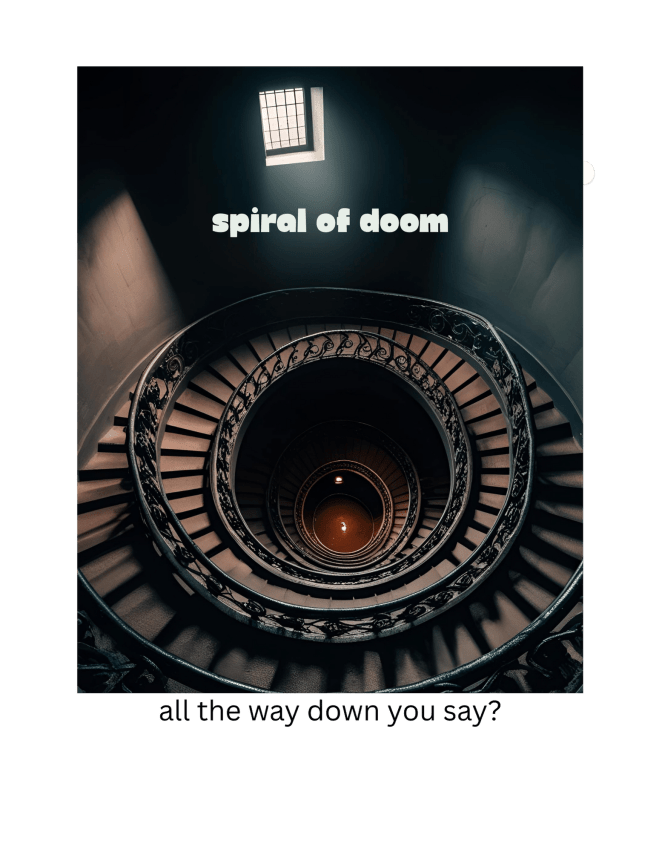
Ever heard of Rejection Sensitive Dysphoria (RSD)? It’s a common experience for people with ADHD and it means that even a hint of disappointment or criticism can hit like a sucker punch to the gut. So now you’re not just late, you’re convinced your friend hates you, you’re the worst human ever, and hey—why not just never make plans again?

This is where ADHD becomes more than a memory issue. It becomes a self-worth issue. You start doubting your ability to be dependable, to show up, to be enough. And when the world keeps reflecting that back at you, the damage compounds.

So What Helps?

  • Compassion (especially from yourself): You’re not lazy. Your brain has different settings. Start there.
  • External supports: Use them all. Alarms, timers, whiteboards, apps, body doubles. Build scaffolding around your brain. I write everything down. I have shit everywhere that I do not remember why I wrote it or sometimes come across the thing I wrote it down for. When I started breaking up every chore into little baby chores I was a lot more real with myself. Like setting the meals as I do. Less chance of me deviating and going into decision paralysis. Though I did mess up this week but it can’t be helped, I forgot and planned a meal on my birthday AND we had a prolonged power outage causing us to throw away a lot of things.
  • Micro-goals: Instead of “clean the house,” try “clear the table.” Progress feels good, if it feels good your brain will do more of it. I do one side of the sink then give myself a free break to write or just veg out for half an hour or whatever. YOU make the rules, there ARE rules though and when you give yourself little dopamine snacks through the day it will make you more even keel.
  • Community: ADHDers need each other. Not for advice—though that helps—but for validation. To always compare yourself against what YOU perceive to be a perfect normal person (though I PROMISE you everyone you meet has stuff bringing them down, some just have the advantage of a prettier package, inside its still the same shit) is pointless.

Here’s the Truth

You can be inconsistent and still be valuable. You can forget the thing and still be deeply caring. You can be unreliable sometimes and still be a good mom, friend, partner, person.

I don’t write this post as a PSA. I write it as someone who has been eaten alive by guilt more times than I can count. I want the world to stop equating productivity with worth. But until it does, I hope this helps someone—even just one person—feel a little less broken. Because I promise, you’re not. Til next time guys. Take care of yourselves and each other

Uncategorized

When Words Go Whoosh:

The Hilarious Hiccups of Auditory Processing

Hey, fellow brain-glitch aficionados! Ever find yourself nodding along in a conversation, when—BAM!—your brain decides to take an impromptu vacation? Welcome to the wild world of auditory processing mishaps!

What’s Happening Up There?
Picture your brain as a super-slick computer. It normally takes in sound, converts it to signals, and serves up meaning faster than you can say “What?” But sometimes, it’s like trying to untangle last year’s Christmas lights: messy and confusing.

The Science-y Bit (Don’t Worry, It’s Fun)
This little brain hiccup is known as Auditory Processing Disorder (APD). It’s when your brain’s sound system decides to prank you. One minute you’re fine, and the next, you’re wondering if everyone around you started speaking Klingon. This little brain hiccup is known as Auditory Processing Disorder (APD). When you have APD, your brain struggles to process the sounds it hears correctly. It’s like if you were listening to music and the song kept skipping, leaving you wondering what just happened.

The brain processes sound in a specific order: first, the ear detects sound waves, then sends electrical signals to the brain. The auditory cortex takes those signals and decodes them into speech and meaning. Simple, right? But when there’s a glitch in that system, you might hear everything perfectly fine, but your brain just can’t put it together the way it’s supposed to. I know for me, it just takes my brain a little extra time to make the words known to my brain. Like my husband can talk, and I swear to you it sounds like Charlie Brown’s adults ‘wha whaaa wha waa wha’ lol, so I will ask for repeats or clarifications, then as he is talking, I understand what they said a minute ago and I have a comment about it. I have a bad habit of interrupting people, I am trying to stop, but I KNOW if I keep my comment to myself theres a 95% chance I will forget (and if I do I’m sorry and that will make me even MORE mad at my misfiring brain, its a perpetual state of loathing)

Fun Fact: Studies suggest that around 5% of children have some form of APD, and it often goes undiagnosed, leaving kids (and adults) in a perpetual state of “Huh?”

Signs You’re Having an Auditory Adventure:

  • Words suddenly sound like gibberish. (Is this what babies feel like all the time?)
  • You catch yourself saying “Huh?” more than a confused owl.
  • You’re nodding and smiling, hoping no one realizes you’re lost in auditory space.

The Plot Twist: When You’re the One Speaking
Irony strikes! Sometimes, your own words decide to play hide and seek in your brain. It’s like your thoughts are sprinting while your mouth is stuck in quicksand. So embarrassing and happens at least once per conversation

Why Does This Happen?


Fatigue: When you’re running low on energy, your brain can’t work at full capacity. Studies have shown that fatigue can slow down the brain’s ability to process auditory information. It can slow down the brains ability to process any information actually. Essentially, your brain starts skipping steps in its usual routine—like a tired computer processing instructions slower than usual. According to research, lack of sleep (or chronic sleep deprivation) can decrease the brain’s ability to filter out irrelevant sounds, leading to auditory processing issues.


Stress: Ever notice how hard it is to concentrate when you’re stressed? Well, turns out your brain is sort of like a nervous multitasker. When you’re under stress, your brain’s focus shifts to dealing with the stressor (like an impending deadline or an important meeting) and less on the conversation happening around you. Research from the American Psychological Association has found that chronic stress can affect how the brain processes auditory stimuli by overloading the prefrontal cortex, which is responsible for attention and processing language.


Sensory Overload: Your brain is constantly bombarded with sensory information—sounds, sights, smells, you name it. When too much sensory input floods in at once, your brain can have a “processing jam.” Think of it like trying to run too many apps at once on your phone. Research has shown that sensory overload, especially in noisy environments, can make it harder for your brain to filter and focus on the important sounds (like someone speaking to you), causing a breakdown in auditory processing. Studies also show that people with APD are more sensitive to background noise, which exacerbates this issue.

Coping Strategies (or “How to Pretend You’re Still on Earth”)

  • The classic “Could you repeat that?” (Works 60% of the time.)
  • Blame it on a sudden case of daydreaming (who doesn’t love a good daydreamer?)
  • Master the art of the vague response: “Wow, that’s really something!” Practice the smile and nod.

Remember, you’re not alone in this auditory obstacle course. So next time your brain takes an unscheduled break, just smile and laugh—it’s too short not to!

Take care, stay quirky, and make sure to be good to each other! Don’t forget to spread the kindness and love, to yourselves and each other! (George is around btw he says hi. I was going to post a picture of George and Georgina they are always playing with their kids in my yard, I’ll get one soon!)

Uncategorized

When the Doctor’s Office Becomes a Battlefield: Understanding Medical PTSD

 Ok gang, let’s get real about something that doesn’t get nearly enough attention: medical PTSD. If you’ve ever left a doctor’s office feeling dismissed, doubted, or downright defeated, you’re not alone. For those of us with chronic illnesses and invisible conditions like fibromyalgia, bipolar disorder, autism, or ADHD, the healthcare system can feel less like a safety net and more like a minefield.

What Is Medical PTSD?

Medical PTSD is what happens when repeated negative experiences with healthcare providers leave you emotionally scarred. It’s not just about a bad appointment here or there—it’s about the trauma that builds up over time when your pain or symptoms are brushed off as “nothing” or “all in your head.” Spoiler alert: it’s not in your head.
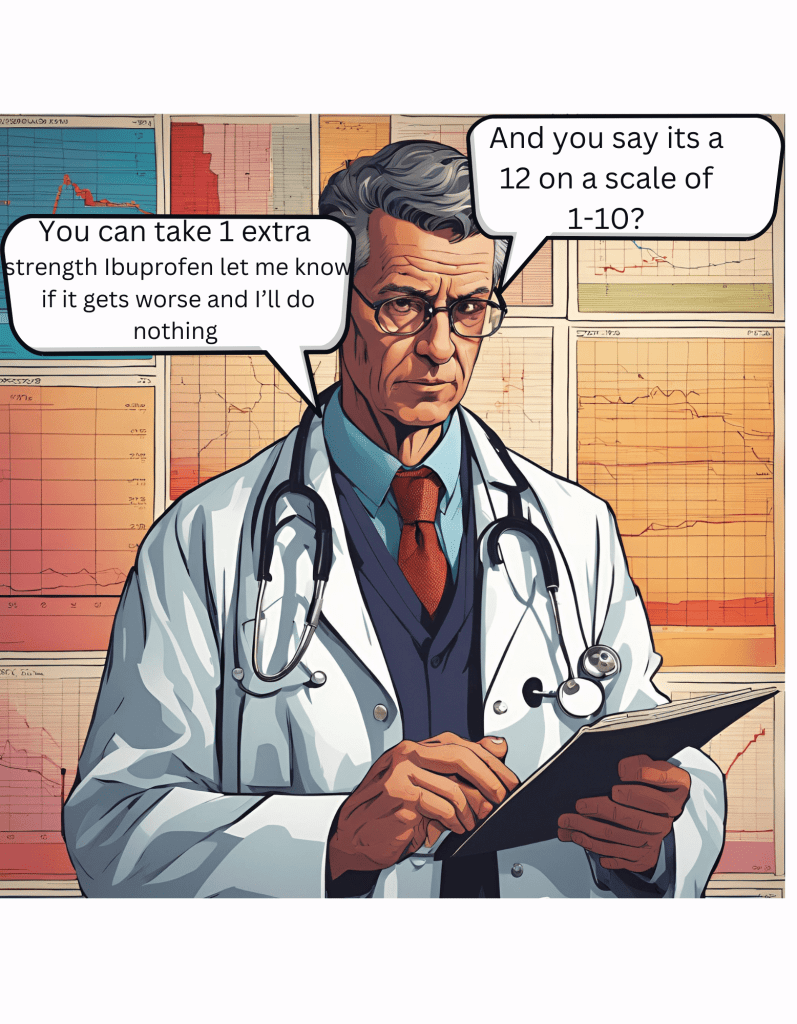
For many of us with invisible illnesses, this is an all-too-familiar story. Bloodwork comes back fine? Must be nothing. Physical exam looks normal? You’re probably exaggerating. And suddenly, you’re left questioning your own reality because someone with a stethoscope couldn’t see what you’re feeling every single day. The number of times I’ve left a doctors appointment shaking my head saying ‘well, I mean if it WAS something wouldn’t they see it?’ No, thats not true, some stuff is tricky and it hides behind stuff. Some times you have to poke around at stuff until you figure it out, that doesnt mean things arent there to find.

Truth Bomb: Invisible Doesn’t Mean Imaginary

Here’s the thing: just because something doesn’t show up on a test doesn’t mean it isn’t real. Fibromyalgia doesn’t light up on an X-ray. Bipolar disorder doesn’t leave a trail in your bloodwork. Autism and ADHD don’t come with flashing neon signs saying, “Hey, I’m here!” But that doesn’t make them any less valid—or any less debilitating.
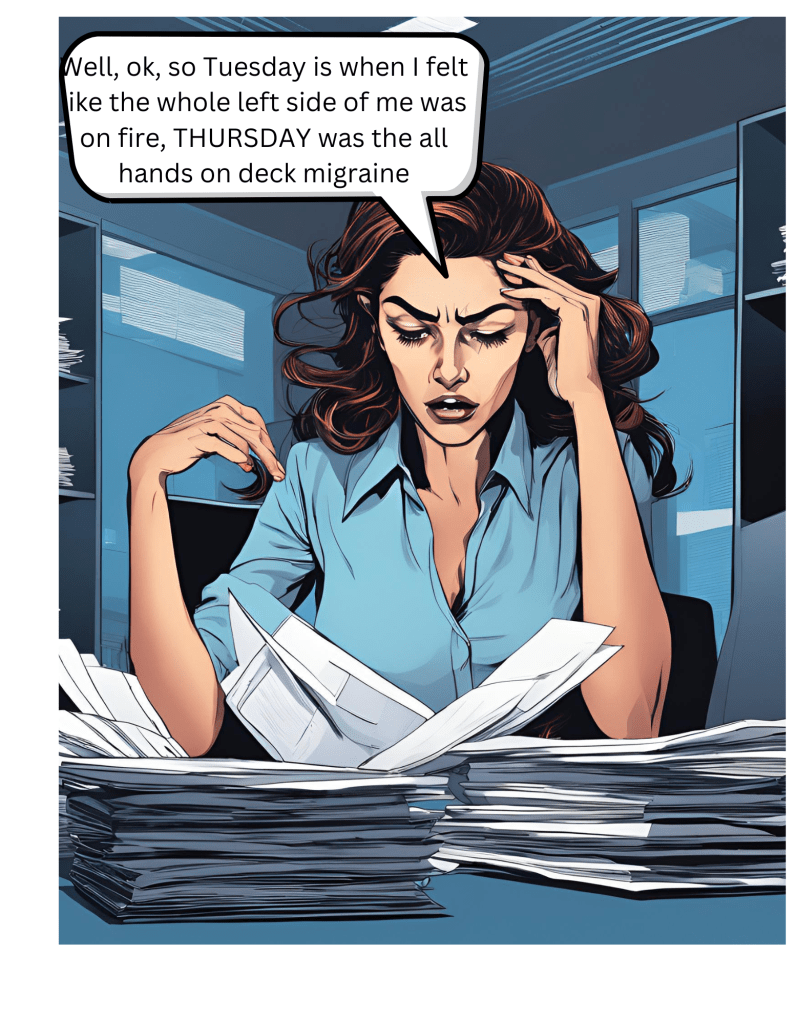
I can’t tell you how many times I’ve walked into an appointment armed with symptom logs, research, and sheer determination, only to be met with raised eyebrows and the dreaded “It’s probably just stress.” Or, ‘well you DO have Fibro’ Oh really? Because last time I checked, Fibromyalgia didn’t cause my hip to stage a full-blown mutiny (looking at you, early retirement hip).

The Emotional Toll of Being Dismissed

Let me paint you a picture: You’re already dealing with chronic pain, fatigue, mood swings—basically the greatest hits of invisible illness. Then you muster up the courage to seek help (because let’s be honest, even making the appointment feels like climbing Everest). You sit there, vulnerable and hopeful, only to be told your symptoms don’t add up or aren’t serious enough to warrant concern.

That kind of dismissal doesn’t just sting—it leaves scars. Over time, it can make you hesitant to seek care at all. Why bother if no one’s going to listen? But here’s the kicker: avoiding care can lead to worsening symptoms and even more complex health issues down the line. It’s a vicious cycle that needs to stop.

Breaking the Cycle: Advocacy and Awareness

So how do we fix this mess? For starters:

Trust Your Gut: If something feels wrong in your body, it probably is. Don’t let anyone convince you otherwise.

Document Everything: Keep a symptom diary so you have concrete evidence to back up your concerns.

Bring Backup: Take a trusted friend or family member to appointments—they can help advocate for you when you’re feeling overwhelmed.

Seek Second Opinions: If one doctor dismisses you, find another who will listen. Your health is worth fighting for. Though check with your doctors office or hospital system on policies, my doctor of 7 years dropped me because I got one.

And let’s not forget the role of healthcare providers in this equation. Doctors need better training on invisible illnesses—period. They need to understand that just because they can’t see it doesn’t mean it isn’t there. A little empathy goes a long way.

My Own Battle Scars

I’ve got plenty of stories I could share about being dismissed by doctors (and believe me, I will). Like the time I was told my fibro pain was just “overexertion” when I hadn’t done more than shuffle from my bed to the couch all week.
Or when my bipolar symptoms were brushed off as “just moodiness” because I happened to be having a good day during my appointment. Yes its about highs and lows but there is so much nuance and theres no way to catalogue each patient’s symptoms into a graph saying which predominant symptom is worse from day to given day, I don’t even know a metric you could rate them on, its just too much.
But perhaps the most frustrating moment was when my hip—yes, my actual joint—was screaming for help, and I was told ‘Well, fibro is painful.’ said sincerely with a hand on my shoulder (do not touch a fibro sufferer there and expect to be conveying sympathy or empathy, its like my BIGGEST tender point, which I never mentioned SPECIFICALLY so I let it go, but you wouldnt do that)
Spoiler alert: it wasn’t just fibro; it was my hip waving its white flag and demanding replacement parts.

The Bottom Line

Medical PTSD is real, and it’s time we start talking about it. For those of us living with chronic conditions and invisible illnesses, advocating for ourselves isn’t just an option—it’s a necessity. So keep pushing for answers, keep telling your story, and never let anyone make you feel like your pain isn’t valid.Because at the end of the day? We know our bodies better than anyone else ever could. And who can tell your story and explain your pain better than you? Til next time gang, take care of yourselves, and each other!