Uncategorized

Neurospicy Squared: Parenting a Teen With Extra Seasoning When You’re Also the Family’s Walking Firecracker

Let me paint you a picture: One neurodivergent parent with executive dysfunction, sensory issues, a flair for hyperfocus (at the worst times), and a caffeine addiction… raising a neurodivergent teen who also has executive dysfunction, sensory issues, and a flair for hyperfocus (also at the worst times). Poor non neurodivirgent Dad lol. (Lucky he’s a little spicy in his own way so he gets it)

What we’ve got here, folks, is not a traditional household.
It’s a feedback loop with matching eye rolls and snack wrappers. With attitude.
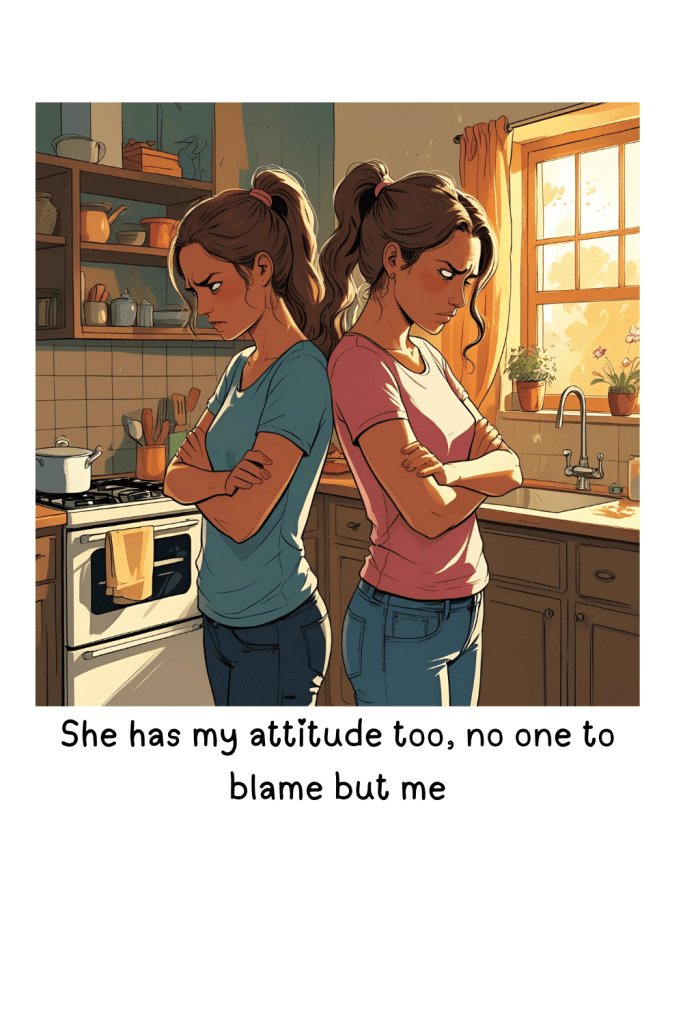

“I’m Not Yelling, I’m Just Expressing Loudly With My Whole Body”

I used to think parenting would be about teaching my child how to be a functioning adult. Now I realize it’s about co-regulating while we both spiral in different directions over things like why the peanut butter is wrong. Not gone. Just wrong.

We’ve had conversations like:

  • “I can’t handle this right now.”
  • “Same.”
  • “So what do you want to do about it?”
  • “I don’t know”
  • “Cool me either. Want to avoid it together?”

When You’re the Grown-Up and Still Don’t Have the Manual

Let’s be real: parenting any teen is a mix of love, worry, and mystery smells.

Sometimes I’m the wise mentor. Sometimes I’m the raccoon in the laundry room making emotionally impulsive decisions because my hair hurts and I need a snack.

We forget things together.
We hyperfixate on the same random topic (shoutout to that two-week deep dive into plane crash documentaries, but our fallback is cat videos lol).
We both get overstimulated in stores and end up leaving without whatever we went in for.

But at least we do it as a team.


What Actually Helps Us (Spoiler: Not Just Schedules)

People say neurodivergent kids need structure. Sure.
But have you ever tried creating that structure while your brain is doing circus tricks and crying at the same time?

So we’ve learned to build little systems that don’t require too many spoons:

  • Timers with fun alarms. (Because “Gentle bells” don’t work on either of us. We need “aggressive robot beep.”)
  • Codewords for meltdowns. (We’ve used “just “NOPE.” but I think we’re good at picking up on each others tells by now no words needed)
  • Parallel processing. (We do our own things side by side while exchanging exactly 4.5 words. Always. We watch Wheel together, we’re not watching it together so much as competing between each other but the sentiment is there)
  • And when all else fails: snacks, memes, and leaving the room before anyone says something regrettable.

The Pick Your Battles™ Scale

Let me introduce you to my secret weapon: the Pick Your Battles™ Scale. It’s how I decide whether to engage or let it go with my spicy teen (and honestly, with myself).

SituationRatingTranslation
They wore pajama pants to the store.1/10Not a fight worth my last nerve, so long as all the bits are covered I’m not stressin.
They forgot their homework again.4/10Gently nudge, don’t die on this hill.
They said I ruined their life because I made pasta instead of rice.2/10Sounds like a feelings day. Feed them, don’t fight them.
They screamed into a pillow instead of at me.0/10That’s emotional maturity, baby. Celebrate it. Hubby gets mad if she walks away mumbling under her breath. I’m like really thats NORMAL teen behavior, I’ve done it, so long as the words are to herself I see no harm in letting her cuss me out. Its when she screams at me thats the problem.
They were mean to the cat.10/10Pause the world. This one needs addressing.

This little internal rubric helps me reserve energy for what actually matters. (Spoiler: it’s not always the socks on the floor.)


The Secret Sauce: Radical Compassion + Shared Eye Rolls

My kid gets it. I get it.
We’re both doing our best with the wonky wiring we’ve got.

Some days that means deep talks about emotions and neurobiology.
Other days that means forgetting it’s trash day for the third week in a row and bonding over mutual shame while taking it out in pajamas at 3 p.m.

There’s beauty in the chaos.
There’s humor in the mess.
There’s love in the way we see each other clearly, even when the world doesn’t.


So If You’re Out There, Fellow Neurospicy Parent…

You’re not failing.
You’re not alone.
You’re just raising a tiny mirror who also loses their phone in their own hand and argues like a well-informed gremlin.

And that? That’s something worth celebrating.

Preferably with matching fidgets and a mutually agreed-upon “silent hour.” Til next time gang. Take care of yourselves, and each other.

Uncategorized

Mi Vida Loca (My Crazy Life)

Why My ‘Organized Chaos’ Is Actually a Master Plan (And No, I Don’t Know Where the Plan Is)
Listen up, you neurotypicals and neat freaks. You might look at my desk and think a tornado had a love child with a paper factory, but let me tell you, there’s a method to this madness. Welcome to my world, where ‘organized chaos’ isn’t just a fancy way of saying “I’m a mess” – it’s a damn lifestyle.

The Art of Controlled Chaos
To the untrained eye, my workspace looks like a dumpster fire had a baby with a thrift store explosion. But let me assure you, there’s a system here. It’s like a game of 3D chess, except I’m playing against myself, and I’ve lost the rulebook.

  1. The Pile-Em-Up Principle

In my world, piles aren’t just messy heaps; they’re fucking archaeological digs waiting to happen. Each pile is a time capsule of procrastination and good intentions. The pile on the left? That’s shit I meant to file last year. The middle pile? That’s where dreams go to die. And the pile on the right? That’s where I put things that have mysteriously appeared from the ADHD void and will eventually be sorted by sheer dumb luck or divine intervention.

  1. The Lost-and-Found Game

Finding anything in my ‘organized chaos’ is like playing a twisted version of Where’s Waldo, except Waldo is that one crucial document I need for a meeting in five minutes. The rules are simple: if it’s important, it’s lost. The thrill is in the panic-induced search, unearthing long-lost treasures like that one sock I’ve been missing since Obama was president.

  1. The Mysterious Filing System

I don’t have a filing cabinet; I have a “file-ninja” system. Documents should appear where you least expect them – like in the fridge, under the cat, or in last year’s Halloween costume. It’s designed to keep you on your toes and ensure that you never, ever know where anything is. It’s the ultimate test of memory and how long you can go without having a meltdown.

  1. The Calendar Conundrum

My calendar is a masterpiece of chaos theory. It’s a tapestry of sticky notes, cryptic symbols, and reminders that might as well be written in ancient Sumerian. I have a color-coding system that makes perfect sense… when I’m high on caffeine at 3 AM.

  1. The Perpetual ‘To-Do’ List

My ‘To-Do’ list is longer than the credits of a Marvel movie and just as never-ending. It’s less a list and more a chronicle of good intentions and abandoned dreams. Some items have been on there so long they’ve developed sentience and are plotting a rebellion.

The Illusion of Control
Despite the seeming disorder, there’s a comforting illusion that I’ve got my shit together. Each misplaced item and chaotic pile is part of a grander scheme that only I can truly understand – mostly because I made it up as I went along.

Conclusion: Embracing the Clusterfuck
So there you have it: my ‘organized chaos’ is actually a master plan, a dazzling display of ADHD ingenuity. It might look like a disaster zone to the casual observer, but it’s a carefully curated mess that ensures I’m always engaged in the thrilling game of “Where The Fuck Did I Put That Thing?”

Next time someone looks at your desk and asks, “Isn’t that a bit messy?” just smile and say, “Oh, you mean my master plan? It’s a fucking work of art!” After all, in the world of ADHD, the real masterpiece is finding joy in the journey of organized chaos – and occasionally finding that one thing you’ve been looking for for three months.

Now, if you’ll excuse me, I need to go reorganize my piles. Or maybe take a nap. Whichever I get distracted by first. (Its nap, its always nap). Take care of yourself gang, and each other.

Uncategorized

Is it blindness if we choose not to see it?

Tonight lets talk about something SUPER fun for people who are NORMAL procrastinators, or people who are just chronically punctual, this shit makes my eye twitch. I want to be on time, but I am ALWAYS either embarrassingly early or unforgivably late, I just can’t find a way to strike a happy medium. I was surprised to learn of the other ways time blindness presents itself in my life, its not just about not being on time. So lets dive into the wild world of time blindness. You know, that delightful phenomenon where your brain treats the concept of time like a cruel joke? Yeah, for those of us with autism or ADHD, keeping track of the chronological flow of existence is about as easy as herding cats on meth.

Let’s start with our autistic homies. For them, time blindness can manifest in a few gloriously confusing ways:
First up, we’ve got the struggle to grasp the very concept of past, present, and future. It’s like the abstract notion of time is an ancient language only understood by neurotypical scholars. “What do you mean, this moment won’t last forever? Blasphemy!”

Then there’s the complete obliviousness to how much damn time has passed. You could be happily stimming away, lost in your own little world, only to emerge hours later wondering where the hell the day went. Time? What’s that? A construct created by the neurotypical elite to oppress us?

And let’s not forget the sacred routines. Stray from the schedule even a smidgen, and it’s like the world is ending. Spontaneity? Never heard of her. Rigidity and predictability are our jam, thank you very much.

But wait, there’s more! Our ADHD brethren also get to experience the joys of time blindness in their own unique ways:

Impulsivity and time management? What a delightful oxymoron! Thinking ahead and considering consequences is for the weak. We prefer to live life on the edge, making split-second decisions without a care for that pesky thing called “time.”

Procrastination is our middle name. Why do today what you can put off until tomorrow, next week, or maybe even next year? Prioritizing tasks and meeting deadlines is so overrated when you could be hyperfocusing on reorganizing your sock drawer instead.

Speaking of hyperfocus, that’s another fun ADHD party trick. One minute you’re trying to be a productive member of society, the next you’re utterly consumed by whatever random interest has captured your brain’s fleeting attention. Time? What’s that again?

At the end of the day, both autism and ADHD involve executive function challenges that make time management about as easy as walking a tightrope while juggling chainsaws. But hey, at least we’re keeping things interesting, right?So embrace the time blindness, folks. Lean into the chaos and confusion. After all, who needs to follow the neurotypical construct of time when you can march to the beat of your own delightfully disordered drum? Til next time gang, take care of yourself, and each other!