

Uncategorized

How I Know I’m Overstimulated (Before I Start Snapping at Everyone)

Lots of stuff floating through my brain guys. I havent been around because full disclosure I don’t know if I want to do this anymore. I feel like I’m screaming into a dark void and nothing is coming back LOL. I started this to help people like me, but also help ME, so I will keep it but you might see changes soon. I’ll probably just go down a package with wordpress but I’m still deciding. Anyway, thats for another day, now lets talk OVERWHELM. There’s a very specific moment where I go from “functioning human” to “if one more person breathes near me I will lose it.”

And unfortunately, I don’t always notice it before I’m already irritated at… everything. Then others point out I’m cranky. As if I am ever anything less than a delight LOL

So here are the signs I’ve learned to catch before I turn into the world’s most overwhelmed mom with zero patience and a twitchy eye

1. Everything suddenly feels… louder than it should be

The TV isn’t even that loud. Nobody is yelling.
But somehow it feels like I’m trapped inside a blender.

Bonus points if multiple sounds are happening at once and my brain just goes “nope.”

2. I get irrationally annoyed at normal human behavior

Someone asking a simple question? Annoying.
Someone walking into the room? Also annoying.
Existing? Honestly… offensive.

This is usually my first clue that the problem is not actually them.

3. My patience drops to zero in 2.5 seconds

I go from “sure, babe” to internally screaming in record time.

Tiny inconveniences feel personal.
Like the universe specifically chose me for suffering because the remote is missing.

4. My body feels tense for no reason

Shoulders up by my ears
Jaw clenched
That low-key “I might cry or scream, we’ll see” feeling

Love that for me.

5. I can’t focus on anything (but also can’t rest)

I try to scroll, watch something, do a task…

…and my brain is just buffering.

It’s like being tired and wired at the same time, which is a special kind of awful.

What I Actually Do About It (aka damage control)

This is not a “perfect self-care routine.”
This is “what can I realistically do before I snap at someone I love.”


✔️ 1. Reduce input immediately

Turn something off.
Lower the volume.
Leave the room if I can.

Less noise = less rage.


✔️ 2. Say it out loud (before it comes out wrong)

“I’m overstimulated.”

That’s it. No speech. No explanation.

It buys me space without starting a fight I didn’t mean to start.


✔️ 3. Change the environment

Dim lights
Different room
Sit in the car for a minute like a gremlin

A small shift helps more than I expect every time.


✔️ 4. Give myself a “no expectations” reset

I stop trying to be productive, patient, or pleasant.

We are in survival mode now.

Even 10–15 minutes helps take the edge off.


✔️ 5. Do something mindless on purpose

Scroll
Play a chill game
Watch a comfort show.
Fold laundry slowly.

The goal is not productivity.
The goal is not snapping.

The part I have to remind myself of

Being overstimulated doesn’t mean I’m failing.

It means:

  • too much input
  • not enough capacity
  • and my brain is waving a tiny white flag

The earlier I catch it, the less damage control I have to do later. Til next time gang. Take care of yourselves, and each other.
Uncategorized

The Autistic Teen Whisperer: A Nature Documentary of My Life

INT. KITCHEN – EARLY MORNING
Cue dramatic voiceover, à la David Attenborough:
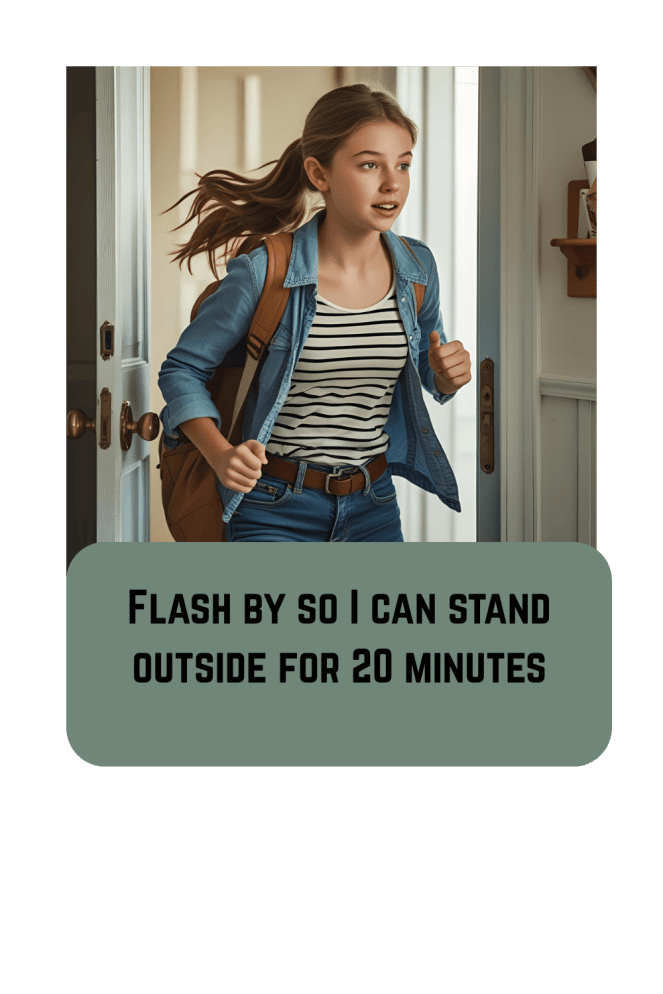
“If we are quiet… very quiet… we may catch a glimpse of the elusive Autistic Teen in her natural habitat. There! A flash of movement, a hoodie, mismatched socks. Blink and she’s gone. Out the door before the sun can fully rise, leaving behind toast crumbs and an emotional riddle.”

Welcome to the wild world of neurodivergent parenting. I’m your guide, an exhausted mom attempting to decode the rituals, migrations, and sensory triggers of my favorite wild animal: my teenager.


The Habitat

The Autistic Teen typically roams the house after 10 PM, nesting primarily in her bedroom—curated with LED lights, noise-canceling headphones, and Very Specific Textures. Her room is both her sanctuary and her command center, and entering without knocking is a rookie mistake you only make once.

Adaptations observed:

  • Can detect the faintest flicker of a light bulb in another room.
  • Has strong opinions about the temperature and humidity level of her socks.
  • Stores snacks in unexpected places. Foraging is an art.

The Communication Rituals

Communication with the Autistic Teen requires finesse, timing, and a willingness to interpret non-verbal cues like you’re deciphering ancient cave drawings.

Sometimes we exchange whole conversations in Minecraft metaphors or sarcastic cat videos. Sometimes, the best thing I can do is sit quietly nearby and let her stim in peace.


Feeding Habits

She has strong food aversions and sacred favorites. I’ve learned the hard way not to mess with the shape of the nuggets or the brand of the mac and cheese. When in doubt: beige, crunchy, and emotionally comforting.

As her caregiver and personal short-order chef, I’ve adjusted. I stock the sensory-safe foods, experiment with new ones slowly, and always, always have backup pop tarts.


Daily Migration Patterns

Between school, stimming breaks, and doomscrolling, her internal compass doesn’t follow a standard map. There is no “typical” day. But I’ve learned to track her rhythms:

  • Mornings: silent, hoodie up, minimal communication.
  • Afternoons: decompressing with art or YouTube rabbit holes.
  • Evenings: bursts of creativity, hyperfocus, or emotional monsoons.

Every day is an expedition. Sometimes I’m chasing her needs through sensory jungles. Other times, I just try to not mess up her flow.


Challenges in the Wild

Sometimes we clash. My ADHD brain is loud, scattered, and constantly shifting. Her autistic brain is methodical, specific, and easily overwhelmed by chaos. We are two storms learning to move together without wrecking each other.

I talk too much. She gets overwhelmed by too many words. I need novelty. She needs routine. It’s not always elegant, but it’s always ours.


The Mutual Bonding Ritual

The bond between Whisperer and Teen is strong, even if it doesn’t always look that way from the outside. We’ve developed our own language—half memes, half silence, all love. She knows I see her. She knows I’m trying. And I know that even when she disappears into her own world, she leaves the door open a crack.

Sometimes I catch her watching me with a mix of exasperation and affection.
Sometimes she randomly tells me a fact about spiders or space or mental health that makes me cry with pride.
Sometimes she texts me from her room to say, “thanks for not being annoying today.”

I count that as a win.


Closing Narration

This isn’t about having it all figured out. It’s about showing up anyway, even when the jungle is loud, the routines are broken, and the brain fog is real.

Because love, it turns out, is the greatest adaptation of all. Til next time gang, take care of yourselves, and each other.