Uncategorized

5 Weirdly Effective Ways to Feel Better Fast (Backed by Science, Not Just TikTok)

Ever feel like your brain’s stuck in dial-up mode while the rest of the world’s running on fiber optic? Been there, ordered the T-shirt, wore it for three days straight. When you’re fried, frazzled, or just feeling emotionally soggy, you don’t always have the bandwidth for a full mental health makeover. The good news? Science has your back—and it doesn’t require a prescription or a bank loan. Here are five surprisingly effective, science-backed ways to feel better fast—without leaving your couch (probably).


1. Deep Breathing: A Free Spa Day for Your Nervous System

Let’s be real: when someone tells you to “just breathe,” it’s usually right before you snap like a glow stick. But hear me out—breathwork is basically a nervous system cheat code.

🔬 Science says: Deep, controlled breathing activates your parasympathetic nervous system (aka the “rest and digest” mode), reducing cortisol and lowering heart rate. One study in Frontiers in Psychology (Zaccaro et al., 2018) found that slow breathing significantly improves mood and lowers anxiety.

🌀 Try this: Inhale for 4 counts, hold for 4, exhale for 4 (aka box breathing). Bonus points if you close your eyes and pretend you’re somewhere tropical and not just hiding from your responsibilities.

I don’t like to recommend anything I don’t do, so rest assured I do this, though I switch up the rhythms, and I would recommend you do the same because so long as you’re breathing, it works doesnt matter how pretty it is.


2. Laughter Therapy: Better Than an Espresso Shot

Who knew memes could double as mental health tools? Turns out, watching something funny isn’t just procrastination—it’s therapy with a punchline.

🔬 Science says: Laughter triggers the release of endorphins and lowers stress hormones. A study in The Journal of Neuroscience (Dunbar et al., 2012) shows that laughter increases pain tolerance and boosts social bonding.

📺 Try this: Watch a short stand-up set, blooper reel, or the 7,000th rerun of your favorite sitcom. Whatever tickles your funny bone.
👉 Real-life moment: You know what I’ve heard? I laugh too much. I’m too loud. I shouldn’t make everything a joke. You know what? I’m beyond caring. You know that whole near death thing? It showed me life was FAR TOO SHORT to waste time on the vast amount of unpleasantness one generally has to put up with. If you can’t laugh did you even enjoy it? I listen to last nights late night monologues or stand up while I’m doing my duolingo in the mornings (take care of your brain folks, no joke, you’ll miss it when it starts to go LMAO) and on mornings that I can’t I find the rest of the day I can be kind of an asshole. I mean, I’m always sorry, but I’m going to be honest with you guys about it LOL


3. Gardening or Nature Exposure: Green = Good Vibes

No yard? No problem. Even a houseplant counts as emotional support foliage. Nature doesn’t judge your outfit or ask how many hours of sleep you got.

🔬 Science says: Time in nature reduces stress and improves mood. The Japanese practice of shinrin-yoku (forest bathing) has been studied extensively; one study in Environmental Health and Preventive Medicine (Park et al., 2010) showed it significantly lowers cortisol.

🌱 Try this: Step outside and touch a tree (yes, really), water your plants, or sit near a window. Even watching nature videos has calming effects.

I am plant killer number one around here. I wouldnt be surprised if my mug shot is hanging in the break room for plants like shoplifters mugshots are at Walmart LOL. That being said, the WORST thing the hip replacement has stolen is my weekly or biweekly mowing the yard. I love it, we have an electric mower so I get a good one hour out of it, bopping alone to some music, its just mindless outdoor sun time. Then stick it on the charger and hit it the next day. I have a hard time sitting in the sun even when I know its good for me and outside I wouldnt last long before getting bored.


4. Listening to Classical Music: Your Brain’s Chill Pill

Before you roll your eyes, no, it doesn’t have to be Mozart. But slower, instrumental music can work some serious emotional sorcery.
🔬 Science says: A study in PLOS ONE (Thoma et al., 2013) found that listening to classical music after a stressor reduced cortisol levels more effectively than silence or other genres.

🎵 Try this: Play something instrumental (piano, strings, lo-fi beats) for 5-10 minutes. Even better? Lie down and do nothing while it plays. Yes, doing nothing is productive sometimes.

I love all music. Classical is not a fave but I will put on some really low volume piano pieces when I need it. Generally its just pop from the 80s though. But try Chopin first lol who knows, it could be your new favorite.


5. Social Connection: Text That One Person (Yes, Them)

When you’re down, your brain might tell you to retreat like a wounded raccoon. But reaching out—even just a little—can flip the script fast.

🔬 Science says: Human connection boosts oxytocin, lowers anxiety, and increases resilience. A study from American Journal of Psychiatry (Ozbay et al., 2007) highlights social support as one of the most powerful buffers against stress.

📱 Try this: Send a funny meme to a friend, voice note someone who “gets it,” or even comment on someone’s post meaningfully.
👉 Its so hard guys. The phone is like there…. And like, sometimes, sometimes it even *gulping loudly*…. RINGS!!! TERRIFYING! I know guys, see, I get it, but how about a text? A text connects you like a ‘sup’ nod between bros, but without the whole sense of the ‘sup’ reply. I bake that shit right into my texts too, I say ‘hey, let me know how you are when you get a minute’. No rush. I’m chill man. Or even ‘just sayin hey and wanted you to know I’m thinking of you’ totally not giving them ANY obligation, because like why would I bum anyone I love out like that?


Closing: Feeling better doesn’t always need to be a full-blown self-care summit. Sometimes, it’s in the little things: a breath, a laugh, a leaf, a lyric, a message. Try one. Try them all. You deserve moments of ease—even when life’s handing out chaos like Halloween candy. Til next time gang. Take care of yourselves, and each other!


recipe · recipes

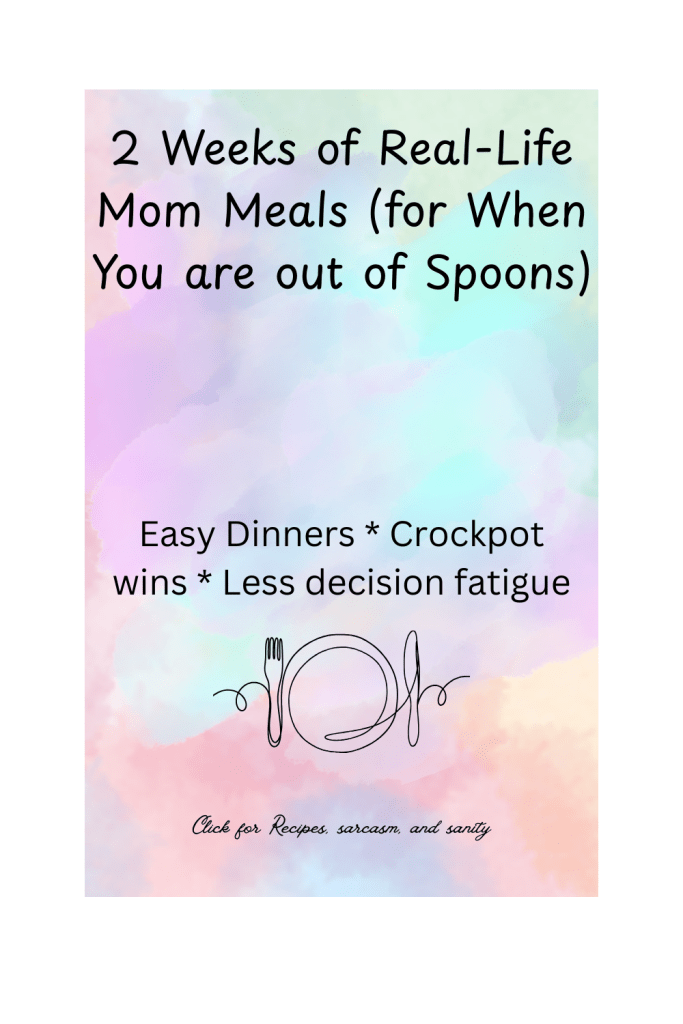
Survival & Sanity: 2 Weeks of Reserve-Based Meals (Weeks 3 & 4)

If you’re anything like me — fibro-fogged, recently-hip-replaced, raising a gloriously neurodivergent teen, and running on caffeine, hope, and probably expired groceries — then planning dinner might feel like launching a rocket from your laundry room.

This meal plan is for those of us trying to survive the week without crying into a dish towel. It’s a real-life, spoon-theory-approved guide with easy cook-day meals and fallback reserves that don’t require your whole brain.


🗓️ Printable 2-Week Meal Menu (with Attitude)

Week Three

DayMeal
MondayMac & Cheese with Sausage — Leftovers from Sunday. Bonus: Only one pan to clean and minimal effort to reheat. That’s a win in my book.
TuesdaySausage & Peppers over Egg Noodles — Bright, flavorful, and uses enough veggies to pretend we’re balanced adults.
WednesdayChicken Strips + Knorr Side — Reserve meal MVP. Add a veggie if you’re feeling wild.
ThursdayBaked Chicken + Roasted Veggies — Sheet pan magic. Roast everything at once and act like it was on purpose.
FridayReserves — Classic, comforting, and suspiciously filling for something this lazy.
SaturdaySausage + Eggs + Toast — Breakfast-for-dinner, aka using breakfast foods to emotionally reset.
SundayCoke Pulled Pork + Mac or Egg Noodles — The crockpot does all the work. You take the credit.

Week Four

DayMeal
MondayPulled Pork “Tacos” — Leftovers dressed up. Throw in onions, peppers, canned tomatoes, and rice. Tortilla optional. I like to make it a rice bowl or in tortillas, we have also put pulled pork leftovers with some salsa and nachos.
TuesdayMeatballs in Marinara — From the freezer to the table. Zero regrets.
WednesdayEggs + Toast + Hashbrowns or Fruit — Breakfast, again. Because we do what works.
ThursdayChicken Stir-Fry + Rice — Takes 15 minutes and makes you feel like you’ve got your life together.
FridaySoup + Crackers or Sandwiches — More reserves. Less thinking.
SaturdayPasta Bake or Lazy Lasagna — Toss it in a dish and bake until bubbly. Cheesy redemption.
SundayMaple Glazed Chicken + Buttered Noodles — The Pinterest recipe you actually pulled off. Hubby-approved. Next time we’re reducing that glaze for stick factor.

🍳 Ingredients for the Cook Day Hits (Sarcasm Included)

Sausage & Peppers over Egg Noodles
Ingredients: sweet Italian turkey sausage, red and green bell peppers, yellow onion, garlic, broth (instead of wine), canned diced tomatoes, tomato paste, dried oregano, olive oil, egg noodles. Honestly I tweak this every time. If it sounds like it’d be good in it I’d try.
Mood: Colorful enough to feel like you’re trying.

Baked Chicken + Roasted Veggies
Ingredients: chicken breasts, potatoes, carrots, olive oil, salt, pepper, whatever seasoning makes you feel chef-y.
Mood: Toss it all on a sheet pan. Roasting = pretending you’re fancy.

Coke Pulled Pork
Ingredients: pork roast, 1 can of Coke, BBQ sauce, salt, pepper, onion powder.
Mood: Dump, set, and go live your life.

Meatballs in Marinara
Ingredients: frozen meatballs, jarred marinara sauce, spaghetti or mashed potatoes.
Mood: It’s giving “fake it till you bake it.”

Chicken Stir-Fry
Ingredients: chicken breasts, frozen stir-fry veggies, soy sauce, splash of broth, oil, rice.
Mood: One-pan wonder with zero side-eyes.

Pasta Bake or Lazy Lasagna
Ingredients: cooked pasta, any ground meat, jarred pasta sauce, shredded cheese.
Mood: Layer, bake, and pretend you slaved.

Maple Glazed Chicken
Ingredients: chicken thighs or breasts, maple syrup, soy sauce, garlic powder or minced garlic, BBQ sauce.
Mood: So good your partner eats the leftovers. Sauce could use a glow-up — try reducing it next time.


🍆 Reserve Staples to Keep on Hand

  • Chicken strips (frozen)
  • Eggs
  • Bread (for toast & sandwiches)
  • Canned soups
  • Frozen vegetables
  • Hashbrowns
  • Knorr sides or boxed pasta mixes
  • Rice
  • Pasta
  • Tortillas
  • Jarred pasta sauce
  • Shredded cheese
  • Bacon or sausage (for breakfast-for-dinner days)
  • Instant mashed potatoes (optional but very sanity-saving)

🚨 Final Thoughts

You don’t have to be a perfect parent or domestic goddess to feed your family. This plan makes use of what you already have, lets you lean on frozen staples without shame, and helps reduce decision fatigue. Keep showing up, spoon by spoon. You’re doing better than you think.

Want more meal plans? Stick around — we’re doing this every two weeks until I run out of freezer space or patience.

Printable grocery list? Right here. Pinterest-worthy recipes? Working on it. Sanity? Pending.

You’ve got this. Til next time gang!

Uncategorized

When Words Go Whoosh:

The Hilarious Hiccups of Auditory Processing

Hey, fellow brain-glitch aficionados! Ever find yourself nodding along in a conversation, when—BAM!—your brain decides to take an impromptu vacation? Welcome to the wild world of auditory processing mishaps!

What’s Happening Up There?
Picture your brain as a super-slick computer. It normally takes in sound, converts it to signals, and serves up meaning faster than you can say “What?” But sometimes, it’s like trying to untangle last year’s Christmas lights: messy and confusing.

The Science-y Bit (Don’t Worry, It’s Fun)
This little brain hiccup is known as Auditory Processing Disorder (APD). It’s when your brain’s sound system decides to prank you. One minute you’re fine, and the next, you’re wondering if everyone around you started speaking Klingon. This little brain hiccup is known as Auditory Processing Disorder (APD). When you have APD, your brain struggles to process the sounds it hears correctly. It’s like if you were listening to music and the song kept skipping, leaving you wondering what just happened.

The brain processes sound in a specific order: first, the ear detects sound waves, then sends electrical signals to the brain. The auditory cortex takes those signals and decodes them into speech and meaning. Simple, right? But when there’s a glitch in that system, you might hear everything perfectly fine, but your brain just can’t put it together the way it’s supposed to. I know for me, it just takes my brain a little extra time to make the words known to my brain. Like my husband can talk, and I swear to you it sounds like Charlie Brown’s adults ‘wha whaaa wha waa wha’ lol, so I will ask for repeats or clarifications, then as he is talking, I understand what they said a minute ago and I have a comment about it. I have a bad habit of interrupting people, I am trying to stop, but I KNOW if I keep my comment to myself theres a 95% chance I will forget (and if I do I’m sorry and that will make me even MORE mad at my misfiring brain, its a perpetual state of loathing)

Fun Fact: Studies suggest that around 5% of children have some form of APD, and it often goes undiagnosed, leaving kids (and adults) in a perpetual state of “Huh?”

Signs You’re Having an Auditory Adventure:

  • Words suddenly sound like gibberish. (Is this what babies feel like all the time?)
  • You catch yourself saying “Huh?” more than a confused owl.
  • You’re nodding and smiling, hoping no one realizes you’re lost in auditory space.

The Plot Twist: When You’re the One Speaking
Irony strikes! Sometimes, your own words decide to play hide and seek in your brain. It’s like your thoughts are sprinting while your mouth is stuck in quicksand. So embarrassing and happens at least once per conversation

Why Does This Happen?


Fatigue: When you’re running low on energy, your brain can’t work at full capacity. Studies have shown that fatigue can slow down the brain’s ability to process auditory information. It can slow down the brains ability to process any information actually. Essentially, your brain starts skipping steps in its usual routine—like a tired computer processing instructions slower than usual. According to research, lack of sleep (or chronic sleep deprivation) can decrease the brain’s ability to filter out irrelevant sounds, leading to auditory processing issues.


Stress: Ever notice how hard it is to concentrate when you’re stressed? Well, turns out your brain is sort of like a nervous multitasker. When you’re under stress, your brain’s focus shifts to dealing with the stressor (like an impending deadline or an important meeting) and less on the conversation happening around you. Research from the American Psychological Association has found that chronic stress can affect how the brain processes auditory stimuli by overloading the prefrontal cortex, which is responsible for attention and processing language.


Sensory Overload: Your brain is constantly bombarded with sensory information—sounds, sights, smells, you name it. When too much sensory input floods in at once, your brain can have a “processing jam.” Think of it like trying to run too many apps at once on your phone. Research has shown that sensory overload, especially in noisy environments, can make it harder for your brain to filter and focus on the important sounds (like someone speaking to you), causing a breakdown in auditory processing. Studies also show that people with APD are more sensitive to background noise, which exacerbates this issue.

Coping Strategies (or “How to Pretend You’re Still on Earth”)

  • The classic “Could you repeat that?” (Works 60% of the time.)
  • Blame it on a sudden case of daydreaming (who doesn’t love a good daydreamer?)
  • Master the art of the vague response: “Wow, that’s really something!” Practice the smile and nod.

Remember, you’re not alone in this auditory obstacle course. So next time your brain takes an unscheduled break, just smile and laugh—it’s too short not to!

Take care, stay quirky, and make sure to be good to each other! Don’t forget to spread the kindness and love, to yourselves and each other! (George is around btw he says hi. I was going to post a picture of George and Georgina they are always playing with their kids in my yard, I’ll get one soon!)