Uncategorized

10 Funny (and Some Serious) Ideas for Things to Do While Recovering from Hip Replacement Surgery

Recovering from hip replacement surgery sounds daunting, so why not make the most of your downtime? I’m a week out and I’m SO bored. I’ll probably knock out at least five of these this week. If you guys have ideas let me know EDITED TO ADD: Mother in law sent me a message letting me know that when her hubby had a hip replacement he built models and thats how she ended up with a curio case full lol. I hadn’t thought of them until she reminded me of Grandpa Greg’s recovery but thats also something tangible so I’d absolutely work on that. Legos too after I thought about it.

1. Binge Watch TV Shows Until You Forget What Day It Is
HBO, Netflix, Hulu… I feel like this one goes without saying… summon the entertainment gods! Start a show so long you’ll still be watching it when you can finally walk without looking like a baby giraffe. I’m planning to re watch this season’s Law and Orders, and Greys, and all the Chicago shows. Then I’ll branch out to see if there are any finished shows, or finished seasons of shows that I have on my to watch list.

2. Perfect the Art of Asking for Everything
This is your time to shine as the supreme monarch of laziness. Channel your inner diva and ask others to fetch you water, snacks, blankets, and everything else. I’ve started calling my husband into the room to do little things once I lay down. I start by justifying it as he’s walking in the room he’s like ‘just tell me, I know you’d do it if you could’. But half the fun is making up the justifying stuff. Make an argument they can’t say no to

3. Assemble a Throne of Pillows
You’re going to be sitting a lot, so why not create the most luxurious pillow fort for your recovery? Bonus points if you make people call you the Pillow Queen. I don’t just want a pillow throne, I want a pillow empire that I may sit atop and be fanned and fed grapes LOL

4. Write a Memoir Called “Titanium and Tantrums”

Chronicle your hip replacement journey in all its glory—include your emotional highs, your many Netflix binges, and the awkward moment you dropped a crutch down the stairs. Kidding, steer clear of stairs for the duration of your recovery. I didnt do crutches, I did a combo of walker and cane but it sucks to drop your cane. I have a grabber that I also drop, so I play pick up sticks with my toes lol. My memoir would be boring, mostly about how I try doing things myself, fail, then wait for someone to *gulp* help.

5. Invent an Alter Ego for Your New Hip
Name your new hip something badass like “T-800” or “Iron Justice.” Refer to it exclusively in the third person. “Iron Justice doesn’t approve of stairs today.” LOL I havent named mine yet, but I did notice I didnt have any bionic powers yet. Super Speed???? Maybe but I wont find that out til its magically activated and I am summoned to my rightful place instead of seated here atop my pillow throne.

6. Train Your Pets to Assist You

Turn your dog into a furry nurse or your cat into a reluctant butler. Teach them to fetch your slippers, deliver snacks, or at least sit next to you and look cute. I’ve been working SO HARD at this one, so far I have gotten two of the four to sit in my vicinity and grace me with their presence, I’ll continue working at it, it will be slow going but I’ve got time.

7. Learn to Swear in Different Languages
You’ll need new words for when physical therapy makes you want to throw something. Imagine shouting “Merde!” or “Scheisse!” to spice up your frustrations. I should look into the swear words, I don’t think they have a section for it in Duolingo lol, but I’ve been doing Duolingo more. Make yourself fluent in a language of your choosing. Thats using your time constructively

8. Create a Playlist Called ‘My Hip Don’t Lie’
LOL You knew a playlist had to be on the list somewhere! Honestly my soundtrack has been senate hearings and stand up comedy, but now that I’m feeling good enough not to sit on my ass today it’s Shakira time. Include other bangers like “Can’t Stop This Feeling” and “Walk This Way.” Dance from the couch (or gently sway if you’re not quite there yet).

9. Become a Professional Napper
If naps were an Olympic sport, you’d be going for gold. Nap at odd hours. Nap mid-conversation. Nap just because you’re bored. Recovery requires rest, after all. I seriously love me a good nap. I havent been sleeping well because I have to elevate my hip and I’m uncomfortable on that side, so if I’m in my chair and the moment calls for it I can be sound asleep in under 3 minutes.

10. Plan Your Post-Recovery Dance Routine

Once your new hip is ready, you’ll obviously want to celebrate with a victory dance. Sketch it out now: a little cha-cha, a hip thrust (carefully), and a triumphant lean. I have actually thought about this a fair amount, I love to dance. I love to move, I hate sitting still so its driving me crazy, but I know I’ll be able to dance soon and feel much better while doing it, so thats what I’m holding on to.

Final Thoughts:

Recovery is hard, but humor makes it bearable. Whether you’re inventing alter egos for your hip or perfecting your dramatic limping skills, the key is to stay entertained and keep smiling (or rolling your eyes). You’ve got this—Iron Justice (or Titanium Tina ooohhh, I like that one) will be back on the dance floor in no time. Til next time gang, take care of yourselves, and each other.


Uncategorized

How I’m Using Art to Cope with the Anxiety of Surgery

So gang, I am very close to my surgery let me tell you, the anxiety has been overwhelming. Between the constant worry about how I’m going to manage after the surgery and the fear of the unknown, I’ve been on edge. And I’ve realized—I’m scared. Really scared.

I think I’ve spent most of my life learning how to cope with anxiety, whether it’s from a health condition or just the daily emotional rollercoaster of managing multiple diagnoses. But this surgery? This is different. It feels like it’s more than just my body I’m worried about—it’s my whole life, my routine, my identity. And when that kind of anxiety takes over, it feels like I can’t think straight.

I’m sure many of you reading this can relate: sometimes, when everything becomes too much, the panic creeps in. And that’s where distraction comes in. For me, lately, it’s been art.

I’ve spent the past week coloring, sketching—literally hundreds of pictures. I’m sure some people would call it “mania,” and, honestly, maybe they’re right. My brain feels like it’s on overdrive, and I can’t seem to stop. But I know that, right now, I need this. I need something to focus on to keep myself from spiraling into full-blown anxiety.


Why Distraction Can Help

Distraction isn’t just a coping mechanism—it’s been a lifeline for me. I know that sounds strange, but it’s true. When you’re dealing with overwhelming thoughts and feelings, whether it’s from anxiety or just pure fear, sometimes the best thing you can do is focus on something that takes your mind off the panic. For me, that’s sketching.

And it’s not just about “getting away” from the anxiety. When I immerse myself in coloring or drawing, my brain gets a break from the constant worrying. I’m able to focus on something else, something creative. It brings a sense of order and control back into a chaotic mind. It calms me down, even if just for a little while.

I’m not saying that distraction is a cure-all. But research does show that activities like drawing, coloring, or other creative outlets can help reduce stress. When we focus on an activity, like sketching lines or picking colors, our minds can get a break from the chaos. We tap into a different part of our brain, one that’s focused on the task at hand and not on the anxiety.

It’s like hitting the pause button for a moment.


How Art Helps Me Manage Anxiety

I don’t want to sugarcoat it: I’m still scared about the surgery. I’m still battling those racing thoughts. But art has been helping me hold it together. And I wanted to share with you how it’s working for me—maybe it’ll help you, too.

  1. Mindfulness Through Repetition
    One of the reasons art works for me is because of the repetition. It’s not just about making something pretty—it’s about finding a rhythm. When I’m coloring or sketching, I get lost in the lines, the colors, the patterns. It’s almost meditative. The more repetitive the action, the easier it is to forget about the spiraling thoughts and focus on something grounding. It gives me a mental “reset” button.
  2. A Safe Space for My Mind
    When the anxiety gets too much, my mind wants to go into full-blown panic mode. But when I sit down to color or sketch, it’s like I’m creating a safe space for my brain. I’m not just making art—I’m creating a moment of peace in my otherwise chaotic head.
  3. A Way to Express What Words Can’t
    Sometimes, words aren’t enough. I can’t always explain what I’m feeling, but I can express it through art. Maybe it’s the colors I choose or the way I draw certain shapes—it’s a release, even if it’s just for me. It feels like I’m channeling my emotions into something productive rather than letting them overwhelm me.

Distraction: Not a Solution, But a Temporary Lifeline

I want to be clear—distraction isn’t the same as dealing with the root of the problem. It’s not a long-term fix for my anxiety. I know I’ll need to face those fears head-on eventually. But right now, I need something to hold on to, something to give me a break from the relentless worry.

And for me, art is that something. It’s not perfect, but it’s helping. So as usual I start wondering WHY it seems to help, in hopes that I can learn where its helping and replicate it, and expand on it if possible. Here’s some facts from some recent studies related to creativity as a stress relief outlet.

Fact: Studies have shown that distraction can be an effective way to manage anxiety, especially in the short-term. Engaging in focused activities like coloring, sketching, or other forms of art can temporarily redirect attention away from anxiety-provoking thoughts, providing relief.

Fact: Engaging in creative activities like drawing, coloring, or painting has been shown to trigger the body’s relaxation response, lowering cortisol levels (the stress hormone) and promoting calmness. Sometimes writing helps but then sometimes that empty page is more added stress, so when I am as all over the place as I am right now I think writing would add to my stress

Fact: Repetitive, meditative activities such as coloring or drawing patterns can act as a form of mindfulness. Mindfulness has been shown to reduce anxiety by allowing individuals to stay present in the moment and shift focus away from intrusive thoughts.

Fact: Art provides a powerful way to express emotions that might be difficult to articulate in words. Creating something visual can give individuals a sense of release and help process complex feelings, such as anxiety or fear.

Fact: Creative activities like sketching, drawing, or painting can be particularly helpful for individuals with ADHD, as they provide an outlet for energy and focus, potentially reducing impulsivity and hyperactivity.


What Can Help You?

Maybe art isn’t your thing. Maybe you don’t have time to sit down and color. But find something that works for you. Whether it’s journaling, knitting, cooking, or even just going for a walk, distraction can be a useful tool. When anxiety is screaming in your face, sometimes the best thing you can do is take a step back and refocus. Give yourself permission to take a break, even if it’s just for a moment.

I know that none of this will take away my fear about the surgery, but I’m learning to use the tools I have at my disposal to help me get through this in one piece. And if this post helps even one of you feel less alone in your own struggles, then it’s all worth it.

If you’re facing a tough time, I encourage you to try something creative—or even just something that lets you breathe for a moment. It doesn’t have to be perfect. It just has to help. Til next time gang, take care of yourselves, and each other!

Uncategorized

The Unsung Hero of Surgery Recovery: Hydration (Yes, Really!)”

When you’re preparing for surgery, the last thing on your mind is probably whether or not you’re drinking enough water. You’re probably thinking about your recovery plan, pain management, or even the growing pile of tasks to tackle before you go under the knife. But here’s the truth: hydration is undeniably one of the most important—and often overlooked—parts of your healing journey. And no, it’s not just a ploy from the water bottle companies (although, they’re not mad about it).

Let’s talk about why staying hydrated during surgery recovery is vital for your body, your mind, and your sanity—and why you might need a gentle nudge to actually drink the water.

Why Hydration Is Crucial: The Science Bit (I Promise It’s Short)

First, let’s get the dry facts out of the way. The body is made up of about 60% water, and every single cell, tissue, and organ in your body relies on water to function properly. When you’re recovering from surgery, hydration helps:

  • Boost Healing: Water helps to carry oxygen and nutrients to your cells, and since your body is focused on healing, it needs all the help it can get. When you’re dehydrated, your healing process could slow down. So if you want to be up and moving sooner rather than later, water’s your best friend.
  • Regulate Temperature: Post-surgery fever or chills? Keeping hydrated can help regulate your body temperature, which is especially important when your body is dealing with the aftermath of a big medical procedure.
  • Fight Fatigue: Surgery can leave you feeling tired, but being dehydrated only adds to that fatigue. If you feel like you need an extra boost, water can be your secret weapon.
  • Now that the science is out of the way, let’s get real for a minute. Staying hydrated during recovery isn’t always easy. For some, the thought of drinking plain water feels as exciting as watching paint dry. You might find yourself staring at that glass of water like it’s an ancient artifact or worse, like it’s a reminder of that one health trend you keep swearing you’ll stick to (but…don’t).


    I have a mixed record when it comes to following trends. I’m on year 6 or 7 tracking my health with my fitbit (I think this is the 5th one I’ve had), so its safe to say I’ve stuck with that and I’d say I’m in the 80-90ish percentile with meeting my step goal daily. Of course getting up and moving is part of it, however a lot of the strength building efforts I don’t follow at all, and my diet is TERRIBLE. I try but have the taste buds of a picky toddler lol.

So How Do You Actually Drink More Water Without Feeling Like a Chore?

Let’s be honest, trying to drink 8 glasses of water a day can feel like a punishment, especially when you’re juggling surgery prep, recovery, and everything else that’s going on in your life. Here are some tricks to make hydration feel a little more doable and a little less like a never-ending task:

  1. Make It Flavorful: Add some flair to your water! Try infusing it with lemon, cucumber, mint, or berries. Suddenly, it’s not just water—it’s a spa experience! (Well, almost.)
  2. Use a Fun Water Bottle: If you’ve got a cute, reusable water bottle with a built-in straw, you’re already ahead of the game. It’s amazing how much more likely you are to drink water when it’s in something you love. Plus, those bottles that say “Drink More!” on the side? It’s basically a mini cheerleader reminding you to hydrate.

I think the bottle you choose plays a role in your enjoyment as well. What good is ice cold water from a warm plastic bottle? I prefer my water cold so I got an insulated bottle.

  1. Set Reminders: Set a timer on your phone every hour to remind you to take a sip. It’s like having a personal assistant, but one that only cares about you staying hydrated. You could even get an app for hydration tracking if you’re the type who loves checking things off.
  2. Use a Hydration Tracking App: There are apps designed to track your hydration. These apps send you reminders and give you points for every glass you drink, which adds a little game to the task. Because who doesn’t love a little reward for staying healthy?
  3. Make It Part of Your Routine: Maybe drinking water could be your thing right after meals, or first thing when you wake up. It’s all about consistency. The more you make it a habit, the less likely you are to forget.

I really do drink extra water, because while I try and be healthy, I also drink coke. I let myself have 3 (it used to be 6 so I really did make it healthier) so to allow myself to feel ok about the coke I go hard at the water to push the soda through my system. Its an imperfect system I know, but my life is checks and counter checks in my head.

The Bottom Line: Drink More Water, Feel Better

Here’s the takeaway: your body is working hard to heal after surgery, and the best way to support that healing process is by giving it the one thing it can’t do without—water. It may sound basic, but staying hydrated will help you feel better, recover faster, and keep you functioning through the post-surgery haze.

So, next time you find yourself staring at that glass of water, remember—it’s not just a glass of water. It’s your partner in crime, your secret weapon for recovery. Don’t let it sit there untouched. Drink it. Your body—and your brain—will thank you.

And hey, if you’re still having trouble getting your daily water intake, just think of it this way: you’re one sip closer to being able to walk without crutches and dance like nobody’s watching. (Okay, maybe we’ll save the dancing for later, but you get the idea.) Til next time gang, take care of yourselves, and each other.

Uncategorized

What to Expect During a Pre-Op Appointment for a Hip Replacement

Your Guide to the Journey


If you’re preparing for hip replacement surgery, the pre-op appointment is an essential step to ensure everything goes smoothly. This appointment helps you, your surgeon, and your healthcare team get ready for the surgery day, addressing any concerns and confirming you’re in the best shape possible for the procedure. I feel like there are two types of people, there are people who need to know every single thing about hips and the surgery to feel better prepared and less scared, or theres the ones that want to know nothing and wake up with a new hip and less pain. I do like to know every little bit, but also I just want to lay down, sleep and wake up renewed with that new hip. Whether you’re nervous or just want to know what to expect, understanding the purpose of the pre-op appointment can ease some of your worries. I just had mine and it mostly helped.

1. Understanding the Purpose of the Pre-Op Appointment

The pre-op appointment is essentially a way for your healthcare team to ensure that you’re ready for surgery. It’s a chance to:

  • Review your medical history: Your doctor will go over any conditions you have, medications you take, and any allergies to ensure there are no surprises. (I have 12 plus over the counter!)
  • Conduct physical exams: The doctor will assess your overall health and do a brief physical exam to make sure your body is in good shape for surgery.
  • Order necessary tests: Blood work, X-rays, and sometimes an EKG or other imaging may be ordered, depending on your age and medical history. I had both and for the first time in a long time it HURT, I had fasted as told and was dehydrated, drink water people it will be less painful
  • Discuss the surgery process: The surgeon will explain how the hip replacement will be performed, the type of implant that will be used, and what the recovery process will look like.


This was when I first understood the extent of the surgery I was about to undergo. I was feeling a bit overwhelmed by the amount of information shared, but it was also reassuring to know that everyone was thoroughly planning for my care.

2. What to Expect During the Appointment

When you arrive for your pre-op appointment, here are the steps you’ll likely go through:

  • Medical History Review: Expect to answer a series of questions about your past surgeries, current health conditions (such as diabetes, heart disease, or respiratory issues), and any medications or supplements you’re currently taking.
  • Physical Exam: The doctor will check your vital signs (such as blood pressure, heart rate, and oxygen levels) and may perform a physical exam of your hips, legs, and overall strength.
  • Tests and Screenings: Depending on your specific situation, you might need tests like blood work, an EKG (electrocardiogram), and imaging to assess the condition of your hip and overall health. Some doctors may also screen you for any signs of infection or other concerns that could affect surgery.
    Discussion of Medications: Certain medications, such as blood thinners, might need to be adjusted or stopped before surgery. Make sure to ask questions about what you can and cannot take leading up to the operation.
  • I had to adjust my medications, especially some that thinned my blood, so this conversation was very important for me. It helped me feel more prepared to follow the specific instructions and avoid any complications. I try and be exact about my meds as its always a consideration with so many meds (12 not counting otcs!)

3. Pre-Surgery Instructions and Recommendations

At the end of your appointment, your surgeon or nurse will give you instructions on how to prepare for the surgery. This could include:

  • Fasting Instructions: You’ll likely be instructed not to eat or drink after midnight the night before surgery to reduce the risk of complications.
  • Arrangements for Transportation: Since you won’t be able to drive after surgery, make sure you’ve arranged for someone to take you to and from the hospital. Also, I wont say everywhere but here they say you have to have someone IN THE WAITING ROOM during the entire surgery so check on that. Most states also have people that volunteer if you need someone to wait for you, or its covered under insurance so check before the big day.
  • Preparing for Recovery: Your surgeon will likely discuss what your recovery process will look like, including physical therapy, pain management, and what you’ll need at home to assist with your recovery. You may also be given recommendations for exercises to do before surgery to strengthen muscles around your hip and prepare for recovery.


My doctor was great at helping me understand what I needed to do to prepare. I received a detailed list of things to bring to the hospital and suggestions for making my home more recovery-friendly. It was a relief to know exactly what to expect. Until I started obsessing about it lol.

4. Questions to Ask Your Surgeon

It’s normal to have a lot of questions before a big surgery like a hip replacement. If you get overwhelmed easy as I do, write them down, that way you have them ready. In the moment when they ask if I have questions, I always know I do but I have no idea what they were so I say no and freak out until its explained causing myself needless pain. Some good questions to ask your surgeon during the pre-op appointment include:

  • What type of implant will be used, and why?
  • How long will the surgery take?
  • What should I expect during the recovery process?
  • Are there any risks or complications I should be aware of?
  • Will I need physical therapy? If so, for how long?
  • What should I bring to the hospital with me?
  • When can I expect to return to normal activities (work, exercise, etc.)?
  • What will I need that first week/month etc?


I took hubby and a notepad to my pre-op appointment to jot down questions that popped into my head. One of the best things I did was ask about the recovery timeline. It gave me realistic expectations and helped me mentally prepare for the long road ahead.

5. The Emotional Side of Pre-Op Appointments

While the practical aspects of the pre-op appointment are important, it’s also normal to feel a mix of emotions—nervousness, excitement, or even uncertainty. Many people find that the more they learn about the process, the more confident they feel. Don’t be afraid to voice any concerns or ask for additional support, whether that’s a follow-up appointment or simply a clearer explanation.


That was the moment when I realized it was okay to be nervous, but also to trust the process. Talking with my surgeon and the team helped me feel supported, and I found that expressing my concerns out loud made me feel more at ease going into surgery.

Conclusion

The pre-op appointment is a vital step in preparing for your hip replacement surgery. It’s an opportunity to learn everything you need to know, ask important questions, and ensure your body is as ready as possible for the procedure. While it’s completely normal to feel a bit anxious, rest assured that your healthcare team is there to guide you every step of the way.

By being proactive, asking questions, and following instructions, you’ll be one step closer to a successful surgery and a smooth recovery. Til next time guys, take care of yourselves, and each other!

Uncategorized

When Words Go Whoosh:

The Hilarious Hiccups of Auditory Processing

Hey, fellow brain-glitch aficionados! Ever find yourself nodding along in a conversation, when—BAM!—your brain decides to take an impromptu vacation? Welcome to the wild world of auditory processing mishaps!

What’s Happening Up There?
Picture your brain as a super-slick computer. It normally takes in sound, converts it to signals, and serves up meaning faster than you can say “What?” But sometimes, it’s like trying to untangle last year’s Christmas lights: messy and confusing.

The Science-y Bit (Don’t Worry, It’s Fun)
This little brain hiccup is known as Auditory Processing Disorder (APD). It’s when your brain’s sound system decides to prank you. One minute you’re fine, and the next, you’re wondering if everyone around you started speaking Klingon. This little brain hiccup is known as Auditory Processing Disorder (APD). When you have APD, your brain struggles to process the sounds it hears correctly. It’s like if you were listening to music and the song kept skipping, leaving you wondering what just happened.

The brain processes sound in a specific order: first, the ear detects sound waves, then sends electrical signals to the brain. The auditory cortex takes those signals and decodes them into speech and meaning. Simple, right? But when there’s a glitch in that system, you might hear everything perfectly fine, but your brain just can’t put it together the way it’s supposed to. I know for me, it just takes my brain a little extra time to make the words known to my brain. Like my husband can talk, and I swear to you it sounds like Charlie Brown’s adults ‘wha whaaa wha waa wha’ lol, so I will ask for repeats or clarifications, then as he is talking, I understand what they said a minute ago and I have a comment about it. I have a bad habit of interrupting people, I am trying to stop, but I KNOW if I keep my comment to myself theres a 95% chance I will forget (and if I do I’m sorry and that will make me even MORE mad at my misfiring brain, its a perpetual state of loathing)

Fun Fact: Studies suggest that around 5% of children have some form of APD, and it often goes undiagnosed, leaving kids (and adults) in a perpetual state of “Huh?”

Signs You’re Having an Auditory Adventure:

  • Words suddenly sound like gibberish. (Is this what babies feel like all the time?)
  • You catch yourself saying “Huh?” more than a confused owl.
  • You’re nodding and smiling, hoping no one realizes you’re lost in auditory space.

The Plot Twist: When You’re the One Speaking
Irony strikes! Sometimes, your own words decide to play hide and seek in your brain. It’s like your thoughts are sprinting while your mouth is stuck in quicksand. So embarrassing and happens at least once per conversation

Why Does This Happen?


Fatigue: When you’re running low on energy, your brain can’t work at full capacity. Studies have shown that fatigue can slow down the brain’s ability to process auditory information. It can slow down the brains ability to process any information actually. Essentially, your brain starts skipping steps in its usual routine—like a tired computer processing instructions slower than usual. According to research, lack of sleep (or chronic sleep deprivation) can decrease the brain’s ability to filter out irrelevant sounds, leading to auditory processing issues.


Stress: Ever notice how hard it is to concentrate when you’re stressed? Well, turns out your brain is sort of like a nervous multitasker. When you’re under stress, your brain’s focus shifts to dealing with the stressor (like an impending deadline or an important meeting) and less on the conversation happening around you. Research from the American Psychological Association has found that chronic stress can affect how the brain processes auditory stimuli by overloading the prefrontal cortex, which is responsible for attention and processing language.


Sensory Overload: Your brain is constantly bombarded with sensory information—sounds, sights, smells, you name it. When too much sensory input floods in at once, your brain can have a “processing jam.” Think of it like trying to run too many apps at once on your phone. Research has shown that sensory overload, especially in noisy environments, can make it harder for your brain to filter and focus on the important sounds (like someone speaking to you), causing a breakdown in auditory processing. Studies also show that people with APD are more sensitive to background noise, which exacerbates this issue.

Coping Strategies (or “How to Pretend You’re Still on Earth”)

  • The classic “Could you repeat that?” (Works 60% of the time.)
  • Blame it on a sudden case of daydreaming (who doesn’t love a good daydreamer?)
  • Master the art of the vague response: “Wow, that’s really something!” Practice the smile and nod.

Remember, you’re not alone in this auditory obstacle course. So next time your brain takes an unscheduled break, just smile and laugh—it’s too short not to!

Take care, stay quirky, and make sure to be good to each other! Don’t forget to spread the kindness and love, to yourselves and each other! (George is around btw he says hi. I was going to post a picture of George and Georgina they are always playing with their kids in my yard, I’ll get one soon!)

Uncategorized

Why Telling Someone with Anxiety to ‘Just Relax’ Doesn’t Help—and What Actually Works

In today’s fast-paced world, we’re constantly flooded with news from every direction—social media, TV, podcasts, and more. It can feel impossible to escape the nonstop flow of information, and for many, this leads to increased anxiety. As someone navigating a neurodivergent mind, I often struggle with how to handle this overwhelming surge of news. I always have. I remember my first existential crisis thought. I asked my Mom what happens when you die and while I don’t remember her reply the feeling of ice down my spine is burned into my soul. I was eight.

When anxiety levels rise due to the relentless news cycle, well-meaning friends and family often offer the same advice: “Just relax” or “Take a break from the news.” While this may sound simple and straightforward, it can feel dismissive to those of us who experience anxiety or ADHD. The implication is that we can simply switch off our feelings and concerns with a flick of a switch. I get the impulse to say it, it comes to mind for us too. Do you think I am not SCREAMING at myself on the inside to just relax? Did you think thats not a thought that has occurred to me in multiple scenarios in my life, NOTHING coming from my rational adult mind is saying lay on the floor in the fetal position and remember every single thing that could go wrong in life, and then here we are.

For many neurotypical individuals, taking a break from the news or engaging in self-care activities can be effective strategies for managing stress. They might find that stepping away from their screens allows them to recharge and regain perspective. This approach can help them feel more grounded and less affected by external chaos. I’ve seen the methods everyone has suggested work, a lot worked well with people I knew to have heightened anxiety, I have SEEN the benefits.

However, for those of us who are neurodivergent, the situation is often more complex. The advice to “just relax” can feel like a foreign language when our brains are wired differently. Anxiety can manifest as racing thoughts or an inability to focus on anything other than the distressing information we consume. This makes it challenging to simply “turn it off.”

For many neurodivergent individuals, there’s a compulsion to stay informed about current events—often driven by anxiety about missing crucial information. This need can lead to excessive news consumption, where checking updates becomes a ritual rather than a choice. Ironically, this behavior can exacerbate feelings of distress rather than alleviate them. Like I GET that the room is on fire, I can feel the heat of it, and you are RIGHT that the room will be on fire whether I’m looking at it or not, HOWEVER if I’m not looking at it how do I know if a spark will land on me. (That metaphor works on multiple levels, my high brain is giving itself a high five lol)

Hyperfixation is another common experience for those with ADHD or anxiety. When something captures our attention—like a troubling news story—we may find ourselves fixated on it for hours or even days. This rumination can lead us down a rabbit hole of worry and fear, making it difficult to engage in other activities or enjoy moments of peace. It follows you whether you want it to or not any the second you relax that control just a little in your mind the bad thoughts have the clearance they need to invade.

The sensory overload created by constant notifications and alerts can further complicate our ability to cope with anxiety. The barrage of sounds and visuals can feel overwhelming, leading to heightened stress levels and an increased sense of panic. It’s as if our brains are on high alert all the time, making relaxation nearly impossible.

Interestingly, the advice to avoid news altogether can create its own set of challenges. For some neurodivergent individuals (myself included) , avoiding distressing information doesn’t eliminate anxiety; instead, it may lead to increased worry about what we might be missing out on or how we might be unprepared for future events. If I don’t know whats coming at me how can I prepare for the inevitable pop up derailments that follow me around like a rain cloud.

The phrase “just relax” often comes from a place of care but can feel frustrating and invalidating for those dealing with anxiety or ADHD. It minimizes the complexity of our experiences and implies that we lack control over our emotions when, in reality, we’re navigating a much more intricate landscape. On top of that it makes me want to look at them and say ‘REALLY? OMG YOU’RE RIGHT THATS THE ANSWER! Thank you SO much now I am cured’

Ultimately, it’s essential for friends, family members, and healthcare providers to recognize that everyone experiences anxiety differently. Acknowledging these differences can foster better communication and support systems that allow neurodivergent individuals to express their needs without feeling judged or misunderstood.

Strategies to Help:

  1. Mindful Media Consumption: Set specific times during the day when you check the news instead of allowing it to infiltrate every moment.
  2. Curate Your Information Sources: Choose reliable sources that provide balanced reporting without sensationalism.
  3. Practice Grounding Techniques: Techniques like the 5-4-3-2-1 method (identifying five things you see, four things you hear, etc.) can help anchor you in the present.
  4. Engage in Absorbing Activities: Pursue hobbies that require focus—like painting or reading—to provide a healthy distraction from distressing thoughts.
  5. Seek Support: Talk openly with understanding friends or mental health professionals who respect your experiences and offer guidance tailored to your needs.

There’s little we can do for much of life beside hang on for the ride but distraction can work wonders. I throw myself into finding the best deals. My mind hasnt quieted enough to help me read which is my favorite down time activity, thoughts are too loud for the book words to penetrate the frustrating shell over my brain. Hang in there guys, lets build a community of people who listen and support rather than rush to judge. I’m always happy to hear what helps for you guys, lets share strategies! Til next time gang. Take care of yourselves, and each other.

Uncategorized

When the Doctor’s Office Becomes a Battlefield: Understanding Medical PTSD

 Ok gang, let’s get real about something that doesn’t get nearly enough attention: medical PTSD. If you’ve ever left a doctor’s office feeling dismissed, doubted, or downright defeated, you’re not alone. For those of us with chronic illnesses and invisible conditions like fibromyalgia, bipolar disorder, autism, or ADHD, the healthcare system can feel less like a safety net and more like a minefield.

What Is Medical PTSD?

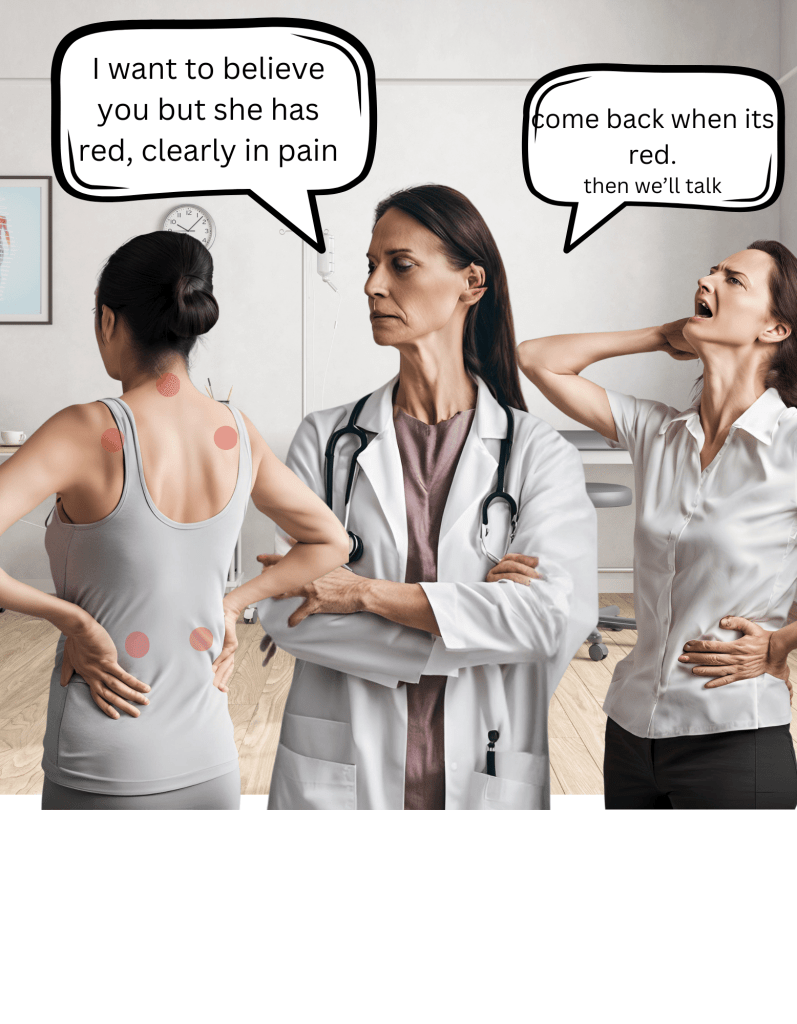
Medical PTSD is what happens when repeated negative experiences with healthcare providers leave you emotionally scarred. It’s not just about a bad appointment here or there—it’s about the trauma that builds up over time when your pain or symptoms are brushed off as “nothing” or “all in your head.” Spoiler alert: it’s not in your head.
For many of us with invisible illnesses, this is an all-too-familiar story. Bloodwork comes back fine? Must be nothing. Physical exam looks normal? You’re probably exaggerating. And suddenly, you’re left questioning your own reality because someone with a stethoscope couldn’t see what you’re feeling every single day. The number of times I’ve left a doctors appointment shaking my head saying ‘well, I mean if it WAS something wouldn’t they see it?’ No, thats not true, some stuff is tricky and it hides behind stuff. Some times you have to poke around at stuff until you figure it out, that doesnt mean things arent there to find.

Truth Bomb: Invisible Doesn’t Mean Imaginary

Here’s the thing: just because something doesn’t show up on a test doesn’t mean it isn’t real. Fibromyalgia doesn’t light up on an X-ray. Bipolar disorder doesn’t leave a trail in your bloodwork. Autism and ADHD don’t come with flashing neon signs saying, “Hey, I’m here!” But that doesn’t make them any less valid—or any less debilitating.
I can’t tell you how many times I’ve walked into an appointment armed with symptom logs, research, and sheer determination, only to be met with raised eyebrows and the dreaded “It’s probably just stress.” Or, ‘well you DO have Fibro’ Oh really? Because last time I checked, Fibromyalgia didn’t cause my hip to stage a full-blown mutiny (looking at you, early retirement hip).

The Emotional Toll of Being Dismissed

Let me paint you a picture: You’re already dealing with chronic pain, fatigue, mood swings—basically the greatest hits of invisible illness. Then you muster up the courage to seek help (because let’s be honest, even making the appointment feels like climbing Everest). You sit there, vulnerable and hopeful, only to be told your symptoms don’t add up or aren’t serious enough to warrant concern.

That kind of dismissal doesn’t just sting—it leaves scars. Over time, it can make you hesitant to seek care at all. Why bother if no one’s going to listen? But here’s the kicker: avoiding care can lead to worsening symptoms and even more complex health issues down the line. It’s a vicious cycle that needs to stop.

Breaking the Cycle: Advocacy and Awareness

So how do we fix this mess? For starters:

Trust Your Gut: If something feels wrong in your body, it probably is. Don’t let anyone convince you otherwise.

Document Everything: Keep a symptom diary so you have concrete evidence to back up your concerns.

Bring Backup: Take a trusted friend or family member to appointments—they can help advocate for you when you’re feeling overwhelmed.

Seek Second Opinions: If one doctor dismisses you, find another who will listen. Your health is worth fighting for. Though check with your doctors office or hospital system on policies, my doctor of 7 years dropped me because I got one.

And let’s not forget the role of healthcare providers in this equation. Doctors need better training on invisible illnesses—period. They need to understand that just because they can’t see it doesn’t mean it isn’t there. A little empathy goes a long way.

My Own Battle Scars

I’ve got plenty of stories I could share about being dismissed by doctors (and believe me, I will). Like the time I was told my fibro pain was just “overexertion” when I hadn’t done more than shuffle from my bed to the couch all week.
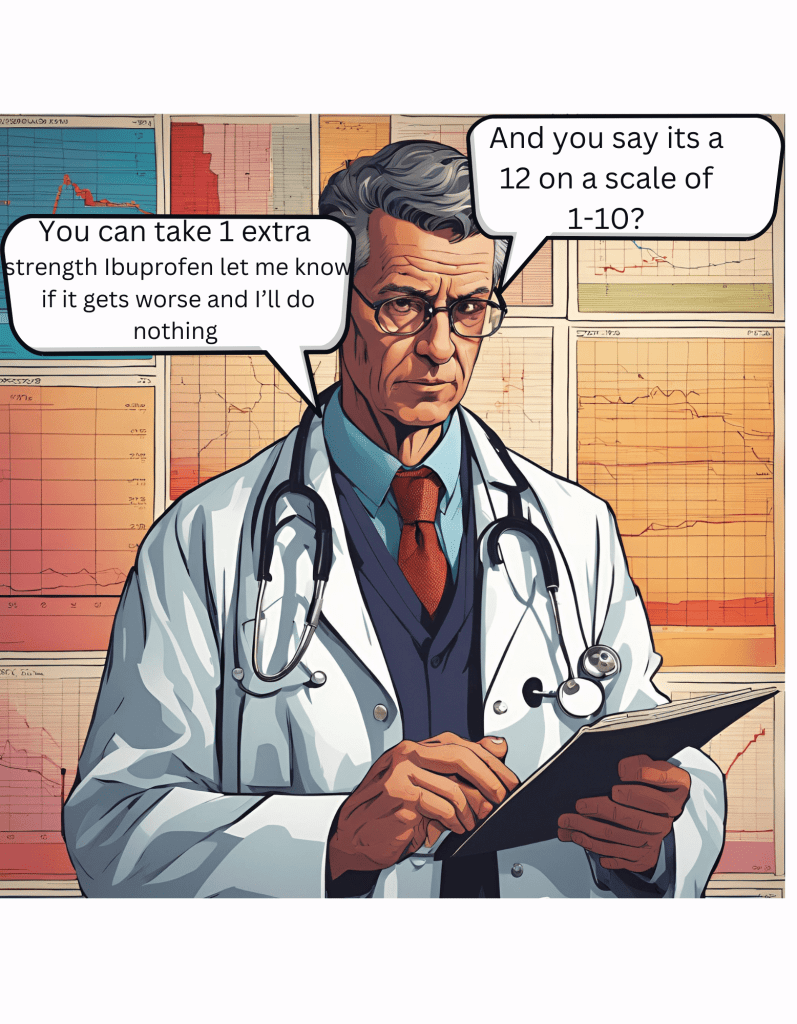
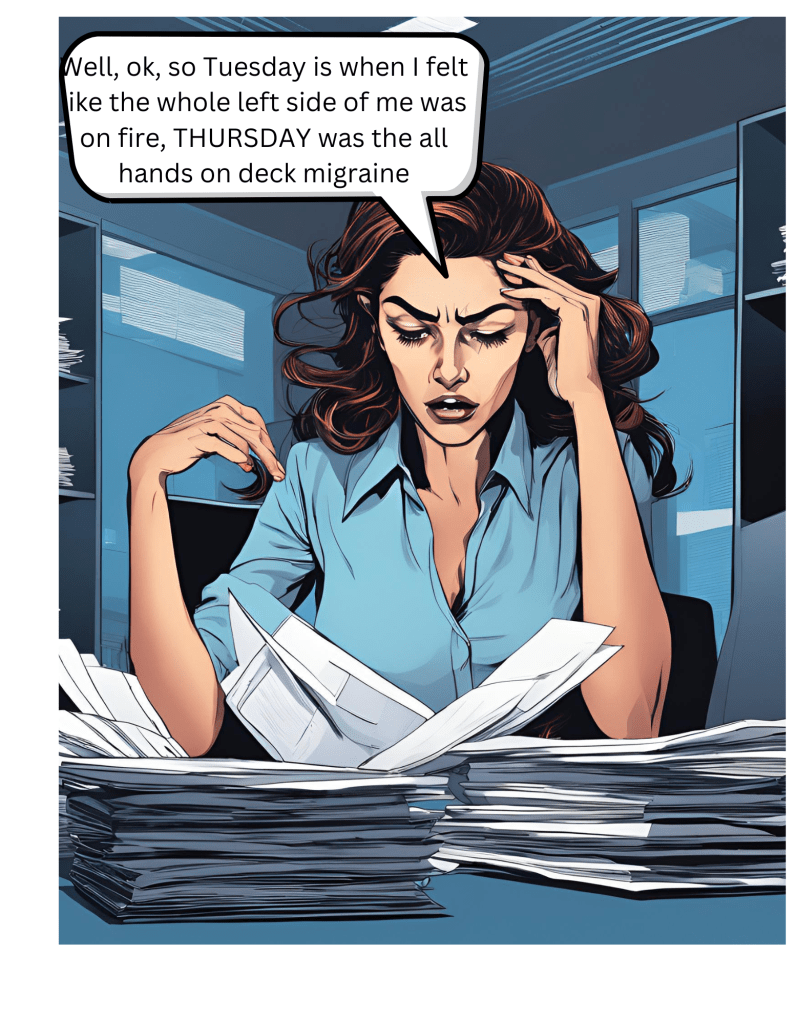
Or when my bipolar symptoms were brushed off as “just moodiness” because I happened to be having a good day during my appointment. Yes its about highs and lows but there is so much nuance and theres no way to catalogue each patient’s symptoms into a graph saying which predominant symptom is worse from day to given day, I don’t even know a metric you could rate them on, its just too much.
But perhaps the most frustrating moment was when my hip—yes, my actual joint—was screaming for help, and I was told ‘Well, fibro is painful.’ said sincerely with a hand on my shoulder (do not touch a fibro sufferer there and expect to be conveying sympathy or empathy, its like my BIGGEST tender point, which I never mentioned SPECIFICALLY so I let it go, but you wouldnt do that)
Spoiler alert: it wasn’t just fibro; it was my hip waving its white flag and demanding replacement parts.

The Bottom Line

Medical PTSD is real, and it’s time we start talking about it. For those of us living with chronic conditions and invisible illnesses, advocating for ourselves isn’t just an option—it’s a necessity. So keep pushing for answers, keep telling your story, and never let anyone make you feel like your pain isn’t valid.Because at the end of the day? We know our bodies better than anyone else ever could. And who can tell your story and explain your pain better than you? Til next time gang, take care of yourselves, and each other!

Uncategorized

In My Broken Era…

Gather ’round fellow sufferers, for a tale of bodily betrayal that’ll make you laugh, cry, or maybe both – because let’s face it, sometimes that’s all we can do when our parts start throwing in the towel! Welcome to your 40s, folks – that magical decade when your body parts start sending out retirement notices faster than you can say “midlife crisis.” It’s like they all got together for a secret meeting (probably while I was napping – thanks, fibro!) and decided, “Hey, we’ve been busting our butts for decades. Time to clock out and let the young’uns take over.”
Now, I’m no stranger to the ol’ body part eviction notice. My colorful past has led to more parts being removed than I care to count. I’m basically a walking “Lost and Found” box at this point. But just when I thought I was done playing Operation with my own body, my hip decides to join the exodus.

There I am, minding my own business (okay, probably complaining about something else hurting, cuz fibro), when BAM! My hip sends in its resignation letter. It’s done. Finito. Sayonara. My hip’s basically like, “Listen, lady, I’ve put in my hours. I’ve carried your sorry ass around for 40+ years. It’s time for me to hang up my hat and enjoy some R&R. Maybe take up golfing or start a hip-hop career. Get it? Hip-hop?”

This trusty joint of mine has been putting in some serious overtime, and let me tell you, it’s been doing it without so much as a coffee break or a “Hip of the Month” plaque. For years, it’s been the unsung hero of my body’s workforce, carrying me through my fibro flare-ups, cat-chasing adventures, and those days when getting out of bed felt like scaling Mount Everest.But somewhere between the thousandth grocery bag lift and the millionth “I swear I’m not limping, I’m just walking with style” stride, my hip started getting a bit… well, hip-ster. It began demanding things like “rest” and “proper alignment” – the nerve! It’s like it suddenly remembered it had rights or something

When it started troubling me I faced the obstacles that are sadly all too familiar to my fellow warriors, I take this new concern to the doctor, it was initially just brushed off with ‘yes fibro is chronic pain’. Then two years after that, with me consistently saying it hurt DIFFERENT than the fibro, she ordered an x-ray since it was such a weird but steadily getting worse pain and the scan showed moderate osteoarthritis. Not curable and one of those ‘just gonna hurt’ pains. Fast forward three years, finaly got another x-ray that reclassified my OA status is severe and severe enough to put me on the hip replacement list. Color me terrified.

Not every pain we have is fibro related. I understand how easy it can be to dismiss our symptoms as ‘just fibro’ or ‘just stress.’ But we know our bodies, and sometimes what feels like one condition is actually something more. Don’t let anyone invalidate your experience. If you feel something isn’t right, advocate for yourself and push for the care you deserve. Our voices matter, and we deserve to be heard when it comes to our health.

So here I am, facing down a hip replacement way too young thanks to fibro, and thanks to the car hitting me when I was walking. Because apparently, I’m an overachiever even when it comes to falling apart. But hey, look on the bright side – at least I’ll have a shiny new bionic part to add to my collection. Maybe I’ll even get a punch card: “10 surgeries and the next one’s free!” I’m probably up to that by now LOL.

The Moment of Truth: Cysts and No Hope for Fixing It

So, what happened next? Oh, just a little something called “The Moment of Truth: Cysts and No Hope for Fixing It

So, what happened next? Oh, just a little something called “subchondral cysts otherwise known as bone cysts.” Because apparently, my body wasn’t just aging gracefully—it decided to throw in some uninvited guests to make things extra fun. The cysts basically sealed the deal. My hip wasn’t just aging out; it was actively failing on me. After an x-ray, my ortho looked at me and said, “Oh honey, this is severe. There’s no saving this one.”

That was it. No shots, (and I had been putting off getting shots for the pain actually, was finally strong enough in my belief that I could do it and I had no more options since I won’t take narcotics) no pills, no more easy fixes. It was time for major surgery—a hip replacement. And honestly? It felt like a bit of a gut punch, but also a relief. I mean, I’d been working with a hip that was basically clocking out without telling me, so now it was time to send it into official retirement.”

Retirement Offer: The Hip Replacement Option

This is where things got real. I thought I could push through, maybe try some shots or other treatments, but nope, that wasn’t going to be enough. The hip sent a strong message that no amount of cortisone was going to keep it in the game any longer. And after consulting with my ortho, we discovered that my old hip wasn’t just tired—it was severe. So, we started the paperwork. A hip replacement is on the horizon.

I look forward to the end of March, that will be near the official day that my hip clocks out for good, and a shiny new joint will step in to take its place.
So, What’s Next?

Aging might be inevitable, but a hip replacement can be a total game-changer. And while I’m not thrilled about the process (did I mention I almost passed out twice during the initial consult?), I’m ready to get that shiny new hip and hopefully say goodbye to some of this pain.

Here’s the thing: The body’s not like it used to be in your 20s and 30s when you could run full speed and wake up feeling like you just slept in a cloud. Nope, my body is now sending in its retirement applications early, and I’m here for it—with a little humor and a lot of prep work, of course.

In the upcoming posts, I’ll share more details about what the process actually looks like: from the pre-op checkups to the (probably highly entertaining) recovery phase. So, if you’re someone who’s looking down the barrel of your own hip replacement, or you just want to see how this unfolds (because who doesn’t love a good recovery journey?), stick around! Maybe my hip will send me a post card lol. Til next time gang, take care of yourselves. And each other.

Uncategorized

Fibromy-thbusters? Mythbusters Fibro Edition

Top Five Most Common Myths about Fibromyalgia

1. Misconception: Fibromyalgia is just “in your head” or not real.
Truth: Fibromyalgia is a real, chronic medical condition that affects the central nervous system. It’s characterized by widespread pain, fatigue, and other symptoms that are definitely not imagined. It’s scientifically recognized and impacts both physical and emotional well-being. Science backs us up on this one, folks.

I can sometimes understand why people might not get it—if I’m having a good day and I’m active, I probably look like your average Midwestern mom. I mean, maybe I should just get an “F” tatted on my forehead? I’ve thought about it. The number of doctors who’ve been dismissive of my very real condition is almost as high as the number of people who are shocked when they hear about my bipolar diagnosis. Clearly, they haven’t seen the rapid mood swings or heard me say, “But you’re sad?” to which I’ll reply, “Yes, amazingly, I can be both sad and manic at the same time, and trust me, it’s a million times worse.”

But I digress. Let’s keep up here—it’s 2025, and fibromyalgia has been a diagnosable illness since 1976. Before that, it was known as fibrositis in 1904, and even earlier, it was referred to as rheumatism. I mention this because, although no one knows exactly what causes it, I’ve been diving into my genealogy—yes, I’m a bit of a nerd—and checking birth and death records to compare what I know versus what I think I know. In the process, I’ve noticed that at least six of my direct ancestors had some form of fibro or rheumatism.

Do I think fibromyalgia will kill me? No—honestly, I have more pressing health concerns to worry about—but it’s been around for a long time. If you come across a medical professional who doesn’t think fibro is real, get a second opinion.
And just to clarify: I’m talking about someone who doesn’t believe fibro even exists—not someone who doubts it’s what you’re suffering from. I’ll say it again: a second opinion never hurts… though, in my case, I had my doctor of 7 years drop me for getting one. So stay informed, don’t get discouraged, and keep pushing until you get the answers you deserve.

2. Misconception: Fibromyalgia is the same for everyone.

Truth : Fibromyalgia is like a box of chocolates, you never know what you’re gonna get. Sure, we’ve all got the greatest hits – pain that feels like we’ve gone ten rounds with a heavyweight champ and fatigue that makes sloths look energetic. But beyond that? It’s a grab bag of fun surprises.
Some of us are walking zombies thanks to sleep issues, while others are living in a fog so thick you’d think we’re extras in a horror movie. And don’t even get me started on the triggers. What sets off my fibro might not even tickle yours.
This is why docs often treat fibro like the ‘rule it out’ illness. They run every test under the sun, and when everything comes back squeaky clean, they throw up their hands and say, “Must be fibro!” I wonder how many times that phrase was said by a doctor to a person who died from something that should have been caught.
Wouldn’t it be peachy if we could all agree on what fibro looks like? Maybe then we’d have a magic pill or a cure. Hell, I’d settle for a flashing neon sign that says, “Fibro flare incoming!” But nope, that’s not how this beast rolls.

3. Misconception: People with fibromyalgia are just “lazy.”

Truth: People with fibromyalgia often experience extreme fatigue that is not relieved by rest. This can make daily activities feel overwhelming and exhausting, but it’s not a matter of laziness—it’s a physical condition that affects the body’s ability to generate energy and recover.
Picture this: you’ve just “slept” for 10 hours, but you feel like you’ve been awake for days, You drag yourself out of bed, feeling like you’re moving through molasses, and even the simple act of making a cup of coffee feels like you’re scaling Mount Everest. That’s fibro fatigue, folks.

This isn’t about being lazy or needing an extra cup of coffee. It’s your body throwing a full-on rebellion, refusing to generate the energy you need to function like a normal person. And let me tell you, it’s beyond frustrating.

The kicker? This fatigue doesn’t play fair. It doesn’t care if you’ve rested, slept for 12 hours, or spent the day binge-watching your favorite show. It’s always lurking, ready to sucker-punch you when you least expect it. And no matter how mad I get at myself, once I’m in a funk its necessities only and they tend to relate to immediate family, so the things I don’t get done pile up until they become daunting to the point that I don’t know where to start so I just DON’T start. Executive dysfunction at its best folks.

So next time you see someone with fibro canceling plans or looking like they’ve been hit by a truck, remember: we’re not being flaky or dramatic. We’re just trying to navigate life with a body that’s forgotten how to recharge its batteries. It’s not laziness—it’s our reality, and we’re doing our best to push through it every single day.

4. Misconception: Fibromyalgia only affects older people.
Fibromyalgia is also not limited to adulthood—children and adolescents can be diagnosed with it, though this is relatively rare. According to the American College of Rheumatology, fibromyalgia in children and teens often presents differently than it does in adults, with symptoms like widespread pain, fatigue, headaches, and difficulty concentrating (often referred to as “fibro fog”). The challenges with diagnosing fibro in younger individuals are compounded by the fact that many of these symptoms overlap with those of other conditions, making it harder to pinpoint fibromyalgia as the cause.

In younger patients, symptoms may be mistaken for growing pains or other childhood illnesses, which can delay a correct diagnosis. The National Fibromyalgia Association states that fibromyalgia in children may be underdiagnosed, partly because doctors may attribute symptoms like tiredness or pain to more common, non-chronic conditions. Additionally, children may struggle to articulate how they’re feeling, which can make diagnosis even more difficult.

Fibromyalgia can occur at any stage of life, and its symptoms vary widely. While some people may have mild discomfort, others experience debilitating pain and fatigue that severely impacts their daily lives. As the condition often fluctuates in severity, it can be hard to predict its long-term course.

It’s important to note that the cause of fibromyalgia is still not fully understood, though genetics, infections, physical trauma, and emotional stress are thought to contribute to its development.

5. Misconception: There’s no treatment for fibromyalgia.

You’ve probably heard there’s no treatment for this beast, right? Well, hold onto your hats, because that’s about as true as saying chocolate isn’t a food group.
Sure, we don’t have a magic wand to make fibro disappear (believe me, I’ve looked). But we’ve got a whole arsenal of tricks to keep this monster at bay. It’s like playing whack-a-mole with your symptoms, but hey, at least we’re not sitting ducks!
First up, we’ve got meds. From your garden variety pain killers to fancy-pants antidepressants and anti-seizure meds, there’s a buffet of options. These bad boys can help tame the pain and maybe even let you catch some Z’s without feeling like you’ve been hit by a truck.
Then there’s physical therapy and exercise. I know, I know, the thought of moving when everything hurts is about as appealing as a root canal. But trust me, a little moderate exercise can work wonders. It’s like giving your body a tune-up.


And let’s not forget about the mind game. Cognitive-behavioral therapy isn’t just for when you’re feeling blue. It’s like a personal trainer for your brain, helping you outsmart the pain and stress.
Now, for the lifestyle changes. Getting enough rest, eating right, and practicing good sleep hygiene might sound like advice your grandma would give, but don’t knock it ’til you’ve tried it. It’s amazing what a difference these can make.
For those feeling a bit adventurous, there’s always acupuncture and massage. It’s like a spa day, but with actual health benefits. Who knew getting poked with needles could feel so good?
The key here, my fellow fibro warriors, is to mix and match. It’s like creating your own personal fibro-fighting cocktail. What works for me might not work for you, and that’s okay. We’re all unique snowflakes in this blizzard of pain.So don’t let anyone tell you there’s no hope. We might not have a cure (yet), but we’ve got options. And in this fibro fight, options are our secret weapon. Now, go forth and conquer my friends, Until next time take care of yourselves, and each other.
Uncategorized

Navigating the Healthcare Maze

A Patient’s Perspective on Medication Refills and Advocacy

As someone living with chronic conditions, I’ve learned that managing medications can be as challenging as managing the illnesses themselves. We trust healthcare providers and pharmacies to support us in maintaining our health and well-being, but when systems break down, the consequences can be painful, frustrating, and even dangerous. Recently, I experienced a frustrating series of events that highlight the need for better patient advocacy and streamlined processes in our healthcare system.

It started with a simple refill request for a medication I’ve been taking for years. What should have been routine turned into a week-long ordeal of pharmacy stock issues, doctor unavailability, and communication breakdowns. I found myself caught between pharmacies and medical offices, desperately trying to avoid withdrawal symptoms while also dealing with an unrelated infection.

I ordered a necessary medication refill on a Tuesday, as part of my routine care plan. I do it regularly every month. By Friday, (note they’d had it 3-4 days at this point, I didnt run out of meds UNTIL Friday) I went to pick it up, only to find that the pharmacy was out of stock. I was told to speak to the pharmacist if the medication was urgent, so I did. However, I was then told that in order to fill the prescription at another pharmacy, I would need a new script from my doctor. But my doctor historically wasn’t available on Fridays.

That weekend, I became unwell. I went to urgent care, where I was diagnosed with an unrelated infection. But alongside my infection, I experienced symptoms of withdrawal—symptoms caused by the missing medication. I immediately sent my doctor a message explaining what had happened and the withdrawal symptoms I was experiencing. I have been under her care since 2017, and she had approved my prescription months ago. There was nothing new or unusual about this situation—this was the same medication I had been prescribed and that I had ordered on Tuesday.

Despite this, my doctor’s office was silent. I continued to feel the effects of withdrawal, unable to eat properly or function without pain. It wasn’t until Tuesday that I finally reached out to the office, explained the situation, and asked for guidance. After some persistence, the office confirmed that they would cancel the Walgreens order and send the prescription to Walmart instead.

But still, nothing happened. By Wednesday afternoon, I received a vague message that gave me the sense that my situation was not urgent or important. (A professional way of saying, your situation is not a priority, she’ll get to it when she gets to it, and believe me, I’m not saying I’m a priority or better than anyone, I am saying MY SITUATION merited a closer than fleeting glance) I had been without my medication for almost a week, and I was truly suffering. Yet, when Walgreens finally called to let me know they had restocked the medication, I immediately called and told the doctor’s office and asked what do I do? She told me not to pick it up from them. They implied that doing so might make me look like I was trying to “beat the system.”

I was simply trying to manage my chronic illness with the medication that had been prescribed to me, a treatment I’ve been using for years. The lack of communication from my doctor’s office made the situation even more exasperating. My health was deteriorating, and yet, I was met with suspicion and delay.

Then, as it was a Friday and I thought the doctors office wasn’t going to respond because it was a Friday I made the decision to pick up the medication from Walgreens anyway, I received an unexpected message from the doctor’s office: they had approved my prescription and were sending it to Walmart. By then, I had already gotten the medication from Walgreens, I of course immediately called the office felt compelled to make it clear that I picked it up. That morning in fact. Then I said I wanted everything handled through Walmart from that point on. This wasn’t an issue of seeking special treatment; it was a matter of ensuring I had access to the medication I needed, which I had been prescribed and ordered in advance.

This experience has shed light on the urgent need for better patient advocacy, both from healthcare providers and pharmacies. Policies and protocols need to be in place to handle situations like this—where patients are at risk of going without crucial medications and the healthcare system fails to support them. When withdrawal symptoms are involved, or when a patient’s medical condition is chronic and requires ongoing treatment, a system should exist that ensures no patient is left in limbo or subjected to unnecessary delays. Communication should be clear, swift, and consistent. When a patient is suffering, there should be a concrete backup plan for emergencies, so that healthcare providers and pharmacies can act quickly to prevent harm.

Unfortunately, my experience with the healthcare system didn’t end there. After seeing how badly I was struggling, my husband urged me to see his doctor, hoping they could offer more support. His doctor is part of the same hospital network, so we made an appointment and explained the situation, he did not think changing to his doctor would make anything worse, he just felt that I deserved better treatment. To his surprise (but sadly not mine), the doctor, without even fully understanding my medical history, immediately dismissed my need for pain medications. She suggested I visit a pain clinic, something I had done years ago, only to be treated like a criminal.

The doctor seemed unconcerned with the fact that I’ve been managing chronic pain from fibromyalgia, a condition with no cure, for years. I explained that I avoid narcotics—especially opioids—due to my previous history. I have not taken opioids since my heart stopped in 2017. Yet, this doctor treated my use of a non-narcotic medication like (L) as if it were just another attempt to get high.

So, how do we move forward? What needs to change to ensure that no patient is left without the care they need?

  • First, healthcare systems must implement clear protocols for handling medication issues and withdrawal symptoms. Providers and pharmacies alike should be trained to recognize the urgency of these situations and act swiftly.
  • Second, patients need better access to advocacy resources and should never feel like they’re fighting an uphill battle to receive their prescribed treatments.
  • And lastly, healthcare providers should understand the real, lived experiences of their patients, especially those dealing with chronic illness.

I’m ready to get started on making these changes happen. There are many moving parts, but with enough support and awareness, we can begin to create a more compassionate, responsive healthcare system for everyone. This is about more than just medication—it’s about treating patients with dignity and respect. This fight isnt only chronic pain, its anyone who takes a prescription they will have withdrawal from. I’m hoping to start/join a community and make a difference. Until next time gang. take care of yourselves, and each other.