Uncategorized

Signs You’re Pacing Your Energy Correctly (Even If It Feels Like You’re Doing Nothing)

If you live with chronic illness, neurodivergence, or both, pacing your energy can feel suspiciously like… failing. We’ve been conditioned to believe that productivity equals worth, and rest is something you earn after pushing yourself to the brink. Spoiler alert: that mindset is garbage — and it actively works against bodies and brains like ours.

Energy pacing isn’t about doing less because you’re “giving up.” It’s about doing what keeps you functioning tomorrow. And sometimes that looks like absolutely nothing from the outside.

Here are signs you’re actually pacing correctly — even if it doesn’t feel impressive.


1. You Stop Before You Crash

If you’re resting while you still technically could keep going, congratulations — you’re doing it right. Pacing means stopping at the “I should probably rest soon” stage, not the “I have made a terrible mistake” stage.

Ending an activity while you still have a sliver of energy left isn’t weakness. It’s strategy.


2. You Plan Rest on Purpose

Rest isn’t something that “just happens” anymore. It’s scheduled. Protected. Sometimes defended like a feral raccoon.

If your calendar includes intentional downtime — especially after appointments, errands, or social interaction — that’s not laziness. That’s advanced-level self-management.


3. Your Week Looks Boring but Survivable

A paced week doesn’t look exciting. It looks quiet. Repetitive. Underwhelming.

And that’s the point.

If you’re no longer stacking five demanding things in one day and calling it “normal,” you’re learning how to live within your limits instead of constantly bulldozing them.


4. You Say No Without a Full PowerPoint Presentation

You don’t owe anyone your medical history, trauma background, or a five-paragraph explanation for why you can’t do something.

If you’re starting to say “I can’t” or “That won’t work for me” without spiraling into guilt — that’s growth. Messy, uncomfortable, necessary growth.


5. You Recover Faster Than You Used To

Maybe you still flare. Maybe you still crash. But if the recovery time is shorter than it used to be — that’s pacing working.

Progress with chronic illness is often measured in less severe consequences, not total avoidance.


6. You’re Choosing the Easier Option Without Shame

Delivery instead of cooking. Grocery pickup instead of the store. Frozen food instead of scratch meals. Sitting instead of standing.

If you’re choosing accessibility over aesthetics, you’re not “giving up.” You’re adapting. And adaptation is how people survive long-term.


7. You Feel “Unproductive” but Less Destroyed

This one messes with people the most.

If you feel like you didn’t do much, but you also didn’t completely wreck yourself — that’s a win. A quiet one. An invisible one. But a real one.


8. You’re Thinking About Tomorrow, Not Just Today

Pacing means asking, “How will this affect me later?” instead of “Can I force myself through this right now?”

If future-you is part of your decision-making process, you’re playing the long game — and that matters.


Final Thought

Pacing doesn’t look heroic. It doesn’t get applause. It doesn’t fit hustle culture or toxic positivity.

But it keeps you alive, functional, and able to show up again.

You are not doing nothing.
You are managing a body and nervous system that require intention, restraint, and care.

And honestly? That’s not weakness.
That’s skill. Til next time gang, take care of yourselves, and each other!


Uncategorized

🧩 11 Things I’ve Accepted I’ll Never Have Together (And That’s Okay)

There comes a point in every adult’s life where you stop chasing perfection and just start chasing peace.
Mine came somewhere between my third “lost laundry sock” breakdown and realizing that meal planning for the week doesn’t make my brain any less chaotic.

So here are 10 things I’ve fully accepted I’ll never have together — and honestly, I’m fine with it.


1. My Sleep Schedule

Some nights I’m out cold by 9. Other nights, I’m rearranging my thoughts (and furniture) at 2 a.m. Balance? Never met her. My problems are in those wee hours of the morning but my issues are waking up no later than 4, even if I dont fall asleep til 3. Its maddening.


2. Laundry

There’s clean, there’s dirty, and there’s “on that chair I swear I’ll fold tomorrow.”
Spoiler: tomorrow’s been rescheduled indefinitely.


3. My Phone Storage

I can delete exactly 400 screenshots and still have “not enough space.” I think the memes multiply when I’m not looking.


4. Matching Socks

At this point, I’m calling it fashion. If my socks are both clean, that’s a win.


5. My Inbox

Some people zero out their email every night. I zero out emotionally about my email every night.


6. That One Junk Drawer

It’s basically a time capsule for expired batteries and mystery cords from 2008.


7. My Brain’s Tabs

They’re all open. None of them are loading. I’ve accepted it’s just part of my operating system.


8. My To-Do List

For every item I cross off, three new ones appear like hydra heads. Productivity is a myth perpetuated by people with working serotonin.


9. My Diet

Sometimes it’s vegetables and lean protein.
Sometimes it’s cold pizza and vibes.
It’s called balance, baby.


10. The Idea of “Having It Together”

Turns out, nobody does. Some just accessorize their chaos better.
So here’s to letting go, laughing at the mess, and knowing that imperfect is still enough.

11. My Posting Schedule

I love sharing my thoughts and connecting with my community — but some days, the mental energy just isn’t there.
And that’s okay.
Skipping a post doesn’t mean I’m lazy or unreliable; it means I’m human. listicles are just easier to do when your brain wont shut up enough to do any research or even just have the mental capacity for boring depressive stuff. I’m trying to keep it up beat and hold it all together. Sometimes “taking care of business” looks like closing the laptop, eating something carb-loaded, and giving my brain a breather.


💭 Final Thought:

You don’t have to fix everything to be doing okay.
Sometimes the healthiest thing you can do is stop fighting the tide and just float for a bit.Til next time gang, take care of yourselves, and each other.

Uncategorized

The Social Hangover: Why One Family Gathering = Three Business Days of Recovery

I did a thing.

I put on jeans. Yes, actual denim. Not “leggings that whisper about being pants if you squint hard enough.” Real jeans. Then, because apparently I like to cosplay as a functioning human, I added makeup. First time in two years. Even did my hair. Honestly, I could’ve stopped there and deserved a medal.

But no, I had a mission: drive three hours each way to see my sister, hand-deliver the painstakingly perfected gifts I’d been working on for weeks, and socialize with more humans than my hermit soul has encountered in… possibly a decade for my sister and grand niece.

Let me tell you, the event itself? Lovely. The invite? Appreciated. The people? Wonderful. The food? Chef’s kiss. My energy afterward? Dead. Buried. Ghosted.

Here’s the unglamorous math nobody tells you:

  • Prep time: two weeks of stressing, shopping, and crafting gifts.
  • Cosmetic upgrades: one hour to transform into “someone who looks like she has her life together.”
  • Event length: six hours in the car, plus a full day of interaction.
  • Recovery time: estimated three to five business days, maybe longer. Please hold.

Today, I’m the human equivalent of a phone stuck on 2% battery with a broken charger. Hollow, sluggish, vaguely resentful at the concept of standing upright. And yet… this is the price of admission when you leave your cave.

So if you’re also lying in bed after “a fun day,” wondering why your body feels like you ran a marathon while juggling flaming swords, let me reassure you: you didn’t imagine it. Social hangovers are real. Spoon debt is brutal. Jeans are a weapon of mass destruction.

Recovery Day Survival Tips (a.k.a. How to Human Again After Too Much Humaning)

  • Hydrate like it’s your new religion. You just sweated out three weeks’ worth of electrolytes socializing.
  • Eat something that doesn’t come in a crinkly wrapper. (No shame if it does, but bonus points for real nutrients.)
  • Lay flat. On the bed, the couch, or the floor — whatever’s closest when you collapse.
  • Noise-cancel the world. Earplugs, headphones, or just a dramatic blanket burrito.
  • Cancel productivity. Laundry and dishes can wait. Your nervous system cannot.
  • Gentle motion only. Stretching, slow walks, or the ceremonial shuffle to the fridge.
  • Remember: jeans are optional for the rest of your life.


Tomorrow I’ll probably be fine(ish). But today? Today is about recovery, snacks, and swearing off denim forever. Til next time gang, take care of yourselves, and each other.

Uncategorized

What Rest Feels Like When You’re Used to Being in Crisis

Rest is weird.

Let’s just start there. Because when your baseline is fight-or-flight, freeze-or-fawn, dissociate-or-die-trying… “rest” doesn’t always feel peaceful. Sometimes it feels like guilt. Or like you’re forgetting something. Like you’re doing life wrong.

If you’ve lived in survival mode for months or years—or forever—it’s not just that you don’t rest. It’s that you’ve forgotten what real rest is supposed to feel like.

1. Rest Feels Like Uncertainty at First

The first few minutes of trying to rest when you’re used to chaos? Horrible. It’s like the world got too quiet and suddenly your brain is staging a protest:

  • “Shouldn’t you be doing something right now?”
  • “Is the other shoe about to drop?”
  • “Are you being lazy or just conveniently forgetful?”

I have terrible self talk and my therapist always has me ‘reframe’ things. Turns out, your nervous system isn’t sure what to do when it isn’t in go-go-go mode. It gets twitchy. Suspicious. Like a cat in a bathtub.

2. Rest Can Look Lazy When It’s Actually Life-Saving

Rest isn’t always bubble baths and soft jazz. Sometimes rest looks like staring at the ceiling, numb and unmoving, because that’s all your body can manage. And that counts. Especially when you’re healing.

Some people take naps. Sometimes I can but I keep naps under an hour if exhaustion hits.
Others… collapse. I’ve done that. I’ve driven cross country 21 hours and legitimately passed out cold. I was apparently parked in front my aunt’s neighbors tennant’s garage and they banged on the window, clearly seeing me sleeping on the couch and not hearing them. LOL They thought I was dead,

Same nervous system need, just wearing different outfits.

3. Rest Doesn’t Mean Everything Is Fixed

Here’s the kicker: you can be exhausted and doing nothing. That’s not failure. That’s biology catching up.

Rest doesn’t mean you’re healed, fixed, or suddenly energetic. Though it helps when the goal is reached. Sometimes it’s just the space between breakdowns. And that’s okay. That’s real. That’s progress, even if it doesn’t sparkle.

4. Rest Can Feel Like Withdrawal

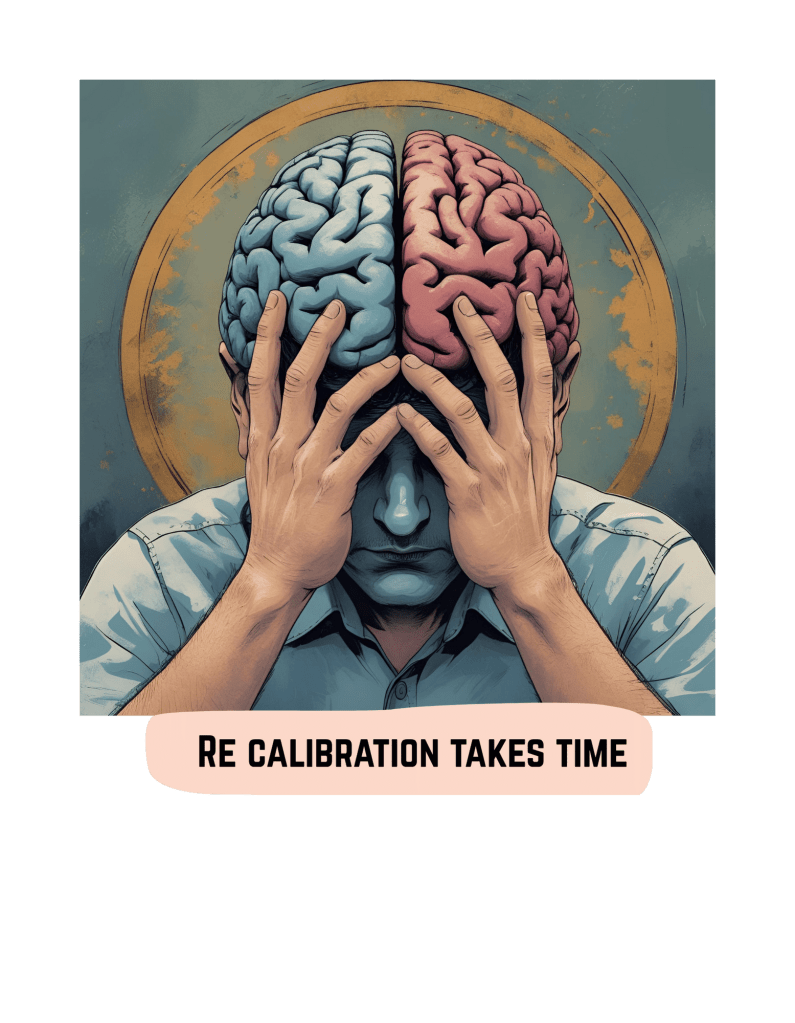
When adrenaline has been your main fuel source, rest can feel like crashing after a sugar binge. You may feel down, irritable, even achey. You’re not broken. Your brain’s just recalibrating. Imagine detoxing from chaos. That’s what this is. Detoxing from adrenaline.

5. You Might Feel Worthless While Resting—But You’re Not

This one cuts deep: “If I’m not producing, I’m not valuable.” Sound familiar?

That’s a trauma belief, not a truth. My eyes were opened with this little nugget, my therapist was the one who started it, and I did believe no one cared about me unless I did things for them, even though I love people without calculating what they can do for me, my brain was hard-wired to tell me I was worthless and I STILL have more days I believe the bad over the good about myself. Curious to see how many of you guys have felt that way too.

We live in a society that measures worth by productivity, but healing means learning your value exists even when you’re still. Even when you’re not doing. You don’t have to earn your rest. You deserve it because you’re human and thats hard enough.


So How Do You Learn to Feel Rest?

Gently. And over time.

Here are a few ways to start:

  • Name it. Tell yourself, “I am resting right now,” even if it feels like loafing.
  • Track your thoughts. Notice when guilt or shame show up. Are they old scripts? Keep a journal by your bed and write whats bothering you down before you lay down so you know you can work on it tomorrow.
  • Set tiny rest rituals. One song. One stretch. One sit on the porch. Practice. One little thing, whatever it is, that gets your mind to stop spinning and rest.
  • Celebrate doing less. Rest is not a reward. It’s a requirement. Its hard NOT to reward ourselves with rest, thats why we have to re-frame our thoughts how we talk to ourselves.

Final Thought: If You’ve Been in Crisis, You Deserve to Feel Safe in Stillness

That’s the hard part—retraining your body and brain to trust quiet moments. But you can. One awkward attempt at a time. You’re not failing when rest feels weird. You’re rewiring. That’s brave work.

And if no one’s told you lately: you’re doing a damn good job surviving. Now, let’s practice what it means to actually live. It feels like all I’ve done my adult life is to go from surviving one thing to surviving the next, I’m going to try and make more time to look around and enjoy the in between. I’ll keep you posted. If anyone has any tips to help with rest be kind and share it with the class. Til next time gang, take care of yourselves, and each other!