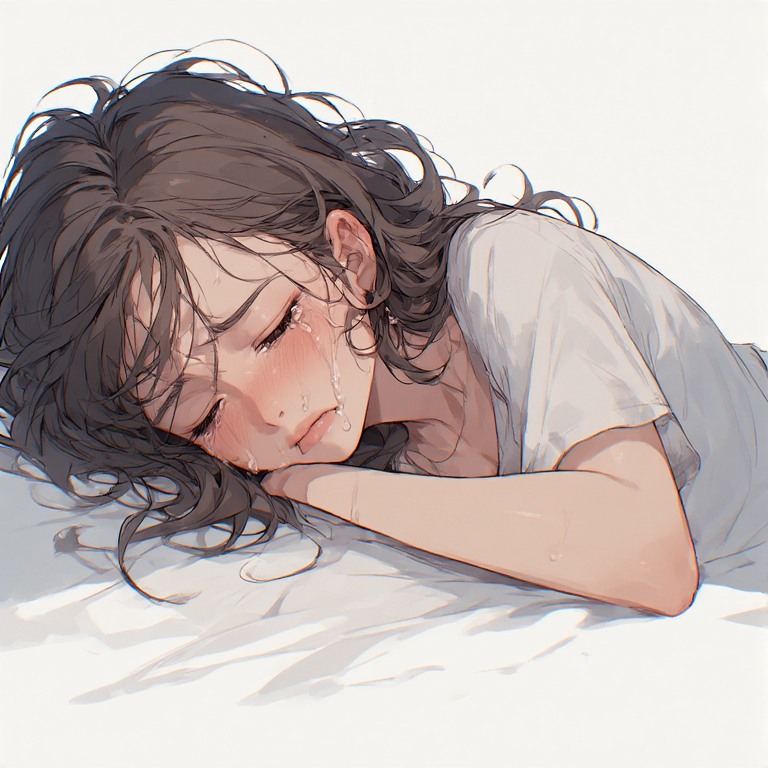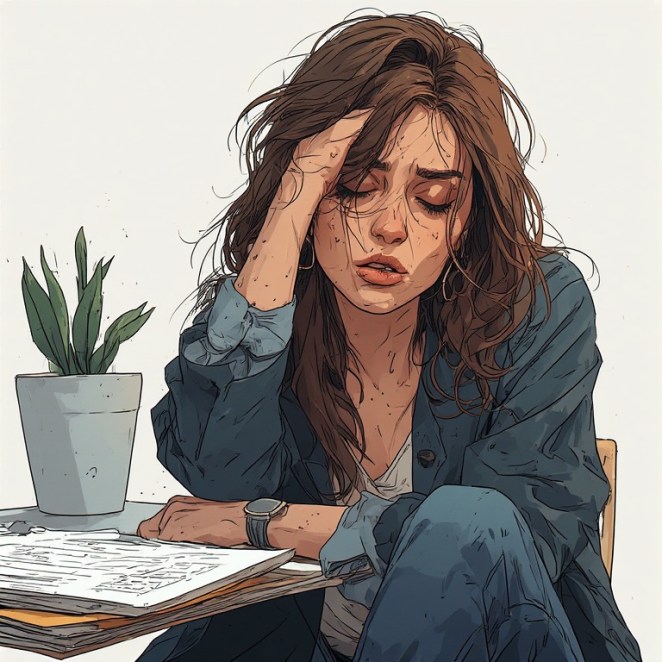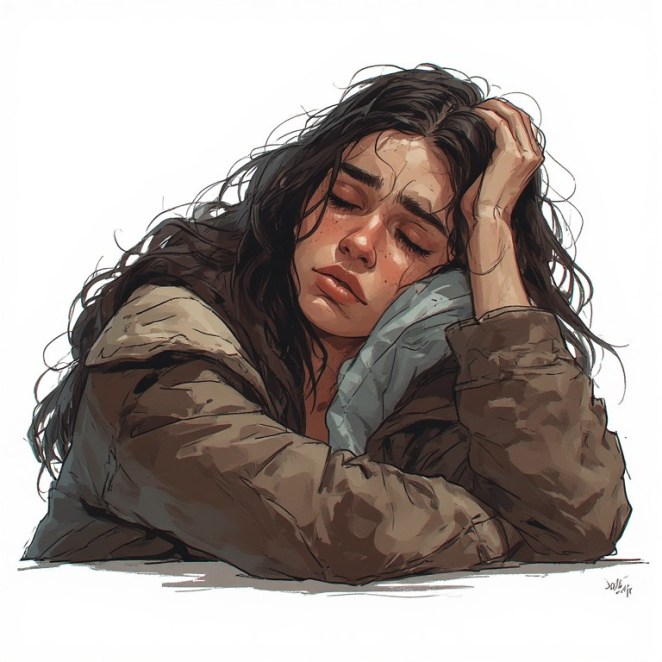
Sometimes I wake up already in pain, which feels rude considering I was unconscious and minding my business.
My jaw aches like I spent the night grinding concrete. My shoulders are locked halfway to my ears. My hands hurt like I’ve been stress-clenching imaginary problems in my sleep (which, honestly, tracks). I didn’t overdo it yesterday. I didn’t injure anything. I just… existed.
This kind of flare doesn’t start in my body — it lands there.
My nervous system wakes up feral. Heart racing. Muscles braced. Skin overly dramatic. Brain fog so thick I could lose a thought mid-thought.
It’s like my body heard a rumor that something bad might happen and decided to prepare for war before confirming the details.
When the nervous system is under prolonged stress, it can amplify pain signals even without new injury — a process called central sensitization. It’s common in fibromyalgia and chronic pain conditions, and it means the pain is real, measurable, and neurological — not imagined or exaggerated.
Here’s the annoying science part: emotional stress doesn’t stay politely in the “feelings” department. It rewires pain pathways, cranks up inflammation, and lowers the threshold for flares. My body doesn’t care if the threat is physical or psychological — it reacts with the same unhinged enthusiasm either way.
So when I say I’m in pain, I’m not being metaphorical. I mean my body is cashing a check my nervous system wrote.
There’s research behind this, by the way. Emotional distress activates the same pain-processing pathways in the brain as physical injury. For people with fibromyalgia or trauma histories, the nervous system can stay stuck in high-alert mode — turning stress into very real, very physical pain.
It looks like moving slower. Canceling plans without guilt (or with guilt, but canceling anyway). It looks like heat packs, silence, and a deep distrust of anyone who suggests I “push through it.” It looks like exhaustion that sleep laughs at and pain that refuses to justify itself with visible damage.
This isn’t weakness. This is a system that’s been on high alert for too long and forgot how to stand down.
Some days the goal isn’t fixing anything — it’s lowering the volume. Fewer demands. Softer expectations. Treating my body like it’s been through something instead of asking it to perform like it hasn’t.
Pain doesn’t always come from injury. Sometimes it comes from carrying too much, for too long, with no off switch. Til next time gang, take gentle care of yourselves, and each other!
The holidays are noisy. Not just with music and parties and people — but with proof. Proof that everyone else seems to be gathering, hosting, laughing, overflowing.
And then there’s your house. Quiet. Still. Too still.
You can be grateful and lonely at the same time. Those aren’t opposites — they’re roommates who don’t speak to each other.
You can know you’re lucky, blessed, resourced, safe… and still feel like something essential is missing. Like the volume of the world has been turned up everywhere else and muted where you are.
That disconnect messes with your head.
Because the messaging is relentless:
Be thankful.
Cherish this season.
Soak it all in.
But what if there isn’t much to soak in? What if you’re not ungrateful — you’re just alone?
There’s a particular kind of loneliness that shows up during the holidays. Not the dramatic kind. The quiet, creeping kind that makes you feel unworthy of love, like if you were easier, better, less broken, someone would be here.
And that’s the lie.
The truth is: Holidays magnify absence. They don’t create it.
Estrangement, distance, grief, illness, burnout — all the things you’ve been surviving all year don’t suddenly take December off. They just get wrapped in twinkle lights and judged harder.
If your house is quiet this season, it doesn’t mean you failed. It doesn’t mean you’re unlovable. It doesn’t mean you did something wrong.
It just means this season is asking something different of you.
Maybe survival instead of celebration. Gentleness instead of gratitude lists. Presence instead of performance.
You don’t have to force joy to prove you’re okay. You don’t have to fake cheer to earn rest. And you don’t have to minimize your pain just because someone else has it worse.
If the holidays are loud everywhere except your house — your quiet is still allowed. Your sadness still counts. And you are still worthy of love, even when no one shows up with cookies and matching pajamas.
Sometimes getting through is enough. Sometimes staying soft in a loud world is the bravest thing you’ll do all season. Til next time gang, take care of yourselves, and each other!
From survival mode to regret, heartbreak to invisibly raging chaos, Taylor somehow finds the words for it all. These lyrics aren’t just clever turns of phrase — they’re mirrors for anyone struggling to be seen, understood, or simply to make it through another day. So the next time your body, brain, or emotions feel like they’re on fire, remember: Taylor’s got a line for that, and so do you. It’s not about whose pain is “worse” or more legitimate — it’s about being seen, validated, and reminded that even in the middle of your messiest moments, you’re still here, still trying, and still worthy of recognition.
“Balancin’ on breaking branches.” — Exile Tell me you live with chronic illness, ADHD, or bipolar disorder without telling me. That line is the daily tightrope walk — trying to look stable while everything underneath you is creaking. You’re functioning, technically… but one more unexpected email, flare-up, or emotional storm and snap. It’s the exhausted kind of resilience that looks impressive from the outside but feels like survival from the inside.
“I’d go back in time and change it but I can’t.” — Back to December, Speak Now Sometimes life leaves you with regrets that can’t be undone. Chronic illness, mental health episodes, or relationship missteps can haunt you, and all you can do is keep going forward while carrying those lessons with you.
“They told me all my cages were mental.” — This Is Me Trying, Folklore Living with invisible illness or neurodivergence can make people question your experience. Taylor nails the frustration of having your struggles minimized or dismissed, even when you’re doing your absolute best to keep it together.
“Love slipped beyond your reaches.” — Champagne Problems, Folklore For anyone navigating relationships while dealing with chronic pain, mental illness, or emotional turmoil, this lyric speaks to those moments when your best efforts simply aren’t enough — and you feel powerless watching connection slip away.
“Did you ever hear about the girl who got frozen?” — Right Where You Left Me, Folklore That’s literally trauma in a sentence. Perfect for describing being stuck in survival mode long after the danger has passed.
“When I was drownin’, that’s when I could finally breathe.” — Clean, 1989 Leave it to Taylor to turn a mental breakdown into poetry. That line perfectly sums up what it feels like when you finally stop pretending you’re fine — when the exhaustion, pain, or chaos finally knocks you flat, and somehow, that’s when you start healing. It’s not weakness; it’s the breath you take after holding it for way too long.
“You made a rebel of a careless man’s careful daughter.” — Mine Generational trauma wrapped in a love song. It’s breaking the patterns you were born into, learning love without fear, and realizing being “the careful daughter” was never the same as being safe.
“Why’d I have to break what I love so much.” — Afterglow For anyone who’s accidentally hurt someone they care about — a child, partner, or even themselves. Chronic illness, emotional overwhelm, or mental health challenges can make us stumble in ways we never intended, and this lyric captures that ache of regret perfectly.
“The room is on fire, invisible smoke.” — The Archer This is what living with chronic illness, PTSD, or anxiety can feel like. Everything in you is alight — panic, pain, exhaustion — but the world sees nothing. Your body aches, your brain races, your emotions combust… and everyone else is just like, “You seem fine.” It’s invisible chaos, and that’s the cruelest part: no one can help fight a fire they can’t see.
“I guess sometimes we all get some kind of haunted.” — Midnight Rain The emotional equivalent of a PTSD flashback, chronic pain flare-up, or neurodivergent meltdown. It’s the moment when your past — trauma, illness, or just life — creeps up on you uninvited. It’s not about reliving the past; it’s about acknowledging that it still lingers.
“I miss who I used to be.” — Would’ve, Could’ve, Should’ve When life steals pieces of you. Chronic illness, mental health struggles, or trauma can leave you staring at the mirror wondering if you’ll ever recognize yourself again. Taylor nails the quiet heartbreak of missing the “you” that existed before pain, betrayal, or illness started rewriting your story.
“How much sad did you think I had in me?” — So Long, London Nails the emotional extremes of bipolar or just being completely maxed out emotionally. That mix of exhaustion, overwhelm, and “I’m still standing, barely” is instantly relatable to anyone with intense mood swings or chronic emotional strain.
“I can go anywhere I want — just not home.” — Exile The heartbreak of estrangement in one line. You build a life, you heal, but that door you once knew as “home” doesn’t open anymore. It’s grief with no funeral, just echoes.
From survival mode to heartbreak, estrangement to invisible chaos, Taylor somehow finds the words for it all. Each lyric shows us we’re not alone in our experiences, that even invisible struggles — chronic illness, mental health battles, neurodivergence, estrangement — are valid and worthy of recognition. So the next time your body, brain, or emotions feel like they’re on fire, remember: Taylor’s got a line for that, and so do you. It’s not a contest about whose pain is “worse.” It’s about being seen, being validated, and acknowledging that even in the middle of your messiest moments, you’re still here, still trying, and still worthy of recognition.
Til next time, gang: take care of yourselves, and of each other.
PTSD isn’t one-size-fits-all, and it definitely isn’t one-story-fits-all. Some people develop it after combat. Others after a car crash, a hospital stay, a toxic relationship, or years of just surviving things that weren’t survivable. The point is — the body doesn’t know why it’s scared. It only knows that something hurt it, and now it refuses to let its guard down again.
And for a lot of us? That means living in a constant state of alert — hypervigilance.
When the Body Becomes the Alarm System
Hypervigilance isn’t about being “paranoid” or “dramatic.” It’s what happens when your brain gets stuck in survival mode. People with PTSD often show increased activation of the amygdala and insula (the brain’s threat detectors), and reduced regulation from the prefrontal cortex (the part that manages logic and fear control). https://pmc.ncbi.nlm.nih.gov/articles/PMC9682920
This creates a brain more prone to automatic threat response and less able to override it.Over time, your body forgets what calm even feels like. It treats peace like a setup.
You start scanning for the next problem, the next crisis, the next disappointment — because deep down, your body doesn’t believe it’s safe unless it’s braced for impact.
What That Does to the Mind
Living that way rewires your thinking.
You might second-guess every decision, waiting for the fallout. You’re never wrong if you argue both sides of the problem.
You may feel detached or foggy — a kind of emotional autopilot. Fibrofog is bad enough but a bad brain day on top of it means no one is getting anything done today lol.
Focus gets harder because your brain is too busy running background security checks on your environment. You spend so much time doing your background checks you miss all the good things.
Even joy feels suspicious, like the quiet before a storm. Waiting for the other shoe to drop is a terrible way to go through life because you have no time to dwell on the good.
Over time, it’s exhausting. Not just “I need a nap” tired, but that bone-deep exhaustion that comes from being on guard 24/7.
What That Does to the Body
Hypervigilance isn’t just mental — it’s physical. When your nervous system keeps sounding the alarm, your body floods with stress hormones like adrenaline and cortisol. That’s great if you’re outrunning a tiger, not so great if you’re just trying to grocery shop.
It can lead to:
Muscle tension (especially in your neck, shoulders, and jaw)
The body doesn’t heal well under constant fight-or-flight — it’s too busy defending.
Headaches and chronic pain Studies show that people with hypervigilance scan their surroundings more, fixate more broadly on ambiguous scenes, and show enlarged pupil responses even when no actual threat is present https://pmc.ncbi.nlm.nih.gov/articles/PMC4211931
Stomach issues or IBS
Insomnia or restless sleep In PTSD, sleep architecture often gets altered: more light sleep, fragmented REM (dream) sleep, and difficulty getting into deep, restorative sleep https://pmc.ncbi.nlm.nih.gov/articles/PMC9682920
Fatigue that doesn’t go away even after rest Also, individuals with PTSD have been shown to keep a higher resting heart rate even while sleeping — signifying that the body never fully “turns off.”
Your body ends up running a marathon it never trained for, with no finish line in sight.
Important Note
This is not about comparing kinds of trauma. PTSD is real whether it came from a battlefield, a hospital bed, a car crash, or a childhood that never felt safe. The source may differ — but the physiology of trauma is remarkably similar. If your nervous system is stuck in fight-or-flight, it deserves care, not comparison.
How to Calm the Body That Won’t Relax
You can’t logic your way out of hypervigilance — trust me, we’ve all tried. The goal isn’t to “calm down,” it’s to teach your body that safety is possible again.
Some small but powerful ways to start:
Name it when it’s happening. “I’m safe right now, but my body doesn’t believe it.” It sounds simple, but naming it gives your brain a choice other than panic.
Release one muscle group. Shoulders, jaw, stomach — anywhere you’re braced. I try and take a shower because my whole body locks up tight.
Temperature reset. Cool water on your wrists or neck, or a cold drink, can nudge your nervous system out of fight-or-flight. I’ve started putting a cool cloth on my neck, if that helps some but I’m still plagued with thoughts I need a break from I’ve started sticking my feet in warm water
Ground through your senses. Notice what you can see, hear, touch, or smell right now. It pulls your brain back to the present. Name all the things you can.
Predictable rituals. Same mug every morning, same playlist before bed — consistency tells your body, “this is safe, this is familiar.”
Gentle movement. Rocking, stretching, or walking helps process the adrenaline your body keeps making. (My movement of choice is rocking, often thats how hubby and monkey know when I am stressed a lot of time I dont realize I’m doing it. Sometimes I start to rock but whatever my pain is stops me)
Healing doesn’t happen in one “aha” moment — it happens in these small, repeated acts of safety. Over time, they teach your body it doesn’t have to live like the worst thing is always about to happen.
Final Thought
If you recognize yourself in this — you’re not weak, dramatic, or broken. You’re someone whose body learned to survive. And now you’re teaching it to live. Til next time gang, take care of yourselves, and each other!
The unexpected psychological aftermath of medical trauma that nobody warns you about.
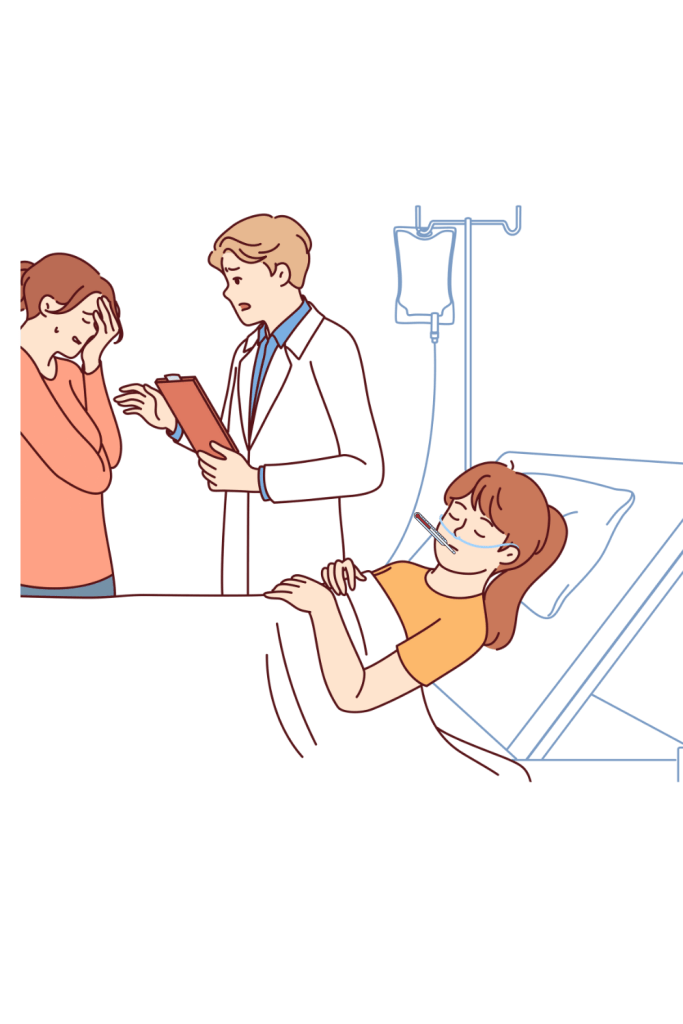
You’d think that surviving something as dramatic as your heart stopping would make you grateful for every breath, right? That’s what everyone assumes. That’s what I assumed. But here’s the plot twist nobody talks about: sometimes surviving the unsurvivable doesn’t make you appreciate life more—it makes living feel impossibly dangerous.
Welcome to the mind-bending world of medical trauma PTSD, where your brain decides that since you almost died once, you’re probably about to die again. Any minute now. Maybe even right now while you’re reading this.
The Science Behind the Psychological Sucker Punch
Here’s what the research says about cardiac arrest survivors that no one mentioned in the hospital discharge paperwork: the prevalence of PTSD among us is high. Like, surprisingly high. Studies vary, but they all agree it’s not just a few people who “can’t handle it.”
Even worse? PTSD in cardiac arrest survivors is linked to a significantly higher risk of another heart event or death within a year. So, while your brain is tormenting you with the idea that you’re going to die… that very torment might actually make you more likely to die.
It’s psychological Russian roulette, designed by a trauma specialist with a PhD in irony.
When I first woke up, I was full of gratitude. My brain was too busy relearning how to walk and do basic things to spiral about what almost happened. But once the dust settled? That’s when the fear moved in.
The Hypervigilance Trap: When Your Body Becomes the Threat
Hypervigilance means constantly scanning your surroundings for danger. But when the danger came from inside your own body, where exactly are you supposed to feel safe?
Every chest flutter is a heart attack. Every dizzy spell is a stroke. And don’t even get me started on tracking your own breathing. Your body becomes a 24/7 threat detection system, and you’re the one being surveilled.
I drink water like it’s a competition. I got a fitness tracker. I monitor every symptom: is that back pain from fibro, chronic kidney disease, or something more sinister? Often, I’ve just pulled a muscle from existing too hard—but my brain doesn’t buy that.
The Symptoms No One Prepares You For
We all know PTSD comes with flashbacks, nightmares, and anxiety. But medical PTSD has some bonus round features:
Medical Setting Panic: The sound of a heart monitor beep? Instant terror.
Body Betrayal Complex: Your once-trusty body now feels like a traitor.
Gratitude Guilt: You’re supposed to feel thankful, but mostly you feel terrified. Then you feel guilty about not feeling thankful. It’s like emotional inception.
Hypervigilant Exhaustion: Your body never relaxes, so your muscles never heal. Which means you always hurt. Which means your mood crashes. And the cycle repeats.
When I close my eyes, I don’t see calm or rest. I see regret. Unfinished business. Conversations I didn’t have. My muscles are always clenched. If I’m always hurting, I’m always depressed—and if I’m depressed, I’m even more tense. Rinse and repeat.
When Existing Conditions Complicate the Picture
If you already had health issues, medical trauma PTSD is like throwing a grenade into a house of cards. For me, fibromyalgia, ADHD, and bipolar disorder were already hard enough. Add PTSD?
ADHD + Hypervigilance = Brain ping-pong with a side of dread.
Bipolar + Trauma = Racing thoughts that might be mania or might be panic. Who knows?
Fibro + PTSD = Every ache becomes a “what if.”
The Irony of Fighting Fear While Pretending You Aren’t
The most exhausting part? You know it sounds ridiculous. You know your stats. You know not every chest tightness is a heart attack. But logic doesn’t matter. PTSD doesn’t speak statistics.
So you’re fighting fear with one hand while pretending to be okay with the other. Panic attack on the inside, small talk on the outside.
The Treatment Nobody Mentions
Here’s a shred of hope: studies show mindfulness-based therapy can actually help cardiac arrest survivors manage PTSD. It’s not one-size-fits-all, but it’s a start.
The problem is, most doctors don’t screen for PTSD after a medical event. They’re focused on your physical recovery. The emotional wreckage? Not on the chart.
Living in the Plot Twist
Some days, I can go hours without mentally scanning every inch of my body. Other days, it’s like I have ESPN for doom.
The real twist? Surviving doesn’t always make you feel grateful. It can make you feel fragile. And maybe that’s okay.
Maybe we don’t need to bounce back stronger. Maybe we just need to keep going, scared or not. That’s resilience too.
The Ongoing Experiment
Every day, I try to live without panicking about living. Some days I fail. Some days I don’t. But I’m still here. Still experimenting. Still trying. Til next time gang, you’re not alone, take care of yourselves, and each other!
If you’re navigating this too, you’re not broken. You’re not being dramatic. You’re surviving something nobody talks about.
Sources:
Columbia University Department of Psychiatry – Mindfulness-based Therapy for Cardiac Arrest Survivors
PubMed – PTSD in Cardiac Arrest Survivors
American Heart Association – Psychological Impact of Cardiac Arrest
Cleveland Clinic – PTSD Symptoms and Treatment
Mayo Clinic – PTSD Causes and Risk Factors
Bay Area CBT Center – Understanding Hypervigilance
Let’s just start there. Because when your baseline is fight-or-flight, freeze-or-fawn, dissociate-or-die-trying… “rest” doesn’t always feel peaceful. Sometimes it feels like guilt. Or like you’re forgetting something. Like you’re doing life wrong.
If you’ve lived in survival mode for months or years—or forever—it’s not just that you don’t rest. It’s that you’ve forgotten what real rest is supposed to feel like.
1. Rest Feels Like Uncertainty at First
The first few minutes of trying to rest when you’re used to chaos? Horrible. It’s like the world got too quiet and suddenly your brain is staging a protest:
“Shouldn’t you be doing something right now?”
“Is the other shoe about to drop?”
“Are you being lazy or just conveniently forgetful?”
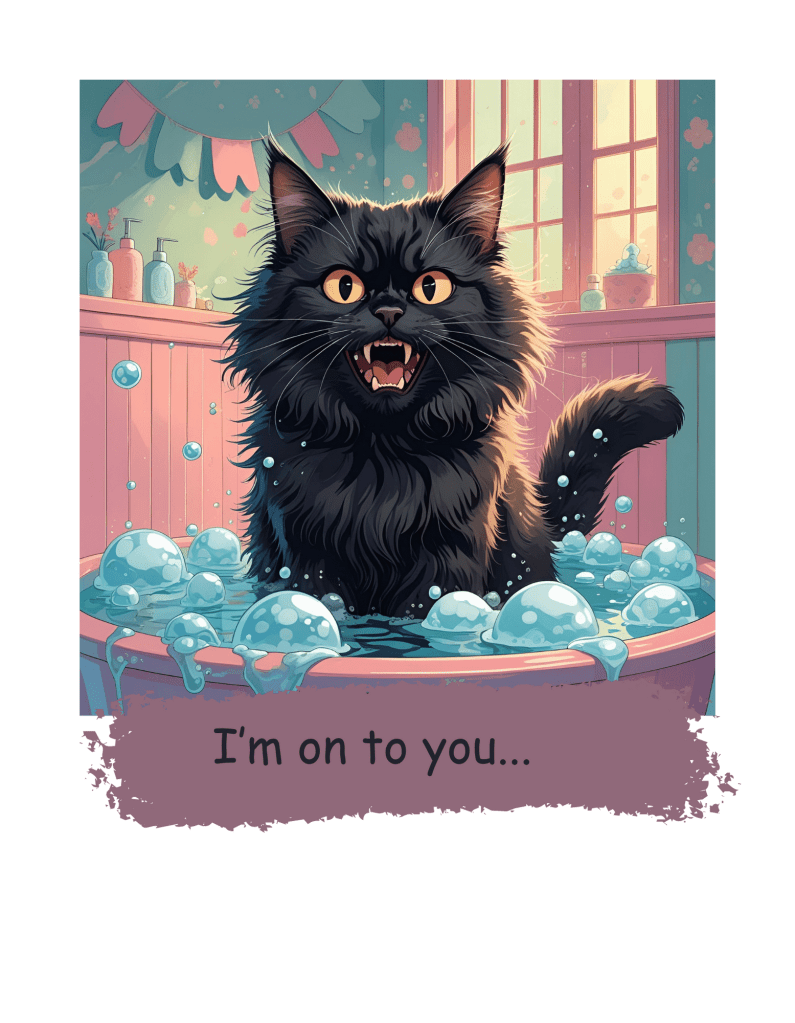
I have terrible self talk and my therapist always has me ‘reframe’ things. Turns out, your nervous system isn’t sure what to do when it isn’t in go-go-go mode. It gets twitchy. Suspicious. Like a cat in a bathtub.
2. Rest Can Look Lazy When It’s Actually Life-Saving
Rest isn’t always bubble baths and soft jazz. Sometimes rest looks like staring at the ceiling, numb and unmoving, because that’s all your body can manage. And that counts. Especially when you’re healing.
Some people take naps. Sometimes I can but I keep naps under an hour if exhaustion hits. Others… collapse. I’ve done that. I’ve driven cross country 21 hours and legitimately passed out cold. I was apparently parked in front my aunt’s neighbors tennant’s garage and they banged on the window, clearly seeing me sleeping on the couch and not hearing them. LOL They thought I was dead,
Same nervous system need, just wearing different outfits.
3. Rest Doesn’t Mean Everything Is Fixed
Here’s the kicker: you can be exhausted and doing nothing. That’s not failure. That’s biology catching up.
Rest doesn’t mean you’re healed, fixed, or suddenly energetic. Though it helps when the goal is reached. Sometimes it’s just the space between breakdowns. And that’s okay. That’s real. That’s progress, even if it doesn’t sparkle.
4. Rest Can Feel Like Withdrawal
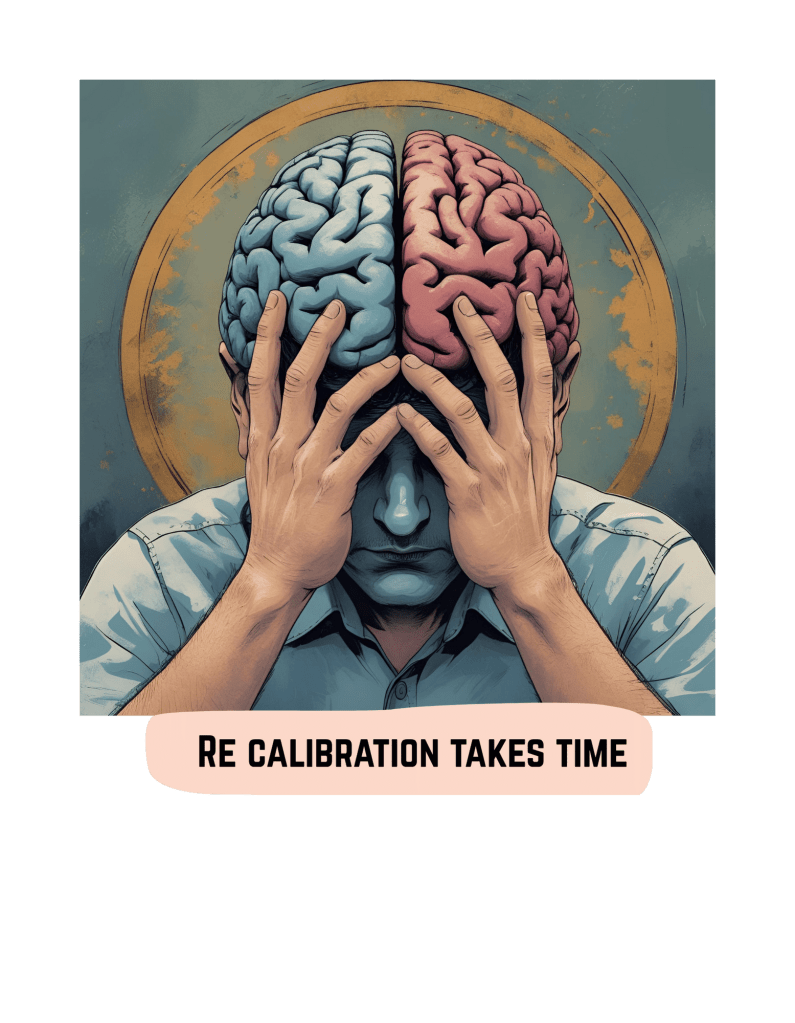
When adrenaline has been your main fuel source, rest can feel like crashing after a sugar binge. You may feel down, irritable, even achey. You’re not broken. Your brain’s just recalibrating. Imagine detoxing from chaos. That’s what this is. Detoxing from adrenaline.
5. You Might Feel Worthless While Resting—But You’re Not
This one cuts deep: “If I’m not producing, I’m not valuable.” Sound familiar?
That’s a trauma belief, not a truth. My eyes were opened with this little nugget, my therapist was the one who started it, and I did believe no one cared about me unless I did things for them, even though I love people without calculating what they can do for me, my brain was hard-wired to tell me I was worthless and I STILL have more days I believe the bad over the good about myself. Curious to see how many of you guys have felt that way too.
We live in a society that measures worth by productivity, but healing means learning your value exists even when you’re still. Even when you’re not doing. You don’t have to earn your rest. You deserve it because you’re human and thats hard enough.
So How Do You Learn to Feel Rest?
Gently. And over time.
Here are a few ways to start:
Name it. Tell yourself, “I am resting right now,” even if it feels like loafing.
Track your thoughts. Notice when guilt or shame show up. Are they old scripts? Keep a journal by your bed and write whats bothering you down before you lay down so you know you can work on it tomorrow.
Set tiny rest rituals. One song. One stretch. One sit on the porch. Practice. One little thing, whatever it is, that gets your mind to stop spinning and rest.
Celebrate doing less. Rest is not a reward. It’s a requirement. Its hard NOT to reward ourselves with rest, thats why we have to re-frame our thoughts how we talk to ourselves.
Final Thought: If You’ve Been in Crisis, You Deserve to Feel Safe in Stillness
That’s the hard part—retraining your body and brain to trust quiet moments. But you can. One awkward attempt at a time. You’re not failing when rest feels weird. You’re rewiring. That’s brave work.
And if no one’s told you lately: you’re doing a damn good job surviving. Now, let’s practice what it means to actually live. It feels like all I’ve done my adult life is to go from surviving one thing to surviving the next, I’m going to try and make more time to look around and enjoy the in between. I’ll keep you posted. If anyone has any tips to help with rest be kind and share it with the class. Til next time gang, take care of yourselves, and each other!
For many of us who live with chronic illness, ADHD, bipolar disorder, trauma, or just the fallout of a childhood where vulnerability wasn’t safe, the idea of trusting our own thoughts and feelings is… complicated. We don’t just second-guess ourselves—we override ourselves. We self-gaslight.
“It’s not that bad.” “I’m just being dramatic.” “Other people have it worse.” Sound familiar? That’s not humility. That’s internalized invalidation, and it’s one of the cruelest things we do to ourselves.
What is Self-Gaslighting?
Self-gaslighting is when you question or dismiss your own reality, often as a learned response from years of being invalidated by others. According to therapist Stephanie Moulton Sarkis PhD, this pattern often forms in people who have experienced emotional abuse or childhood neglect.¹ It’s a survival mechanism that becomes self-sabotage.
And it’s common—especially in neurodivergent and chronically ill communities. Studies have shown that women are especially likely to have their symptoms dismissed or misdiagnosed, leading to a long-term mistrust of their own internal cues. For example:
Up to 50% of women with ADHD are misdiagnosed with anxiety or depression first.²
1 in 5 people with bipolar disorder go undiagnosed for more than a decade.³
Chronic pain conditions like fibromyalgia are disproportionately underdiagnosed and stigmatized, especially in women.⁴
“I Hate Needing Help”: The Roots of Self-Gaslighting and How I’m Unlearning the Lie
I hate needing help. Like… viscerally. It makes me feel less than, and not in some abstract way — in the deep, core-wounding kind of way. And it didn’t come from one trauma or a single toxic person. It came from a thousand tiny, normalized moments that stacked up over time, whispering that needing help was weak. That I was weak.
I grew up steeped in traditional expectations most of us did at my age: men work hard and provide, women do everything else. Even if she worked outside the home, the mom still handled the doctor appointments, the homework folders, the mental load of everyone’s everything. I saw it play out every day. When the school called home, they didn’t call my dad — even though he worked at the same place as my mom. They called her. Because, of course they did.
One of my earliest memories of being “too much” started when I was seven and sick — fever, sore throat, the works. I said I was hurting, but everyone figured I was just being dramatic. (To be fair, I am dramatic, but I was also SEVEN and clearly not faking it.) They took me to the doctor, got me antibiotics, and figured that was that. But I wasn’t getting better.
Eventually — after more crying, more pain, and more dismissal — my Gram told my Mom to take me to a backup pediatrician because my doctor happened to be out of the office that day. That man took one look at me and told my mom, “She needs to go to the ER. Now. Her appendix is rupturing.”
He didn’t mince words: “She’s small. If the infection spreads, it could be too late.”
The surgery happened that night. It turned out my appendix had been leaking slowly — poisoning my body while I was being told I was too sensitive, too loud, too whiny. And sure, they saved me (yay!)… but the version of the story that stuck in my head wasn’t about how I survived. It was about how much of a burden I was.
To this day, my mom recalls how she had to carry my “heavy ass” because I couldn’t walk. Now, was I actually heavy? No. I was maybe 45 pounds of dead weight and fever. But it embedded this core belief in me: I’m dramatic. I’m too much. I’m inconvenient.
That belief stayed with me. Through childhood. Through my first marriage. Through flare-ups of chronic illness. Through postpartum depression. Through ADHD paralysis. Through years of pushing myself past the edge so no one would see me as “lazy.”
When people doubted my pain — or worse, when I doubted it myself — I swallowed it. I thought maybe I was just being dramatic. Maybe I should be able to handle it all. After all, other people have it worse, right?
That’s self-gaslighting. And it’s insidious.
It’s the voice that says:
“It’s not that bad. You’re overreacting.”
“You’re not really in pain, you’re just tired.”
“You could do this if you tried harder.”
It’s what kept me quiet when I needed help the most.
But therapy — lots of therapy — helped me finally unravel it. It took years, but I finally get it now:
You don’t have to earn rest.
You’re not a burden for having needs.
You’re not weak for needing help.
Other people can have it worse AND your situation can still suck.
You are allowed to ask for support before you collapse.
And honestly? That doesn’t make you selfish. That makes you human.
If you’re unlearning this too, here’s what I want you to know:
You are not too much. You were never too much. People’s discomfort with your needs doesn’t make those needs invalid. Being the “strong one” doesn’t mean you can’t fall apart. You get to rest. You get to be supported. You get to live a life that isn’t about surviving on fumes and masking your pain to protect someone else’s comfort.
I spent decades trying to be perfect, to be easy, to be less. But screw that. Life is too short to shrink yourself into silence. Take up space. Let people help. Let them carry you sometimes.
Because you are worth it. Even on your worst day. How to Begin Healing From Self-Gaslighting
Let’s be real—this is messy work. You don’t fix it by reading a meme or journaling once. You fix it by practicing the opposite, over and over, until it becomes your new truth. Here are some small steps with a big impact:
Reality checking with safe people — someone who validates your feelings can be a lighthouse when you’re lost in doubt. It can be anyone but make sure its someone you can trust for their honesty but also know your heart and can be critical while still being gentle.
Name the gaslighting — say it out loud: “That was a survival thought, not a truth.” Say it like you are talking to someone you are trying to help.
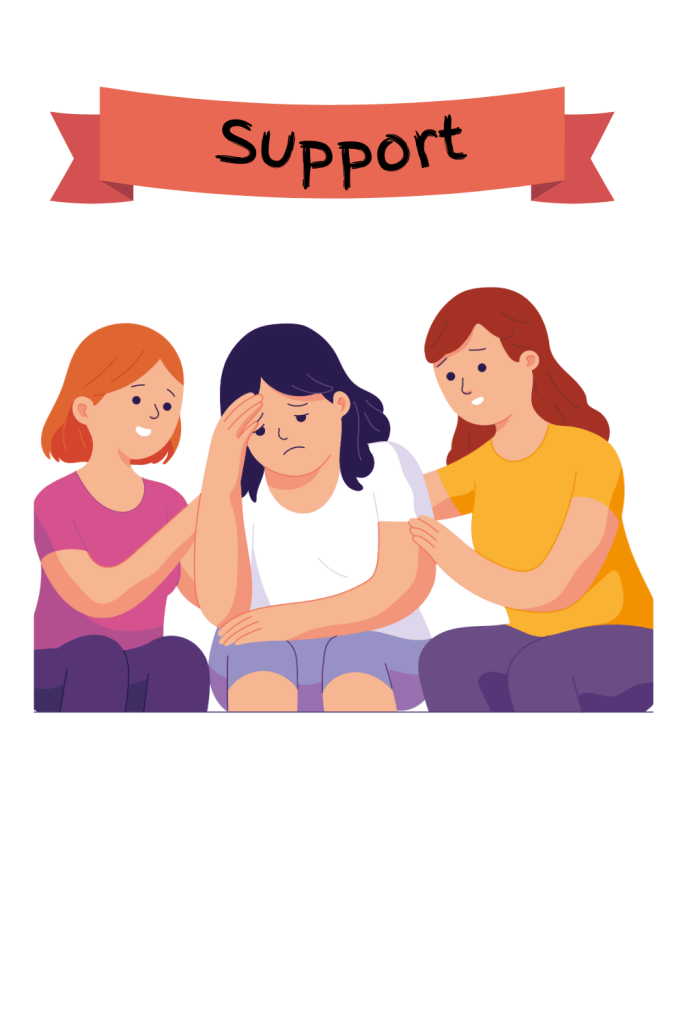
Document your experiences — journaling, voice notes, or even social media posts (if safe) can help anchor you in your own story. I journal, its incredibly freeing even just writing it down, seeing it, releasing it, but find which of the healing paths fits the best for you. Sometimes, its beneficial to have a community for support, even if its online, so googling support groups for whatever is the most emergent need in your life. I’m big on support
Therapy, when possible — especially trauma-informed or neurodiversity-affirming practitioners. If the first one you talk to doesnt vibe, don’t give up, sometimes it takes one or two before you really feel like you have that connection.
You’re Not Broken. You’re Healing.
You’re not too much. You’re not making it up. You’re not weak because you’re tired or need help. You are unlearning a system designed to keep you quiet and compliant. That is hard and brave and it counts—even when it’s invisible. Til next time gang, take care of yourselves and each other.
Sources:
Sarkis, S. (2018). Gaslighting: Recognize Manipulative and Emotionally Abusive People—and Break Free.
Quinn, P.O., & Madhoo, M. (2014). A Review of Attention-Deficit/Hyperactivity Disorder in Women and Girls. The Primary Care Companion for CNS Disorders.
Hirschfeld, R.M.A. (2001). Bipolar disorder: The rate of nonrecognition. The Journal of Clinical Psychiatry.
NIH & Mayo Clinic studies on gender bias in pain diagnosis and treatment.
let’s talk about how your Spotify playlist might just be the unsung hero in your battle against the chaos in your head. Buckle up, because we’re about to dive into the wild world of music therapy for our neurodivergent brains.
Life with ADHD, autism, or bipolar disorder is trying on its BEST behavior, but on particularly bad days it can be like is like being on a perpetual rollercoaster designed by a sadistic toddler. But before you dive headfirst into your Netflix queue (again), consider this: music isn’t just for your next embarrassing TikTok dance attempt. It’s scientifically proven to be your secret weapon in the war against your own brain. So, let’s crank up the volume and see why your playlist might be more effective than your therapist (don’t tell them I said that).
The Science Behind the Symphony (Or Why Your Brain is Basically a Rave) First off, let’s talk brain chemistry, because nothing says “fun” like neurotransmitters, right? Turns out, listening to music triggers a dopamine release in your brain. Dopamine is like your brain’s personal cheerleader, minus the annoying pep. It’s the “fuck yeah!” chemical that makes everything seem less like a dumpster fire.
For us ADHD folks, music is like Ritalin without the side effects. Studies show that background tunes, especially with a steady beat, can help us focus and stop us from getting distracted by every shiny object in a five-mile radius. So, next time you’re struggling to read that mind-numbing report, slap on some Mozart or lo-fi beats. It’s like noise-canceling headphones for your ADHD.
And for our autistic pals, music is the universal translator we’ve been waiting for. It’s a way to express emotions without having to decipher the enigma that is human interaction. Research says music therapy can improve social skills, communication, and overall quality of life. It’s like having a cheat code for emotions.
Bipolar disorder, where your mood swings make a pendulum look stable. Music can be your emotional seatbelt on this wild ride. Studies show it can help regulate mood and reduce symptoms of depression and anxiety. When your brain is doing its best impression of a ping-pong ball between mania and depression, music can be the net that catches you. Think of it as your personal mood ring, but actually useful.
The Brain’s Playlist: How It All Works (Warning: Science Ahead) So, what’s actually happening in your brain when you hit play? It’s like a rave in there. The limbic system (your brain’s drama queen) and the prefrontal cortex (the responsible adult) light up like a Christmas tree. This helps synchronize your neural networks, leading to improved mood and emotional resilience. In other words, music makes your brain cells hold hands and sing Kumbaya.
Why Your Music Taste Matters (Yes, Even Your Guilty Pleasures) Of course, not all music is created equal. The impact on your mood can vary depending on what you’re into. So whether you’re headbanging to death metal or chilling to lo-fi beats, it’s all about what makes your neurons dance. The key is finding that sweet spot where the music enhances your mood without making you want to punch a wall.
Bottom Line: Hit Play for Better Days (Or At Least Slightly Less Terrible Ones) So, the next time you’re feeling like your brain is a blender set to puree, don’t underestimate the power of a good playlist. Science says it’s not just about the sick beats; it’s about how music bitchslaps your brain into behaving. So go ahead—press play, let the music work its voodoo, and remember: sometimes the best therapy comes with a side of headphones and a killer soundtrack. Now, if you’ll excuse me, I need to go make a playlist for “Days When My Brain Decides to Be an Asshole.” It’s going to be fire. 🎵🧠🔥 Be kind to yourself and each other