Let’s be honest: if forgetting what you were saying mid-thought was an Olympic sport, I’d have gold medals in every category. Freestyle Rambling. Synchronized Brain Fog. And my personal favorite: Disappearing Train of Thought With a Triple Mental Backflip.
People say “don’t be so hard on yourself,” and I’m like—buddy, I’m not. I’m just trying to remember what I came into this room for. And repeatedly. I’m not being ‘so hard’ on myself, I’d say I’m at least the appropriate level of hardness if not under lol
Somewhere between ADHD, fibromyalgia fog, bipolar whiplash, and a few hundred browser tabs in my brain, my inner monologue starts to sound like a dial-up modem trying to load a YouTube video. In 2003. On satellite internet. In a thunderstorm. A mile and a half down a country dirt road where theres NOTHING for miles
🧠 Exhibit A: “What Was I Saying?”
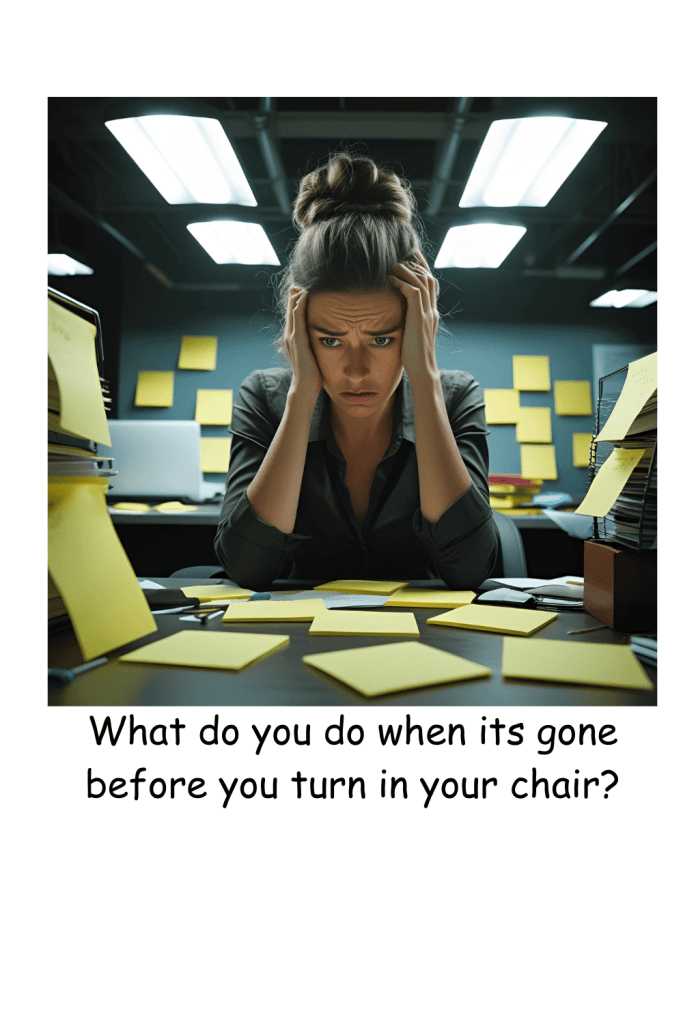
It’s not even a joke anymore. I’ll be mid-conversation, completely coherent, and suddenly—boom. Blank screen. I can literally see the words running off a cliff like cartoon lemmings.
“Wait—what was I saying?”
No really. What was I saying? I know its annoying to you, do you know how annoying it is and how much I absolutely hate the part of my brain thats supposed to remember things? Me and my brain are in an absolute love/hate relationship and we are definitely in our Hate each other era.
🤯 Fibro Fog: Not Just a Myth, Unfortunately
If you’ve never tried to function while your entire nervous system is on delay like it’s waiting for subtitles, congratulations—you’re not me. Fibro fog isn’t just forgetfulness. It’s walking into a room and standing there like you’re the main character in a slow-motion scene… except no one yelled “Action,” and you definitely missed your cue.
My body hurts, my thoughts hurt, my hair hurts, and occasionally my elbow forgets how to be an elbow. But hey, at least I still remember none of my passwords!
🎢 Bipolar Bonus: Now With Extra Whiplash!
Imagine being hyperfocused on color-coding your sock drawer one minute, then sobbing because your spoon fell on the floor the next. Now toss in some guilt about not replying to texts from 2017, and you’ve got the Bipolar Expansion Pack.
Highs that make you reorganize your pantry at 2 a.m., lows that make brushing your hair feel like a heroic feat. All while your memory plays musical chairs.
💁♀️ So What’s the Point?
The point is: if you’re out here trying your best with a glitchy brain, a misfiring mood system, and a body that acts like it was coded in beta—you’re not alone. You’re in deeply relatable, exhausted, beautifully chaotic company.
Some days I cry over spilled plans. Some days I laugh at my own internal commentary. And most days, I absolutely forget what I was saying.
But I’m still here. Still making stuff. Still showing up. Even if it’s ten minutes late and I forgot to put on pants. Til next time guys, take care of yourselves, and each other.
There’s something almost intoxicating about hypomania. Your brain buzzes, ideas come faster than you can write them down, and suddenly everything feels possible. You’re cleaning the garage, starting a new project, texting friends back after weeks of silence, and maybe even feeling like you’ve finally “figured it out.”
But here’s the part people don’t talk about enough: what happens after.
When the sparkle fades and your energy crashes back to earth, you’re left sorting through the emotional and physical wreckage. It’s not just exhaustion—it’s this weird cocktail of regret, confusion, and grief. You might feel raw, embarrassed, or even guilty for things you said or started and couldn’t finish. That aftermath can be brutal.
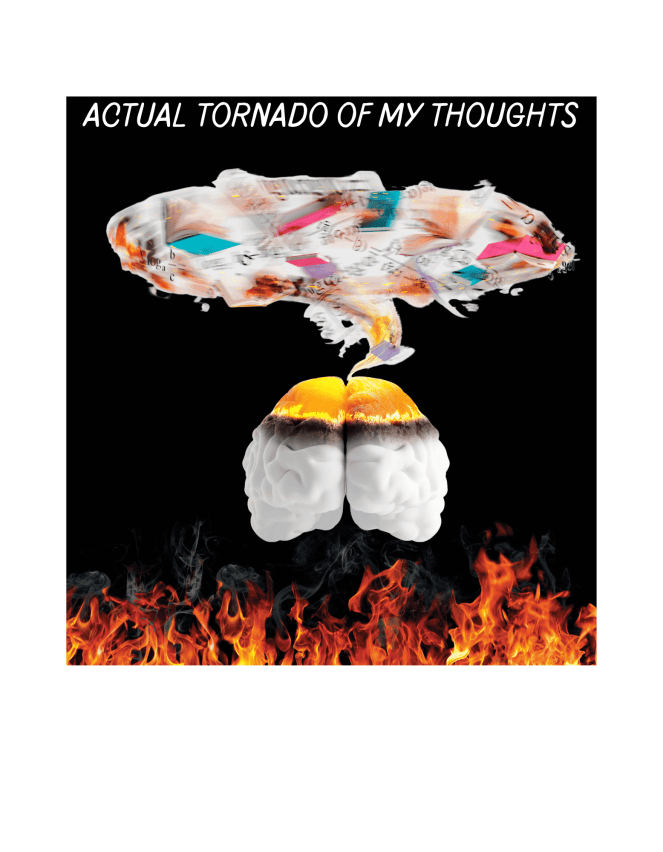
Hypomania is part of bipolar II disorder—it’s marked by elevated mood, a surge in productivity, and bursts of creativity or restlessness. But while it can feel euphoric at the time, the come-down can leave you reeling, questioning your choices, and trying to clean up the mess your over-caffeinated brain tornadoed through.
The Cycle of Risk and Regret (a.k.a. Oops, I Did It Again — But Not in a Fun Britney Way)
Here’s the thing no one glamorizes about hypomania: the aftermath of impulsive choices that seemed like brilliant ideas at the time. One minute you’re ordering $200 worth of “self-improvement” stuff at 2 a.m., signing up for a new certification course, and texting your ex like you’re starring in your own comeback tour — and the next, you’re wondering what the hell just happened.
And science backs it up. According to research published on PubMed, people in hypomanic states often engage in high-risk behaviors — overspending, substance use, reckless decisions — the kind of things that feel like you’re chasing possibility, but too often watching it all boomerang back with the grace of a collapsing Jenga tower.
What follows? That slow, sinking feeling. Guilt. Shame. Maybe even avoidance. You look at the credit card bill, or a strained relationship, and suddenly the vibrant energy of hypomania gets replaced with the emotional hangover no one warned you about.
You’re not the only one who’s been caught in this loop. You’re not a bad person. You’re a person with a disorder that messes with impulse and inhibition. It doesn’t excuse the consequences, but it does explain the pattern — and understanding the pattern is how we start breaking it. I was so stuck here myself but perhaps worse is the gaslighting I do over EVERY. SINGLE. DECISION. afterwards because I sincerely have lost all faith in my own judgment. Like every little thing, ‘is it a good idea or are you just manic’ plays in my head on a loop.
The Crash Landing No One Talks About
If hypomania feels like flying a little too close to the sun, then the crash that follows is more than just a rough landing — it’s a total freefall. One minute, you’re bursting with ideas and energy, barely sleeping, maybe even reorganizing the garage at 2 a.m. like you’re possessed by the spirit of Marie Kondo on espresso. And then… it’s like the lights shut off. The energy vanishes. You’re not just tired — you’re hollowed out. The sadness is deep, the fatigue bone-heavy, and everything starts to feel like too much and not enough, all at once.
It’s not just a “mood swing.” It’s a full-body, full-mind shutdown that makes even brushing your teeth feel like a high-stakes negotiation. And the cruelest part? The contrast. You remember how you felt just days ago, and now you can’t fathom getting off the couch. That whiplash is its own kind of heartbreak. Like it physically makes me ache sometimes.
When Life Throws a Brick Through the Window
Here’s the thing: if you’re already dancing on the edge of a depressive episode, real-life chaos doesn’t just nudge you — it can send you tumbling. Research backs this up: negative life events (you know, the kinds that seem to show up all at once like uninvited guests) have been shown to intensify depressive symptoms in folks with bipolar disorder [PMC, Cleveland Clinic]. And if you’re someone already wired with a predisposition
to depression? That impact hits even harder. It’s why managing stress isn’t just a suggestion — it’s survival. I will legit cry over such trivial stuff, then hate myself cuz I KNOW its dumb to cry about it so I cry more cuz I’m mad at myself for not being able to look at a situation thats got nothing to do with me or so so trivial Learning how to soften life’s blows, build resilience, and stack the odds in your favor might not make the hard stuff disappear, but it can definitely make it hurt less when it lands.
Moving Forward: Strategies for Coping (AKA, Surviving the Crash Without Losing Your Damn Mind)
Look, managing life after hypomania is like waking up in a house you swore you just deep cleaned, only to find emotional dishes stacked in every room. But there are ways to climb out of the mess — even if you’re doing it one spoon at a time.
🔹 Self-Compassion This is not a personal failure, a moral shortcoming, or some character flaw you need to apologize for. It’s a medical condition — full stop. Remind yourself (repeatedly, if needed) that what you’re feeling isn’t your fault. You’re not broken, you’re human. In a world that crops all the edges to paint a rosier picture be the straight angle in black and white.
🔹 Structured Support When your brain feels like a Pinterest board of chaos, routines can become lifelines. Simple, repeatable actions — morning check-ins, meal planning, a therapy appointment every other Tuesday — can help stabilize the rollercoaster. And yes, professional help is allowed and encouraged (therapy = tools, not weakness). Every morning my routine has been the same for years, Duolingo while I listen to stand up comedy with the news in the background, if any of those is missing my day starts out lacking which leads to a bad day
🔹 Community Connection Even if you’re more “socially exhausted introvert” than “group hug enthusiast,” connecting with people who get it can make a huge difference. Whether it’s an online forum, a group chat, or that one friend who won’t judge your 2 a.m. existential texts — don’t go it alone. Thats what I’m trying to do here, build a community, hopefully to work right on up to a forum we can all support each other. Thats my goal anyway the minute I can sell enough in my store to pay to host the forum it will be done!
Understanding the highs and lows — especially the rough emotional terrain that can follow hypomania — isn’t just helpful, it’s empowering. When you mix solid science with self-awareness and some well-worn coping tools, you start to feel just a little more in control. Not perfect, not invincible — but stronger. And that counts. Til next time gang, take care of yourselves, and each other. P.S. If this hit a little close to home and you’re looking for something to help you process the messy in-between parts — I made a workbook just for this. It’s not magic, but it’s honest, helpful, and created by someone who’s been there. Check it out
(aka, How Stockpiling Became My Quiet Way of Fighting Back)
Some days, my body feels like a traitor. I can’t bend over very far, I can’t pick up anything off the floor or up high without my grabber thingy. I can’t haul laundry up the stairs. I can’t even promise I’ll be the same “me” tomorrow that I am today.
I’m caught up on reading anyway
Living with chronic illness — especially things like fibromyalgia and ADHD — means my energy, my ability, my very reliability can vanish without warning. (And nothing says “party” like waking up with zero spoons and an entire day’s worth of responsibilities, right?)
When your body plays dirty, it’s easy to start turning that anger inward. It’s easy to start hating yourself for being “unreliable,” for needing help, for “failing” even when you’re trying so damn hard. And that self-loathing? It can spiral faster than you’d believe.
But here’s something I want to say — to myself and to you: You are not unreliable. You are surviving a body that hands you chaos every morning and expects you to make peace with it by lunchtime.
🛒 Pantry Planning: My Quiet Rebellion
I can’t control how many spoons I’ll have tomorrow. I can’t always cook a gourmet meal or deep-clean the house or check every box on my to-do list.
But you know what I can do? I can plan. I can stockpile. I can quietly, stubbornly, prepare for the days I know will be hard — because they will come.
Even if I can’t cook today, I can make sure next week’s meals are lined up. Even if I can’t carry groceries, I can still hunt down deals and plan freezer meals. Even if I can’t do it all, I can still do something.
And that matters. I can be ready and save my family money on groceries if I shop coupons and deals. I love the hunt of finding the good deals (coke 12 packs under 3 dollars? Sign me up!) That counts. You count.
🧠 The Science of “Just Being Ready”
Here’s a wild little truth bomb for you: ✅ Studies show that having even a small emergency plan (whether that’s for food, money, or time) significantly reduces anxiety, depression, and feelings of helplessness.
A 2017 study published in Disaster Medicine and Public Health Preparedness found that people who felt “prepared” — even just having a few extra essentials on hand — reported higher self-efficacy and lower distress during crises.
Translation? Planning ahead can actually make you feel more in control, more capable, and less crushed by uncertainty.
As someone who is often referred to as a little bundle of anxiety I can tell you, when shit gets real, and lets face it, if nothing else in life, you’re promised those ‘shit gets real’ moments, (my most recent I think was the school calling me telling me they lost my kid, AGAIN, and asked if I knew where she was! I was thankful my anxiety always makes me have like 20 back up plans lol) prepared people can stand up in times of crisis and fall apart much later after its all taken care of.
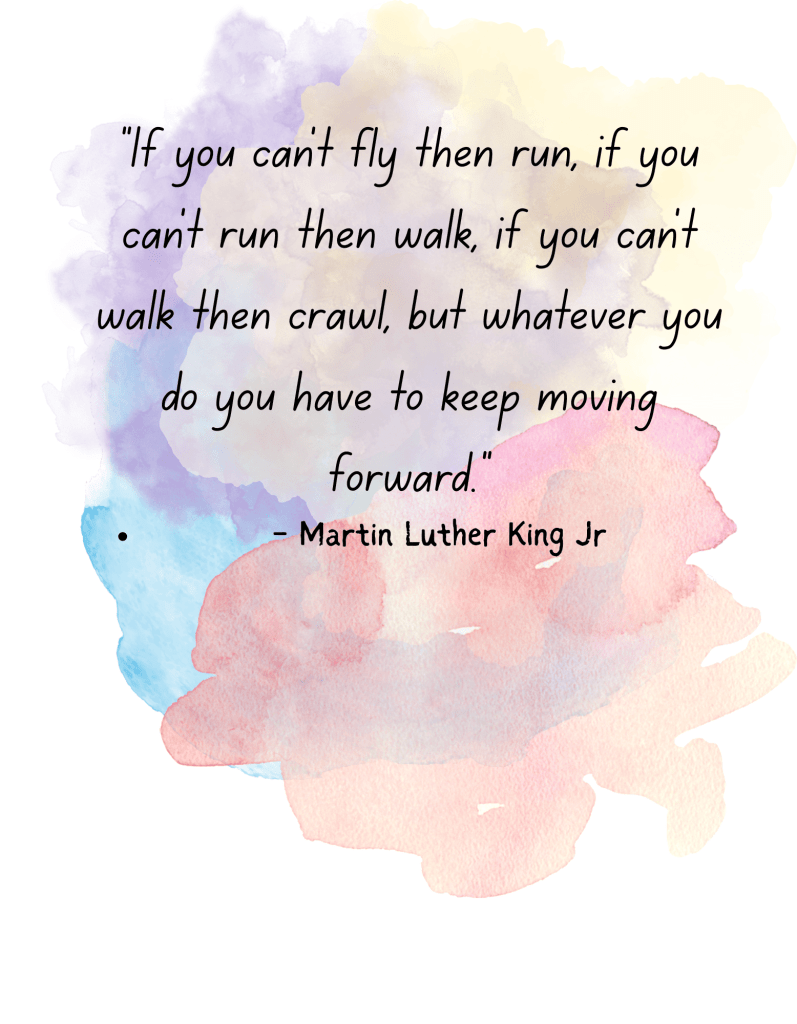
Another study in The Journal of Anxiety Disorders found that taking small action steps (like stockpiling shelf-stable foods or creating a “bad day backup” list) built measurable resilience — even in people dealing with ongoing chronic illnesses. Sound familiar? It boils down to an expression I have heard and will try not to butcher from Dr Martin Luther King Jr. “If you can’t fly then run, if you can’t run then walk, if you can’t walk then crawl, but whatever you do you have to keep moving forward.”
Even micro-actions matter. Even thinking ahead counts.
🛠️ Solutions for the Hard Days (A Tiny Toolkit)
Because let’s be real: Some days are still going to suck. But we can stack the deck a little bit in our favor.
Here are a few things that help when it feels like you’re drowning:
“Shelf Stock” Meals: Build a few meals that live completely in your pantry — no fresh ingredients needed. (Cooked chicken + pasta + jar sauce = emergency lasagna.)
Backup Spoon Days: Have 3-5 emergency meals that you could make half-asleep with one hand. (Instant rice + microwaveable veggies + rotisserie chicken, anyone? They have individual rice cups, or you can nuke a pouch in 90 seconds and they have a number of flavors, and at our local store whatever rotisseries don’t sell the next day they strip and sell the meat per pound, its amazing to keep on hand, throw it into pasta or rice. I usually do that with sausage and peppers too, makes good dirty rice)
Permission Slips: Give yourself permission, in writing if you need to, to just survive some days. “Not today” is a full sentence.
Grabber Tools & Adaptations: They might feel frustrating, but they’re not failure — they’re gear. Gear up like the warrior you are.
“I’m Still Here” Reminders: Keep a list somewhere visible of the things you have accomplished — even the tiniest wins. Every day I write lists and lists just so I can check them off then never worry about them again. Some days? “I fed myself and stayed alive” deserves a damn standing ovation.
💬 Final Word (From One Battle-Scarred Soul to Another)
Maybe I can’t build the world I dreamed of today. Maybe my body won’t let me build anything at all.
But I’m still here. I’m still planning. I’m still stubbornly, fiercely, stocking a pantry, preparing a home, building a future — even if some days, all I can build is a grocery list and a whispered prayer.
And friend, if you’re reading this? You’re still building too. Even if no one else can see it. Even if it hurts like hell. Even if today looks small.
You’re still fighting for yourself. And that’s enough. That’s always enough. Til next time gang. Take care of yourselves, and each other!
Recovering from hip replacement surgery sounds daunting, so why not make the most of your downtime? I’m a week out and I’m SO bored. I’ll probably knock out at least five of these this week. If you guys have ideas let me know EDITED TO ADD: Mother in law sent me a message letting me know that when her hubby had a hip replacement he built models and thats how she ended up with a curio case full lol. I hadn’t thought of them until she reminded me of Grandpa Greg’s recovery but thats also something tangible so I’d absolutely work on that. Legos too after I thought about it.
1. Binge Watch TV Shows Until You Forget What Day It Is
HBO, Netflix, Hulu… I feel like this one goes without saying… summon the entertainment gods! Start a show so long you’ll still be watching it when you can finally walk without looking like a baby giraffe. I’m planning to re watch this season’s Law and Orders, and Greys, and all the Chicago shows. Then I’ll branch out to see if there are any finished shows, or finished seasons of shows that I have on my to watch list.
2. Perfect the Art of Asking for Everything
This is your time to shine as the supreme monarch of laziness. Channel your inner diva and ask others to fetch you water, snacks, blankets, and everything else. I’ve started calling my husband into the room to do little things once I lay down. I start by justifying it as he’s walking in the room he’s like ‘just tell me, I know you’d do it if you could’. But half the fun is making up the justifying stuff. Make an argument they can’t say no to
3. Assemble a Throne of Pillows
You’re going to be sitting a lot, so why not create the most luxurious pillow fort for your recovery? Bonus points if you make people call you the Pillow Queen. I don’t just want a pillow throne, I want a pillow empire that I may sit atop and be fanned and fed grapes LOL
4. Write a Memoir Called “Titanium and Tantrums”
Chronicle your hip replacement journey in all its glory—include your emotional highs, your many Netflix binges, and the awkward moment you dropped a crutch down the stairs. Kidding, steer clear of stairs for the duration of your recovery. I didnt do crutches, I did a combo of walker and cane but it sucks to drop your cane. I have a grabber that I also drop, so I play pick up sticks with my toes lol. My memoir would be boring, mostly about how I try doing things myself, fail, then wait for someone to *gulp* help.
5. Invent an Alter Ego for Your New Hip
Name your new hip something badass like “T-800” or “Iron Justice.” Refer to it exclusively in the third person. “Iron Justice doesn’t approve of stairs today.” LOL I havent named mine yet, but I did notice I didnt have any bionic powers yet. Super Speed???? Maybe but I wont find that out til its magically activated and I am summoned to my rightful place instead of seated here atop my pillow throne.
6. Train Your Pets to Assist You
Turn your dog into a furry nurse or your cat into a reluctant butler. Teach them to fetch your slippers, deliver snacks, or at least sit next to you and look cute. I’ve been working SO HARD at this one, so far I have gotten two of the four to sit in my vicinity and grace me with their presence, I’ll continue working at it, it will be slow going but I’ve got time.
7. Learn to Swear in Different Languages
You’ll need new words for when physical therapy makes you want to throw something. Imagine shouting “Merde!” or “Scheisse!” to spice up your frustrations. I should look into the swear words, I don’t think they have a section for it in Duolingo lol, but I’ve been doing Duolingo more. Make yourself fluent in a language of your choosing. Thats using your time constructively
8. Create a Playlist Called ‘My Hip Don’t Lie’
LOL You knew a playlist had to be on the list somewhere! Honestly my soundtrack has been senate hearings and stand up comedy, but now that I’m feeling good enough not to sit on my ass today it’s Shakira time. Include other bangers like “Can’t Stop This Feeling” and “Walk This Way.” Dance from the couch (or gently sway if you’re not quite there yet).
9. Become a Professional Napper
If naps were an Olympic sport, you’d be going for gold. Nap at odd hours. Nap mid-conversation. Nap just because you’re bored. Recovery requires rest, after all. I seriously love me a good nap. I havent been sleeping well because I have to elevate my hip and I’m uncomfortable on that side, so if I’m in my chair and the moment calls for it I can be sound asleep in under 3 minutes.
10. Plan Your Post-Recovery Dance Routine
Once your new hip is ready, you’ll obviously want to celebrate with a victory dance. Sketch it out now: a little cha-cha, a hip thrust (carefully), and a triumphant lean. I have actually thought about this a fair amount, I love to dance. I love to move, I hate sitting still so its driving me crazy, but I know I’ll be able to dance soon and feel much better while doing it, so thats what I’m holding on to.
Final Thoughts:
Recovery is hard, but humor makes it bearable. Whether you’re inventing alter egos for your hip or perfecting your dramatic limping skills, the key is to stay entertained and keep smiling (or rolling your eyes). You’ve got this—Iron Justice (or Titanium Tina ooohhh, I like that one) will be back on the dance floor in no time. Til next time gang, take care of yourselves, and each other.
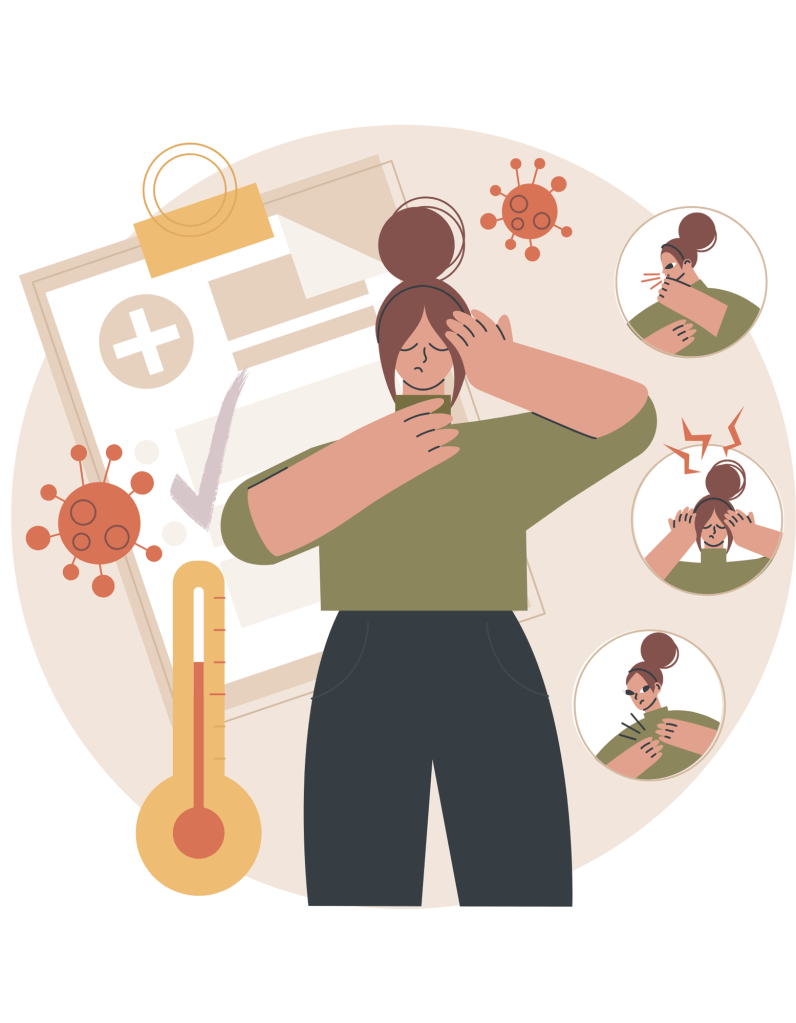
Ok gang, let’s get real about something that doesn’t get nearly enough attention: medical PTSD. If you’ve ever left a doctor’s office feeling dismissed, doubted, or downright defeated, you’re not alone. For those of us with chronic illnesses and invisible conditions like fibromyalgia, bipolar disorder, autism, or ADHD, the healthcare system can feel less like a safety net and more like a minefield.
What Is Medical PTSD?
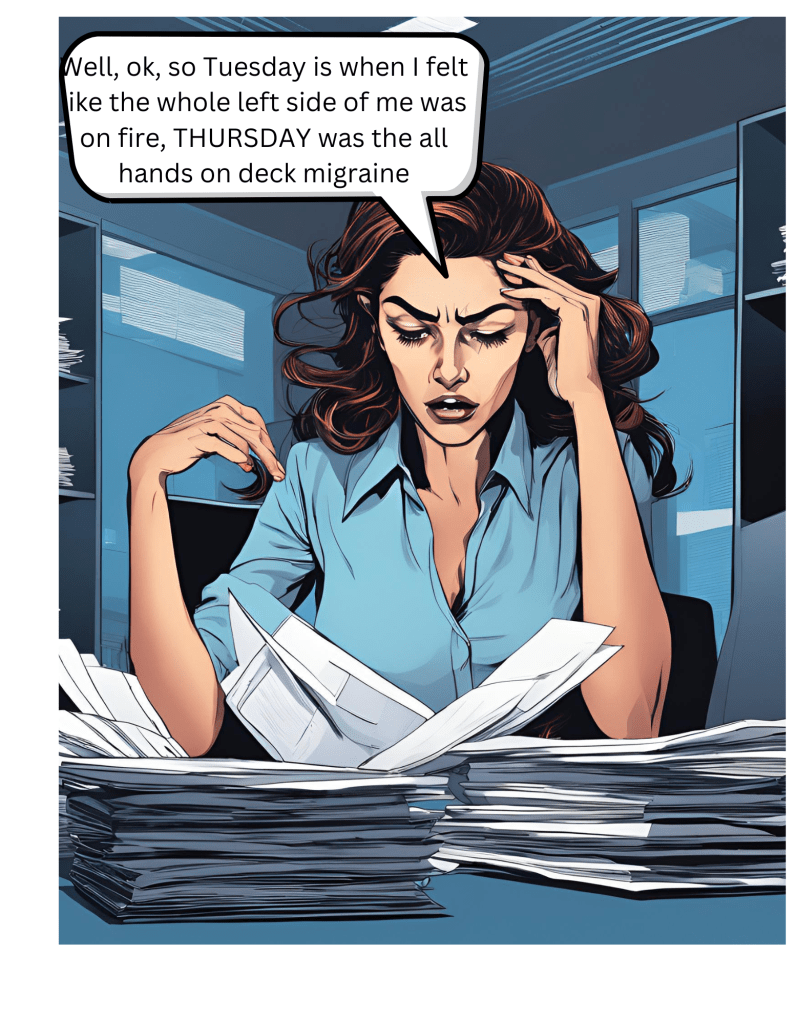
Medical PTSD is what happens when repeated negative experiences with healthcare providers leave you emotionally scarred. It’s not just about a bad appointment here or there—it’s about the trauma that builds up over time when your pain or symptoms are brushed off as “nothing” or “all in your head.” Spoiler alert: it’s not in your head. For many of us with invisible illnesses, this is an all-too-familiar story. Bloodwork comes back fine? Must be nothing. Physical exam looks normal? You’re probably exaggerating. And suddenly, you’re left questioning your own reality because someone with a stethoscope couldn’t see what you’re feeling every single day. The number of times I’ve left a doctors appointment shaking my head saying ‘well, I mean if it WAS something wouldn’t they see it?’ No, thats not true, some stuff is tricky and it hides behind stuff. Some times you have to poke around at stuff until you figure it out, that doesnt mean things arent there to find.
Truth Bomb: Invisible Doesn’t Mean Imaginary
Here’s the thing: just because something doesn’t show up on a test doesn’t mean it isn’t real. Fibromyalgia doesn’t light up on an X-ray. Bipolar disorder doesn’t leave a trail in your bloodwork. Autism and ADHD don’t come with flashing neon signs saying, “Hey, I’m here!” But that doesn’t make them any less valid—or any less debilitating. I can’t tell you how many times I’ve walked into an appointment armed with symptom logs, research, and sheer determination, only to be met with raised eyebrows and the dreaded “It’s probably just stress.” Or, ‘well you DO have Fibro’ Oh really? Because last time I checked, Fibromyalgia didn’t cause my hip to stage a full-blown mutiny (looking at you, early retirement hip).
The Emotional Toll of Being Dismissed
Let me paint you a picture: You’re already dealing with chronic pain, fatigue, mood swings—basically the greatest hits of invisible illness. Then you muster up the courage to seek help (because let’s be honest, even making the appointment feels like climbing Everest). You sit there, vulnerable and hopeful, only to be told your symptoms don’t add up or aren’t serious enough to warrant concern.
That kind of dismissal doesn’t just sting—it leaves scars. Over time, it can make you hesitant to seek care at all. Why bother if no one’s going to listen? But here’s the kicker: avoiding care can lead to worsening symptoms and even more complex health issues down the line. It’s a vicious cycle that needs to stop.
Breaking the Cycle: Advocacy and Awareness
So how do we fix this mess? For starters:
Trust Your Gut: If something feels wrong in your body, it probably is. Don’t let anyone convince you otherwise.
Document Everything: Keep a symptom diary so you have concrete evidence to back up your concerns.
Bring Backup: Take a trusted friend or family member to appointments—they can help advocate for you when you’re feeling overwhelmed.
Seek Second Opinions: If one doctor dismisses you, find another who will listen. Your health is worth fighting for. Though check with your doctors office or hospital system on policies, my doctor of 7 years dropped me because I got one.
And let’s not forget the role of healthcare providers in this equation. Doctors need better training on invisible illnesses—period. They need to understand that just because they can’t see it doesn’t mean it isn’t there. A little empathy goes a long way.
My Own Battle Scars
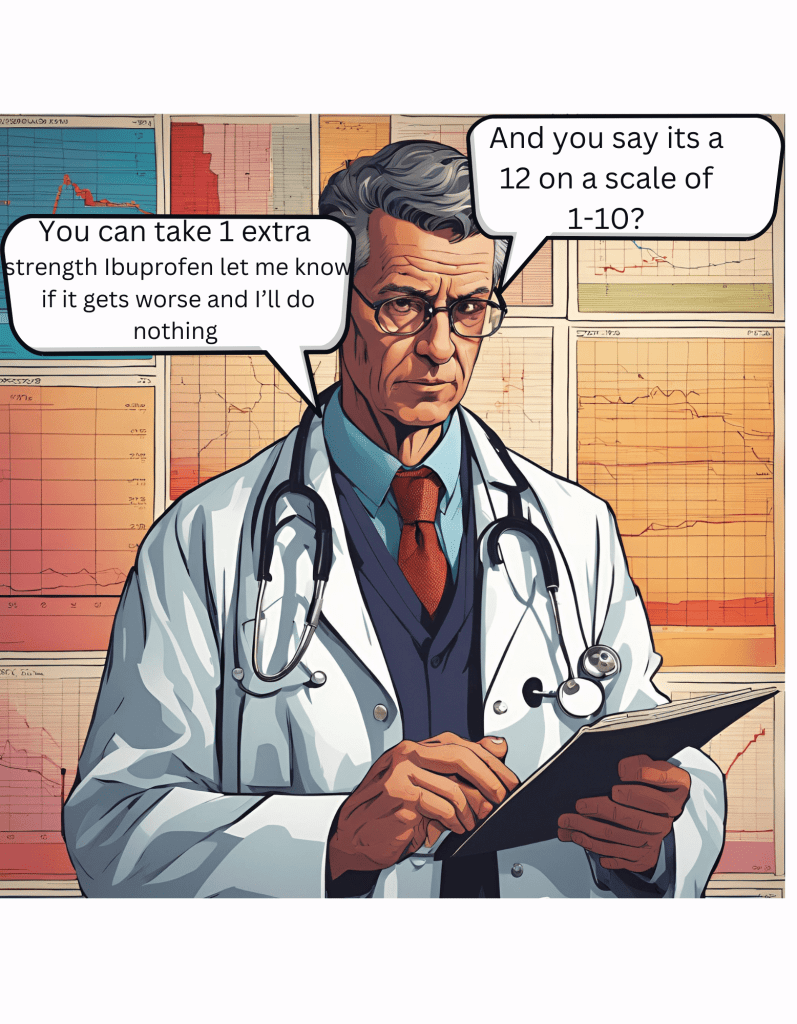
I’ve got plenty of stories I could share about being dismissed by doctors (and believe me, I will). Like the time I was told my fibro pain was just “overexertion” when I hadn’t done more than shuffle from my bed to the couch all week. Or when my bipolar symptoms were brushed off as “just moodiness” because I happened to be having a good day during my appointment. Yes its about highs and lows but there is so much nuance and theres no way to catalogue each patient’s symptoms into a graph saying which predominant symptom is worse from day to given day, I don’t even know a metric you could rate them on, its just too much. But perhaps the most frustrating moment was when my hip—yes, my actual joint—was screaming for help, and I was told ‘Well, fibro is painful.’ said sincerely with a hand on my shoulder (do not touch a fibro sufferer there and expect to be conveying sympathy or empathy, its like my BIGGEST tender point, which I never mentioned SPECIFICALLY so I let it go, but you wouldnt do that) Spoiler alert: it wasn’t just fibro; it was my hip waving its white flag and demanding replacement parts.
The Bottom Line
Medical PTSD is real, and it’s time we start talking about it. For those of us living with chronic conditions and invisible illnesses, advocating for ourselves isn’t just an option—it’s a necessity. So keep pushing for answers, keep telling your story, and never let anyone make you feel like your pain isn’t valid.Because at the end of the day? We know our bodies better than anyone else ever could. And who can tell your story and explain your pain better than you? Til next time gang, take care of yourselves, and each other!


















 WannaBeNormal